
It's Paradise Lost as Climate Change Remakes Europe's Summers - The New York Times


 S E E D E D C O N T E N T
In peak vacation season, many of the continent's most desirable getaways are becoming places to get away from.
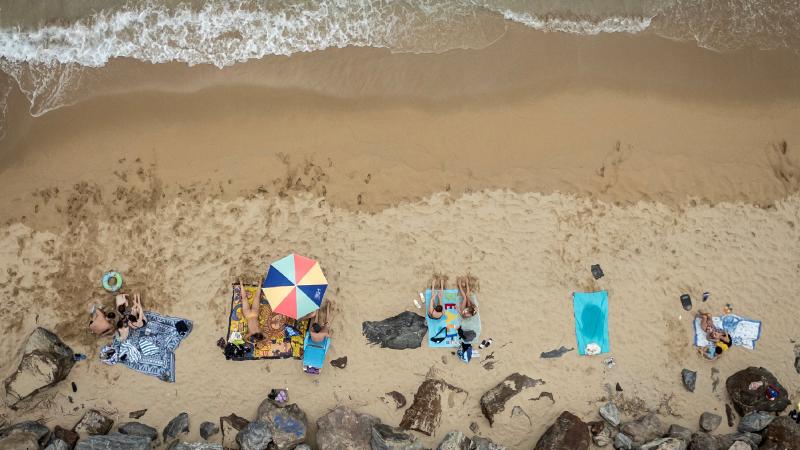
Increasingly frequent storms have washed much of the sand from the beach at Montgat, near Barcelona, Spain.Credit...By Finbarr O'Reilly For The New York Times
It's Paradise Lost as Climate Change Remakes Europe's Summers
In peak vacation season, many of the continent's most desirable getaways are becoming places to get away from.
Increasingly frequent storms have washed much of the sand from the beach at Montgat, near Barcelona, Spain.Credit...By Finbarr O'Reilly For The New York Times
Not so long ago, families coming to the shore in Montgat, Spain, just outside Barcelona, built sand castles, played paddle games and lounged around on the broad band of sand that was the picture of the European summer vacation. But now in some places, there is hardly enough room to put down a towel.
"From here to there," said Sofia Mella, 19, as she pointed far out to sea, "it was all sand."
Climate change is changing Europe into a summer paradise lost. Across Spain, Italy, Greece, France and beyond, sand-devouring storms, rising seas, asphyxiating temperatures, deadly floods and horrific wildfires have year after year turned some of the continent's most desired getaways into miserable locales to get away from.
As southern Europeans dream of fjords, the traditional hot spots and fixtures of travel agency package deals no longer seem so desirable. This past week, even though temperatures broke across much of the continent, experts and officials warned that the next heat wave would come soon, endangering vulnerable locals and making tourists question what they had gotten themselves into. Even activists seeking to free their cities from the scourge of overtourism saw no silver lining to the brutal conditions.
"It's hell," said Daniel Pardo Rivacoba, who lives in Barcelona, and who spoke for a group fighting overtourism — and its climate-change fueling flights. He saw the scorching sun not as an ally to keep the tourists away, but as a common enemy that will melt them both.
The scourge of overtourism in cities like Barcelona has amplified climate change and angered the locals
Last year, Mr. Pardo Rivacoba's group went viral by organizing demonstrations against overtourism that including spraying tourists with water guns. This year, he said, it was so hot that "we used the water guns on ourselves."

Tags
Who is online
98 visitors
Maybe they'll all immigrate to America.
lol
I can't imagine anyone in britain complaining about a heatwave, or even sunshine for that matter on that soggy mess ...
Morning...oh yes they do..hits 25c and they are virtually dieing in the streets as it is so hot!!..the Kiwi's aren't much better..I am walking around in a jumper and jeans and they are like aren't you hot?
When they migrate here which State do they head to... Queensland...
One of the warmest and most humid States then they sook about the heat, flies, snakes, crocs etc...
just put them on the ferry to tasmania and tell them to get off at new london ...
Apparently the Tassie Devil freaks them out even more...
... more than swimming back to oz?
They are doomed either way..😁
but they're so cute! They can't be all that bad. Bugs Bunny liked one
Evening...ahh yes I like the little Tassie beasties...they scream at night hence their name... the White convicts and settlers were terrified by them..
They are the only carnivorous marsupial in the world and their bite is extremely powerful...it can crush bone..so you do tend to keep your hands away from them..
Certainly not my photos...I value my fingers...what a cute button nose...
Evening...ahhh music to Aussie ears in Tassie..😊
No wonder it scared the crap out of the English..🤣
Yes. Soothing twilight sounds...
LOL!
My pigs used to make that sound when I was trying to herd them back into their pen
I've heard that pigs will eat pretty much anything, too.
only if they're really hungry
Morning... absolutely..🤣
You would drop right off to sleep after hearing that, when you have just stepped foot into the country in the 1800s...
Climate change is changing Europe into a summer paradise lost. Across Spain, Italy, Greece, France and beyond, sand-devouring storms, rising seas, asphyxiating temperatures, deadly floods and horrific wildfires have year after year turned some of the continent's most desired getaways into miserable locales to get away from.
More unsupported hysterical speculation and fear mongering. Here in Denver, it didn't get to 90 until June 14th, Highest temp so far this summer is 100, no new record. None of these supposed effects can be linked to climate change. The climate change cult is going to have to come up with better propaganda to be taken seriously
Heat has killed people in Europe forever. They just don't do anything about it, like adopt air conditioning. It's not a new problem, but one that gains more exposure because America essentially conquered "heat" as a problem decades ago (despite much hotter temps) while Europe lags half a century behind. European stagnation means the problem won't get solved anytime soon, either.
I know that this is probably a waste of time, but as someone who taught earth science, let me explain this to you.
It is the whole planet (not just Europe) that is experiencing climate change. The earth has experienced a huge uptick in global temperature, as seen in this chart:
This is not a normal uptick for a short period, but it does correlate to the population growth and the use of fuels. This chart shows the earth's population over time:
You will notice the global population reached 1 billion around 1804, and then experienced rapid acceleration, reaching 8 billion in 2022.
In 1900, the Earth's population was 1.6 billion, and not using fossil fuels. Looking at this chart, you can clearly see the huge uptick in temperature, which is abnormal for this short a period of time. Today, we are at 8.23 billion and beyond fossil fuel usage, feeding a population this size produces a huge amount of greenhouse gases from the animals we eat. We can't control feeding people, but what we can control is what kind of energy we use.
You can not increase a population that much in such a small period of time and not expect an impact on Earth. It flies in the face of science, since we know that for every action we get an equal reaction.
thanx for this, as it is very illustrative to a native
Of course it has gone up a whopping .8 of a degree in 175 years, we are in an interglacial period. Current sea level rise is about .13 mm a year. The subject has been fear mongered to death and fools calling it a crisis. The question remains, what can be done about it.
The reality of the situation is that fossil fuels remain relatively cheap, abundant, and reliable. The same can't be said of wind and solar. If it's a global problem, then there has to be a unified global plan of action, which doesn't seem likely or possible. The name calling and shaming of skeptics hasn't had the desired effect, so what's the next step.
“High Priests of Consensus Panic: The NYT’s Meltdown Over Scientific Skepticism” – Watts Up With That?
Those high priests were telling us that most of the east coast's beaches would be underwater by 2020.
It's a great gig. It doesn't matter how many times they are spectacularly wrong, people will still unquestioningly believe them. It's a cult.
It has actually gone up 1.8°F, which is a lot for such a short period of time. And I've been to Alaska and was shocked at how much the glaciers have retreated. Just because fossil fuels remain cheap doesn't mean that they are good for us. Solar power is reliable, and there are new technologies that are coming along all the time. I don't disagree that it has to be global, but that doesn't stop the Western world to try and mitigate our impact.
Btw, I checked out your site and it has a bias against anything to do with global warming, so holy confirmation bias. I am not an alarmist, but how many 100-year floods do we have to have in a week to get a reaction?
How many 100 year floods do we need in a week? It's like science denial has become a cult.
How many flood plains are there in the US? If you do the math and understand how big the US is, you would expect "once a century" floods to be occurring multiple times a year in the US.
It's not science denial, it's understanding math.
... it's the same cult.
Show me your information, and I'll show you mine.
Correct, but not multiple times in a month.
So... you take your news from an openly climate-skeptical blog, rather than the New York Times? Do you realize how that choice makes you look to any sensible observer?
Great link you gave us, Sean.
Oh, wait... you didn't give us a link, did you...??
[deleted]
It's an obligatory sub-section of MAGA dogma.
I asked a question. Not sure how I can show information for that.
For purposes of this discussion, I assume its common knowledge that there are thousands of lakes, rivers etc in the US? Minnesota claims 10,000 on its own. Simply acknowledging that there are a couple thousand in the entire US is enough to prove my point.
but not multiple times in a month.
That's exactly how random distribution works.
Sean,
It is not the number of lakes, floodplains, or rivers that cause catastrophic effects. It is rainfall that is far beyond normal.
While weather does work on random distribution, it also follows Chaos Theory. That being said, you are talking about forecasting, and I am talking about the frequency of events. The frequency of events has gone up. Since 2000, the number of events has more than doubled.
Never claimed it was. It's the sheer number of floodplains that guarantees some of them will be going through once in a century floods. Each floodplain has a 1 in a 100 chance of going through a once in a century flood every single year. With thousands of such areas, each with a 1% chance.....
ou are talking about forecasting, and I am talking about the frequency of events.
I'm talking about frequency, not forecasting. Every year America has, and always will have absent some continent wide drought, "once a century" floods. Some years will have relatively more. Some less. Sometimes they will clump together. Sometimes they will be evenly distributed.
Ummm... Greg...
Denver isn't in Europe.
overpopulation is the root cause of this problem,
Correct.
No.
Agronomists agree that the Earth can support at least fifteen billion people... IF RESOURCES ARE MANAGED CORRECTLY. The problem isn't too many people.
The problem is incompetent "leaders".
Not so sure about that number. I highly doubt it, since we would use up every bit of land possible.
Leaders are always incompetent.
I'm getting to like ChatGPT:
what about wildlife?
What about it? I don't understand the question.
Wildlife also needs space
... and... ?
did the figures in 3.1.3 include wildlife?
ChatGPT is available to everyone.
It may be possible, but what about quality of life?
And yes, ChatGPT is cool.
Yes, and I used it and here is the response:
🌍 Can wildlife coexist with 10–15 billion humans?
Yes, it’s possible — but only under certain conditions. It will require major shifts in how we use land, produce food, consume resources, and design cities.
🐾 The Main Factors That Matter:
Land Use & Habitat Preservation
Agriculture is the #1 driver of habitat loss. As more people need food, forests and wildlands often get cleared.
Solutions: shift to sustainable agriculture, regenerative farming, protect natural corridors, and reforest degraded areas.
Urban Design & Population Density
Sprawling suburbs destroy more habitats than dense cities.
If cities grow upward instead of outward, more land stays wild.
Dietary Choices
Meat-heavy diets require vast grazing land and feed crops, reducing land available for wildlife.
A shift toward plant-based diets (even partly) frees up space and reduces emissions.
Conservation Policies
Setting aside protected reserves, enforcing anti-poaching laws, and restoring habitats will be essential.
30x30 Goal: Protecting 30% of land and oceans by 2030 is gaining momentum globally.
Technology & Innovation
Precision agriculture, lab-grown meat, vertical farming, and synthetic biology may help meet human needs without encroaching on nature.
🔥 What Happens If We Don’t Change?
With business-as-usual models of consumption and land use:
Wildlife populations will continue to plummet.
Ecosystem collapse could threaten human survival too (pollinators, clean water, etc.).
I have to say, this does not sound great. Honesty, I feel that humans are a blight on the planet compared to other species.
It's a question of density. Java or Montana.
The ChatGTP text seems to me to be pretty open. I'm too lazy to run the numbers.
Industrialization is the root cause. Overpopulation is adding insult to injury... A BIG insult.
At this point, they kind of go hand in hand. Feeding a human population this big also causes problems.
Absolutely. Growing population causes increased industrialization to meet their needs.
ive read overpopulation is popular in underpopulated areas, at least thats what the crowds would say, if they were populated enuff to gather...
i'm amazed how climate change is invisible, while destroying so much
Overpopulation is only the root cause if climate change is a hoax. If it is not a hoax the extreme weather will be the same no matter how many people are living there.
its not usually considered extreme, unless us peasants inhabit the area and we or something we've built, is destroyed....
It's interesting how the word "extreme weather" has crept into climate lingo.
How does extreme differ from severe
I think quality over quantity is better.
Are we expected to take this article seriously with a line like this? Tourism now causes climate change? You just can't make bullshit like this up.....Or maybe you can, this author did.
I think that this article has it wrong. But we are experiencing global warming on a level not seen in human history. Articles like this do take away from the legitimacy of the real problem.
global warming on a level not seen in human history.
In the past 800 ky the earth has seen this level of warming prior to each ice age. The only way the sea levels will reach what they did prior to every ice age is Greenland and Antarctica will lose more of their ice sheets to gain the extra 25 ft. needed to start the next ice age, (btw, when I say the ice ages I mean the latest glaciations. Some fool on another site started arguing with me that an ice age is actually when a continent drifts to one of the poles and a permanent ice sheet develops which had nothing to do with what I was explaining.) The main reason we have no record of this is the ice sheets wipe away all the evidence of the colder latitude warm ups.
This all happens before an ice age, the colder latitude warming, the sea level rise, and the natural CO2 level rise with the warming.
You are correct that we are in an interglacial period, but we have been for a very long time. What is unprecedented is the sudden increase in temperature.
Yup. Geological time is very hard for us to apprehend.
Is it? We don't really know, because, as I have explained, the ice sheets of the ice ages melt away and take with them any evidence prior to their development and any record stored in them. The Antarctic however stays pretty much the same no matter what due to it's a continent surrounded by water and under the influence of a constant albedo effect.
There are reports showing the decreasing albedo effect in the NH which stands to reason for to get the sea level rise to start the next ice age requires the Greenland ice sheets to do considerable melting as well as the rising sea levels causing Antarctic glaciers to increase their rate into the ocean.
The bottom line is, assuming that climate change is in fact real, there is not really anything we can do about it, other than adapt to what might happen Much of New York City's utilities and infrastructure lies several hundred feet below street level, so they need to plan ahead
History has shown that the area of NYC will be under water as well as any other land within 25' of present, this happens prior to every ice age. The good news is it won't last long underwater, but more bad news it will lose it's ports as the water will continue to recede as the ice sheets creep closer to NYC.