
Why Did Truman Support Civil Rights?



Truman’s domestic agenda attempted to solve the problem of Black American oppression while undermining the progressive wing of the Democratic Party

I'd never really thought about Truman being a politician from the South, and therefore probably not exactly a fan of the Civil Right Movement. I just knew all the good he did.
This explains it.
 S E E D E D C O N T E N T
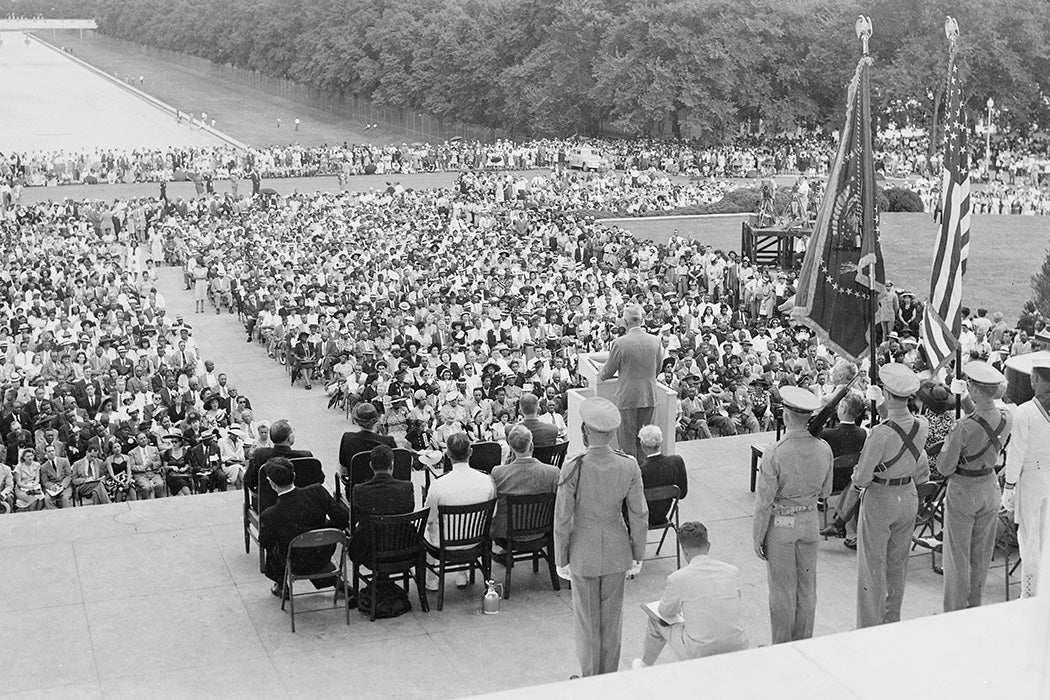

When Harry Truman became president after the death of Franklin Roosevelt in 1945, it represented the ascendancy of the conservative side of Roosevelt’s Democratic Party coalition. Truman was a Missouri native who privately expressed support for white supremacy. And yet, over his first few years in office, Truman proposed federal laws against lynching and poll taxes , and, when that didn’t work, used executive orders to desegregate the military and require racial equality in federal hiring.
Why did he do it? Sociologist Joshua Bloom argues that he was successfully pushed by Black activists who fought the oppression of Black Americans as part of a larger global anti-colonial struggle .
After the end of World War II, Bloom writes, the global role of the US was in flux. Truman supported an aggressive stance toward the Soviet Union along with firm support for Britain and France in their colonial endeavors . But he had opponents inside, as well as outside, the Democratic Party’s leadership. This created the real possibility of a party split, with Henry A. Wallace leading a coalition of progressives and labor advocates that opposed the emerging Cold War.
Another part of the broad opposition to Truman’s foreign policy agenda was what Bloom terms a Black anti-colonial insurgency, supported by figures like labor leader A. Philip Randolph , performer and activist Paul Robeson , and sociologist W. E. B. DuBois . For example, Walter White, executive director of the NAACP, described the Black struggle against lynching and Jim Crow laws in the US as part of a broader anti-imperialist fight also playing out in India, Africa, South America, and elsewhere. The Black press also attacked Truman’s support of France and Britain’s colonialism, and the white media reported on Black anti-colonial protests.
In 1946, several high-profile lynchings drew thousands of protestors to the White House to demand federal action. That September, Truman met separately with two groups calling for federal anti-lynching legislation, one led by Robeson and the other by White—who was joined by some insiders in the Democratic Party coalition’s progressive wing. Robeson put the problem of Black American oppression in the context of international relations and suggested that if the US government couldn’t stop lynchings, foreign nations should intervene to protect Black citizens. White, on the other hand, declined to connect lynching with colonialism and instead suggested that the murder of Black Americans was a vulnerability on the global stage and that addressing it could help fight the Soviets.
Truman responded warmly to White’s group and soon took some of the first steps toward a civil rights agenda. While he was much less welcoming to Robeson, Bloom argues that part of his motivation was blunting the power of that faction.
And, indeed, with Truman now taking anti-Black discrimination seriously, White pushed Du Bois out of the NAACP when he supported Wallace’s Progressive Party campaign in 1948. And, as the federal government began targeting radicals like Du Bois and Robeson, the NAACP, other civil rights groups, and the Black press moved away from anti-colonial politics.
Whatever
Tags
Who is online
80 visitors
So... would he be pleased or horrified by MAGA?
Blacks were mostly oppressed by the party of racism, the Democratic party, particularly in the South. Don't forget, they fought the passage of the Civil Rights Act of 1964 tooth and nail. The Republicans were largely responsible of getting it passed.
MAGA as a group believes that all are created equal, which is why so many Blacks and Hispanics have chosen to follow Trump and the Republicans, because the progressives have betrayed and abandoned them.
[Deleted]
They do????
LOL. Democrats proposed the legislation, authored it, the majority of Democrats passed it and then a Democratic President signed it into law.
Civil Rights Act of 1964 - Wikipedia
So, a total of 199 Democrats voted FOR the 1964 Civil Rights Act vs a total of 163 Republicans voting for it.
Also to note, 100% of Southern Republicans voted AGAINST the Civil Rights Act. And 96% of Northern Democrats voted FOR the civil rights act while just 84% of Northern Republicans voted for it.
It's clear that some Republicans today have fooled themselves into thinking that they're on the right side of history. The fact is that after the civil rights act passed Republicans did employ the Southern strategy and were clearly successful in winning over the disaffected by the Democrat party that abandoned the racist rightwing conservative confederate loving religious bigots that used to control the South under a Southern conservative Democrat banner. The only thing that has really changed is the banner to a Southern conservative Republican banner.
Don't get me wrong though, I don't expect Republicans to stop lying about this though, they simply can't do anything other than double down on their lies. They have but one option which is the Joey Bishop defense... deny, deny, deny.
Deny, Deny, Deny: Joey Bishop/Imagene Coca - YouTube
Don't confuse them with facts
Lemme see - 1970 - 2025 is - 55 years ago - Phillips is Nixon's strategist - published in the NYT
Just don't need to go any further.
Facts? In 1970, Nixon's (a Republican President) actions and policies were focused on both domestic and international issues. Domestically, he faced significant anti-war protests related to the Vietnam War, and in an effort to curb inflation, he imposed wage and price controls for 90 days. Internationally, Nixon continued the Vietnam War, including military operations and bombing campaigns in Cambodia, while also seeking to negotiate an end to the conflict, and signed the Occupational Safety and Health Act, National Environmental Policy Act, Clean Air Act and Endangered Species Act .
Nope - nothing dealing with racism there.
Next.
Racists think everyone else is as obsessed with race as they are, so they attribute race to everything. In their world Wars, jobs, taxes, crime, inflation etc.. don't matter to people it's only race, because it's all they care about. So Nixon winning 49 states could only be because of race in their obsessive world.
Really?
If you can't see what happened to party affiliation in the South over the last 55 years then you're either not looking or you're deep in denial because the truth would destroy your sad bullshit narratives of the racist white conservative Southern Democrats somehow magically leaving the South to be replaced by white conservative Southern Republicans who look exactly the same, have the same ancestors, many owning and living on the same property that their white conservative families have owned for a century and still defend the confederacy and continue to attempt to disenfranchise black voters in their States with onerous unnecessary voting laws.
No one with more than half a brain and any cursory study of politics in the US believe the revisionist history bullshit Republicans have manufactured to try and distance themselves from their deeply conservative Southern Democrat roots. They just continue to employ the same strategies that their racist ancestors did of trying to obfuscate their racism with code words like "thugs" "law and order" "states' rights" and "silent majority".
It's slowly trended Republican as it became more affluent and blacks now migrate there to escape democratic run cities in the north.
Would really appreciate if you would tone down your language.
Read the CoC.
1st request.
I think he would be horrified
I think that Truman, who desegregated the US military would be pleased to see that black Americans live better than black communities elsewhere in the world including every country on the continent of Africa. I think he would be disgusted however by Obama & Biden trying to divide the country over race. I think most Americans are fed up with the left's use of race.
That has to be one of the dumbest things I've seen in print in a long time, and I've read some of Trump's tweets recently so that's saying something. The fact that there are actual people who believe that hilarious bullshit truly reveals how deeply fucked up in the head some folk are these days.
They always have to divide the people, because the people won't vote for their ideas.
Thus, it has always been from Marx to Lennin.
Damn - can't believe I had to read the entire thread/seed - three times - to find any reference to MAGA - and still haven't found one.
Wonder why that is?
Truman was different and not because he is/was from Missouri, which was a state with divided loyalties during the Civil War - and the Confederacy recognized it as one of their states. While the state convention voted against secession, a pro-Confederate faction established a separate government that was recognized by the Confederacy. Ultimately, the Union maintained control of Missouri throughout the Civil war.
During his nearly eight years in office, Truman confronted enormous challenges in both foreign and domestic affairs. Truman's policies abroad, and especially toward the Soviet Union in the emerging Cold War, would become staples of American foreign policy for generations. At home, Truman protected and reinforced the New Deal reforms of his predecessor, guided the American economy from a war-time to a peace-time footing, and advanced the cause of African-American civil rights.
Historians now rank Truman among the nation's best Presidents .
Don't think that "cat-fishing" about Truman to gain some type of recognition of distain for Make America Great Again is appropriate - but, hey some people just have to voice their opposition as best they can. I'm thinking that we can/should have more productive discussions of much regarding our nation's political future, but the constant ragging on one concept that many don't understand nor have knowledge of is a major force blocking good and successful discussions on that future.
e I had to read the entire thread/seed - three times - to find any reference to MAGA - and still haven't found one.
It goes to show you how Trump has broken some on the left's brain. They can't process anything outside of their Trump obsession.