
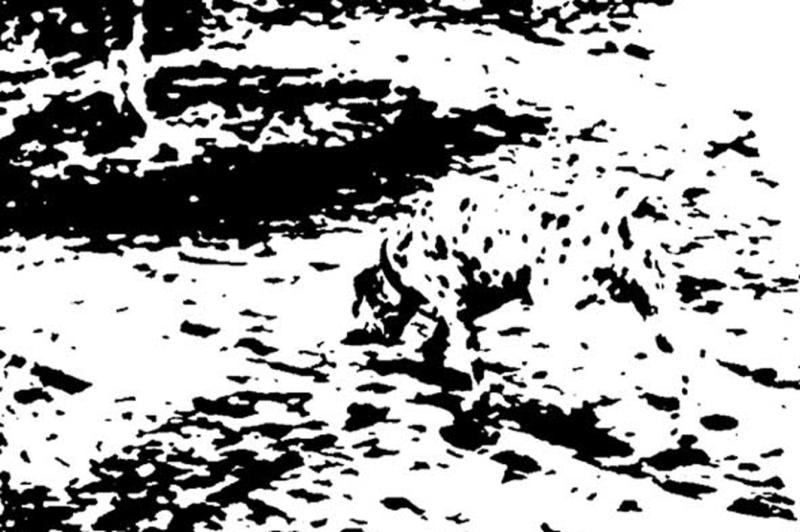
These splotches hide an image if you think about it hard enough


 S E E D E D C O N T E N T
There’s an image hidden in these black-and-white blotches. Once you spot the figure, that’s it: The shape will emerge, and then, try as you might, you’ll never unsee it. Consider yourself warned. It’s a Dalmatian, bending down to drink water. See it now? That’s because the images we “see” are really our mind’s own creations.
In the early 1900s, the German psychologists behind Gestalt theory first introduced the Dalmatian scene with this reasoning: Humans aren’t passive recipients of incoming images, rather we impose a structure on what we see.
Today, we’re still piecing together how our brains do this, but here’s our best guess: Light lands on our eyes’ retinal cells, which send a signal to the visual cortex, the area of the brain that heads up sight. Simultaneously, other areas within our brain’s cortex, which assemble higher-level thinking, send predictions down to the visual cortex of what the picture might be. So, any notion that a Dalmatian is there primes the cortex to identify an ambiguous white stripe as a leg, the black mark above and to the left as an ear, and so on.
We do this instantly, but even the sharpest image-recognition software can’t. Until we fully grasp the neural processes at play, says Dartmouth College visual scientist Howard C. Hughes, we’ll still be sharper than the bots.
Tags
Who is online
114 visitors
I found this interesting. I think it’s true that you could stare at this image all day and not see what’s there until you’re told what it is, and from there it’s impossible to not see it. It’s good to remind ourselves of what makes us human, and stay aware that AI simply cannot do everything that we have evolved to do. Not yet, anyway.
It took me about 20 seconds to see the dog. But the principle is very interesting.
I asked AI to make the dog in the image red, and then to make the dog sitting down. It was able to locate the dog’s head but otherwise failed miserably. I like the feeling of knowing that trillion dollar software can’t see what I can see with my own two eyes.
Gemini readily identified the Dalmatian. But Gemini also admitted the image was in its training data. So Gemini's response may have simply been recall of stored information. However, it is an interesting test. I may try to create some posterized images that could not be in any training data to see how Gemini performs.