
Do We Have a Place in a New World Order Architecture?

By: Peggy Mohan (Wire)

The brutal truth is that the opinions expressed in this article are clear, compelling justifications for MAGA and 'America First' policy. The United States is both architect and victim of a technocratic world order that deified the economics of efficiency and exploitation. The rich prospered by collecting tolls on human intellect while the rest struggled to maintain a stable, functioning society with little more than sweat and dirty fingernails.
The cheap labor pools that became the foundation of the old world order of financial gatekeeping have grown to become the innovators for the future. The old order's cheap labor has now become skilled labor that creates its own capital to sustain itself. The financial gatekeepers of the old order have employed a stopgap of collecting rents from themselves; further isolating themselves from the new productive world order. And that new productive world order is more competitive and transactional than the old world order can accommodate. (The point missed in the seeded article. Attempting to make the new order work like the old order is a fool's errand.)
Economies based on capital intensive services that collect tolls simply cannot compete with economies that produce what is needed for societies to function and sustain themselves. MAGA supposedly promised to change policy priorities and revive the innovative prowess and productive capacity of the United States to create a sustainable future. That would secure a place for the United States in the future. Sadly MAGA has only waded into the financial swamp that was to be drained. MAGA has become another self-serving backwater of financial flimflam and 'get-rich-quick' schemes where promises go to die.
 S E E D E D C O N T E N T

Recently, a well-known public intellectual wrote a newspaper article about India stepping up as an architect of a new world order. I read it quickly, hoping to see some sort of road map from where we are now, a nation sleeping through the biggest global reset in living memory, to being one that has rested, waking up in a less adolescent age when we no longer have to deploy all our brain power on weapons and war just to survive. But no.
Not very long ago India was a nation known not for the hypersonic missiles that now dominate the newsfeeds, but for spacecraft capable of escape velocity (40,000 km per hour), a lunar landing, and not simply reaching Mars but staying in orbit for eight years.
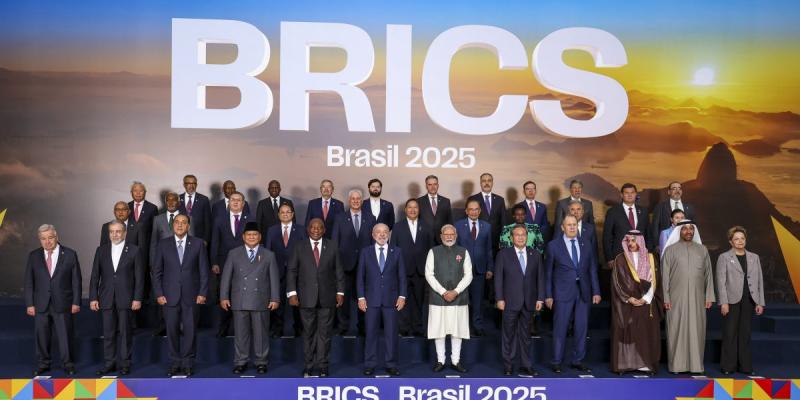
And long before words like ‘multipolarity’ came into existence, India was speaking of non-alignment, an original idea that went beyond the binary of falling in line with either imperial formation. India also became a founding member of BRICS, the ‘I’ of a new group that now comprises more than a quarter of the global economy.
From where we now stand that feels like a faded memory. We have metamorphosed into a nation where our best universities are under attack and treated as subversive, and where far from having confidence in our ability to take our tech forward, we have sunk to viewing tech as something we buy from abroad. We have been derailed.
How do we find our footing again? How do we become, once again, the sort of nation that others might see as a ‘credible architect’ of a new world order?
If we look at the nations that seem poised to dominate the new age – China, Russia and Iran – the first thing to note is that they do not approach science and tech via English. As a result, their entire populations have become potential participants in scientific work: when they started their journey, these three nations set as a priority making their populations fully literate, and keeping science and tech in the language that was accessible to their citizens.
It also allowed them to focus on themselves and their own needs, rather than just wanting to be seen as ‘credible’ by the outside world. What did they need in order to thrive? What were the resources available to them? How should they build their infrastructure to take advantage of their strengths and minimise their weaknesses? They understood that they were on their own.
We, on the other hand, run our tech establishment on English, a language spoken at home by only about 2% of our population, and comfortably by not that many more. This is not the usual tired plug for Hindi: it is an appeal for us to base our future on who we are, a multilingual nation.
We have it in us to build an AI that will let us all work in our own languages, making them instantly translatable over all of India, and, indeed, South Asia, handing the future back to the truly innovative ones among us. We cannot leave our science and tech in the hands of a tiny upper crust that would prefer to administer and manage.
In recent years, we built ourselves a setup that needed more and more fossil fuel, a resource we needed to import, making us extremely vulnerable to supply chain shocks. Worse, we went on increasing the distances in our daily lives, building superhighways that are gridlocked with people on their daily commute to and from work. We built an agriculture dependent on imported fertiliser, and proceeded to privatise our core public sector industries, healthcare, and the educational institutions thoughtfully set up at the time of independence.
From a brisk start as self-reliant innovators we slipped into being traders, fatally dependent on an outside world we actually had no reason to trust, making geopolitical alliances that sounded clever and bold, but which did not sit well with who we were. Now we struggle to persuade a sceptical outside world that we can seriously contribute to the future.
What is particularly sad is that there is, in fact, a feeling that our moment was near, that as the other Asian giants began to slow, see their populations and momentum declining, India with its demographic dividend would be poised not only to keep things going, but to steer the world back onto a sustainable path that led to an open ended future.
It can still happen, but the opportunity is not going to fall into our lap without effort and readiness to adapt ourselves to a coming age where successful societies will be the ones that ‘fire on all cylinders’, the ones that do not dismiss 90% of their human resources as simply ‘labour’. The last ship to the Asian Century sailed without us. That may have been a blessing, because it left us alive and unharmed in a time of war and devastation. But if we truly believe we have a role to play in shaping the future, it is time to get busy.
Peggy Mohan is a linguist who writes on the history of Indian languages. Her forthcoming book, Framing The Future, will appear as a Penguin publication in September 2026.
Be a good human. Grossly derogatory comments, blatantly inflammatory comments, excessive trolling, mean-spirited taunting and insults, scamming, spamming, and off topic comments may be removed in compliance with the site's Terms of Service and the Code of Conduct. The moderators have the final word.

Tags
Who is online
75 visitors
The warning signs heralding the collapse of the rules-based liberal world order have been flashing for decades. For years US policymakers have been slapping patches upon patches to hide systemic rot. We desperately need to shift priorities to meet an emerging world order that is more productive, competitive, and transactional.
Unfortunately, the United States is saddled with a President who thinks in marketing slogans and cannot plan beyond the next news cycle. The 'America First' promises addressed exactly what was needed to prepare us for the future. But the body politic elected the wrong President for the wrong reasons at exactly the wrong time. We traded structural reform for a sleazy self-serving sales pitch.
Nerm, remember what Socrates said: "strong minds discuss ideas, average minds discuss events and weak minds discuss people."
President Trump certainly does talk about himself a lot, doesn't he?
He is clearly a man of ideas
Half baked, short lived, and self-centered.
Bad ideas most often have bad endings.
and many of them fleece his own supporters.
And the left LOVE talking about Trump.
Not as much as Trump loves talking about himself. Trump is the GOAT, after all.
Tell me Tess, were you invited back or just helped by an old friend?
More slander
I've provided the long list many times. Three times should be enough
A long list of ideas? Promises kept? Or tangible results?
Was it President Trump's idea to save the liberal world order? That is what Trump is attempting to do with threats, coercion, and madman diplomacy. Trump seems to have suddenly realized that 'America First' was intended to step away from US global dominance through banking, finance, and dollar diplomacy. 'America First' deliberately changes the rules of competition and alters measures of success. 'America First' was supposed to make the 'money rich' players obsolete in world affairs.
Donald Trump seems to have missed the part where winning the election was supposed to make himself less important.
Looking around here on NT. It's the left. Regardless of the article topic, they'll bring him up with some moronic statement.
Of course, the 'left' will comment on Trump. Why wouldn't they? Trump does try to dominate the news cycle so there's little else to talk about.
Trying to change the subject with 'culture war' narratives must compete with Trump's self adoration in every news cycle. Trump Republicans' greatest strength is also their greatest weakness.