
Two reasons Democrats can overcome infighting next year

By: Robert Reich (the Guardian)


 S E E D E D C O N T E N T
Democrats usually suffer big tent disease. To win, they put together such large coalitions of voters - working class, middle class, Black people, Latinos, women, young people, moderates, liberals - that once they're in office, intraparty feuds often threaten their agenda.
Will it happen again when they take power in January? I don't think so. Two outside forces will keep Democrats glued together.
The first is raging economic inequality.
Wages and salaries have now fallen to 43% of the country's gross domestic income, the lowest since 1929. By contrast, corporate profits have climbed to a record high of 12.4%. Those profits go to the owners of corporations - top executives and investors whose incomes depend largely on shares of stock.
These trends are squeezing average working Americans. They caused a large majority of voters to demand change in the midterm elections.
The trends won't change anytime soon because they're the result of monopolies now baked into the economy, combined with the lowest level of labor unionization in almost a century, and a vicious cycle of legal bribes paid to politicians by big corporations and wealthy individuals seeking to keep their taxes low and maintain their government perks.
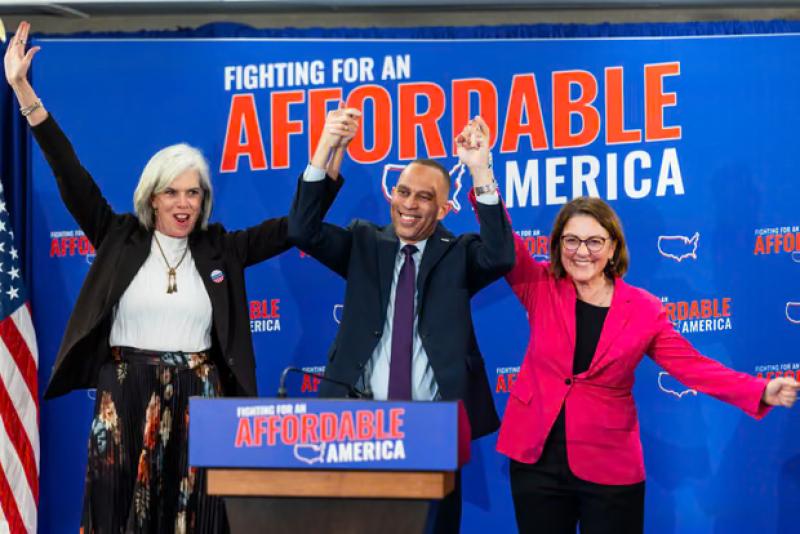
This raging inequality has given Democrats a clear goal - to reduce it! - and a clear villain: billionaires and greedy corporations. The recent campaigns of nearly all newly-elected Democratic members of Congress - whether "moderate" or "democratic socialist" - blasted billionaires and corporate greed.
Democratic winners from purple battleground states are singing from the same hymnals as the winners from deep blue states.
The representative-elect Sam Forstag of Montana, who flipped a conservative seat, said he'd "fight for populist economic policies that are actually going to help working people, and finally put us back at the front of the line in terms of who Congress should be working for".
In what had been ruby-red Republican Kansas, the senator-elect Adam Hamilton campaigned to expand Medicare to cover vision and dental care. The Texas senator-elect James Talarico, a self-styled moderate, wants to allow every American, regardless of age, to join Medicare. So do Michigan's senator-elect Abdul El-Sayed and Maine's Troy Jackson.
The second force that will keep Democrats together is an even more combative Trump along with Trump's more belligerent sycophants.
Trump likes nothing better than to go on the attack, and for the second half of his term, he and his party have selected attack dogs: his new chief of staff, Stephen Miller, and the new House minority Leader, Jim Jordan. And he's decided to keep the most belligerent member of his cabinet: Secretary of Defense Pete Hegseth.
It would be different if the midterm shellacking had caused Trump to rethink his approach to governing - making him more amenable to working with the new Democratic majorities, softening his rhetoric, moving him to fire Hegseth and appoint a more reasonable defense secretary and a chief of staff who'd extend peace offerings, and back a House Republican leader who'd collaborate with the Democrats.
Under these circumstances, some Democratic members of the next Congress might be tempted to tone down their demands and work with Trump Republicans.
But Trump has chosen the opposite approach. This week's letter from the White House counsel, Will Scharf, to the incoming House oversight committee chair Robert Garcia - warning that aggressive congressional investigations into the Trump administration could "cross the line into blatant criminality" - illustrates the sort of bizarre hostility we're likely to see starting in January.
Trump's fragile ego may feel more secure this way. As long as his attack dogs fill the airwaves with pugilistic assaults and nasty invective, Trump won't have to admit to himself the mammoth failure of his presidency or its colossal repudiation by voters.
But his belligerence and that of the people around him are a gift to the Democrats. As with the record levels of inequality uniting Democrats, the administration's hostility toward them will also help keep Democrats together.
The Democrats' big tent disease has found two big cures.
Robert Reich, a former US secretary of labor, is a professor of public policy emeritus at the University of California, Berkeley. He is a Guardian US columnist and his newsletter is at robertreich.substack.com. His new book, Coming Up Short: A Memoir of My America, is out now in the US and in the UK
Be a good human. Grossly derogatory comments, blatantly inflammatory comments, excessive trolling, mean-spirited taunting and insults, scamming, spamming, and off topic comments may be removed in compliance with the site's Terms of Service and the Code of Conduct. The moderators have the final word.

Tags
Who is online
122 visitors
Robert Reich's optimistic spin doesn't seem grounded in reality. Following his 'advice' would actually trap Democrats into backsliding toward stale tropes and questionable politics of the past.
The kneejerk policy agenda of increasing corporate taxes and using a scapegoat to regulate everything would be a distraction that doesn't really address inequalities and affordability. A wage rebellion by workers won't lower prices, can't lower interest rates, and makes imports more attractive. Raising tax revenue for government handouts won't address the systemic faults in our financialized economy, either. Reich's Pollyanna outlook is, in fact, a recipe for disaster because there's no realistic way for Democrats to fulfill their economic promises.
Trying to use Trump to sustain Democratic unity faces serious hurdles, too. Trump is already a lame duck; he won't be on the ballot in 2028. Vance and Rubio have already begun distancing themselves from Trump on several issues. Trump's loyal support in Congress was just shown the door by voters. It doesn't seem likely the Republican base will remain loyal to a loser, no matter what story the media tells us. Will Democrats show they are fighters, or will they just be beating a dead horse?
Robert Reich's politics from the Reagan and Clinton era aren't nearly as relevant today. It's impossible to ignore the fact that a financialized services economy cannot sustain itself competing with producing economies. That would seem to be the real issue that needs attention. Trying to double down on some sort of Clintonesque 'third way' agenda hoping for a labor revolution and public/private partnerships seems out of touch. Was the midterm rout by Democrats really a call to return to the past? Or was it a demand to pass the torch to a younger electorate?