
Opinion | Margaret Atwood: Born Into a Storm

By: Margaret Atwood (The New York Times)

 S E E D E D C O N T E N T

To mark The Times's 175th birthday , Times editors asked writers to reflect on — and imagine a little bit about — the newspaper's front page on the day they were born. Look up your own birthday page here or from The Times Store .
I was born in the late afternoon of Nov. 18, 1939, just after the Grey Cup football semifinals, in which the Ottawa Rough Riders walloped the Toronto Argonauts, 11-0. The doctors thanked my mother for waiting until the game's end. Not that she had anything to do with it: In those days they etherized women in labor, so she was unconscious.
The Rough Riders' triumph did not appear on the front page of The New York Times that day. If it had, there would have been several puzzled readers ("What?" "Where?"), since Canada was an afterthought for most Americans then. Instead, The Times devoted more than half of its front page to "the international situation."
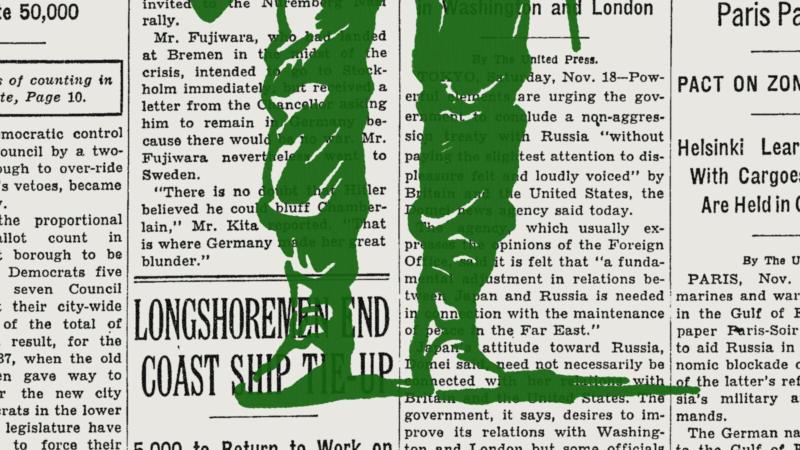
Among the news covered: A Japanese envoy, Mr. Kita, refused to deliver gifts intended for Hitler, since Japan, recalling its 1904-05 war with Russia, was annoyed by the Stalin-Hitler pact. The Times article concluded with a zinger from Mr. Kita: "There is no doubt that Hitler thought he could bluff Chamberlain. … That is where Germany made her great blunder." In another article, we find Japan seeking a nonaggression pact with the Soviet Union, since it feared a renewal of hostilities.
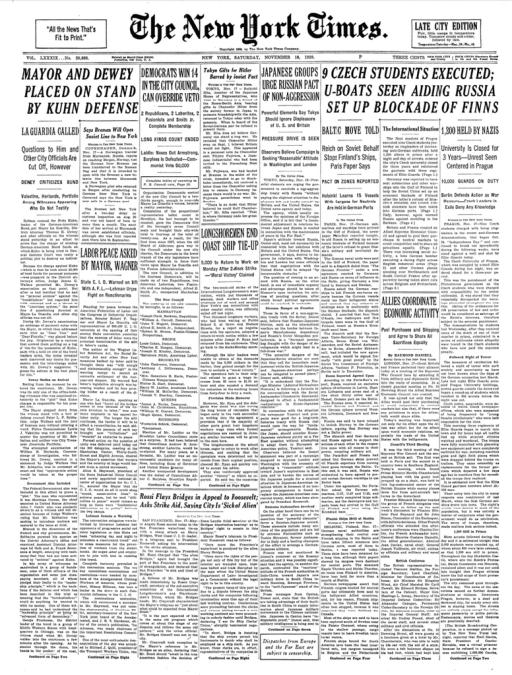
There is also a sad little story about the confident and optimistic creation of the Allied Supreme Economic Council, envisioning a sharing of capabilities — sad because in June 1940, France was to be overrun by the forces of the Third Reich. The German occupation of France was to give rise to many books and films — including "Casablanca" (1942), with its iconic scene in which the singing of "La Marseillaise" overcomes the German officers belting out "Die Wacht am Rhein." (French Morocco aligned itself with the Nazi-friendly Vichy regime, which accounts for the singing German officers.)
But the day’s biggest headline reads “9 CZECH STUDENTS EXECUTED; U-BOATS SEEN AIDING RUSSIA SET UP BLOCKADE OF FINNS.” This serves two separate stories below. The Finnish report is a red flag: A mere 12 days later, the Soviet Union would invade Finland, kicking off “the winter war” — an early example of a small country with specialized know-how resisting a much larger power. (In Finland’s case, the specialized know-how was winter warfare.) The Soviets were able to grab some Finnish territory but in the end Finland managed to see them off, and the Germans, too, to maintain its independence.
In the Czech story, we read that in addition to murdering nine students in response to widespread protests in Prague, Germany had arrested 1,200 people and shut down a university for three years. After a “night of terror,” downtown Prague was a “dead and darkened city,” because everyone was afraid to go out. The Germans also stuffed 10,000 “elite guards” into Prague. (I remind you that Ingrid Bergman’s character’s husband in “Casablanca” is a Czech anti-Nazi resistance fighter. Could the screenwriters have read this article in The Times? Odds on …) I’m struck by how contemporary this story feels, even 87 years later. The arbitrary arrests, the extrajudicial shootings, the attempts to control universities … sound familiar?
Why was Germany in Prague? By the Munich Agreement of 1938, Germany, Britain, France and Italy pressured Czechoslovakia to give up the Sudetenland, which had a large German-speaking population. (Crimea, anyone?) In return, they promised “peace for our time.” But with its border defenses gone, Czechoslovakia was a sitting duck, and when Germany violated the accord and marched in there was no effective resistance. Nor did the European powers push back. (Crimea, anyone?) Naturally, Germany was emboldened, and figured it could take over Poland without any meaningful objection from England and France. Thus the war began.
This is the world I entered on Nov. 18, 1939. The war was in its early stages — few could imagine how far and how fast it would spread. As I turned 1 and then 2 and 3 and 4, the war was our zeitgeist. Anxiety, news broadcasts from the BBC about bombings and retreats, adults murmuring among themselves, relatives enlisting. Kids played war games and collected airplane cigarette cards and listened to wartime dramas on the radio — and read comic books like “Johnny Canuck,” a Canadian superhero who for some reason always seemed to fight Nazis with his top off. Canada was unlikely to be bombed, but Ottawa practiced blackouts anyway. One plus side of wartime? Fewer tooth cavities: Sugar was rationed. What a joy it was, as a child, to stick the colored ration stamps into the ration book!
For the first 27 months Britain and its allies fought alone, as the United States did not enter the war until the attack on Pearl Harbor in December of 1941. Canada transformed itself into a wartime production superpower, churning out planes and ammunition at a breakneck rate. Halifax Harbor served as the staging ground for the convoys that ferried supplies, arms and soldiers to Britain while they were hunted by U-boats. Canadian soldiers developed a reputation as shock troops, sent into difficult situations because they could improvise, were used to harsh weather conditions and didn’t easily stop, rest or retreat. Consequently, they paid a high price in per capita deaths.
So my birth date was — some might say — badly aspected. But it gave me perspective. “This is the worst thing that’s ever happened,” young people say about our present situation.
“No,” I say. “Actually, it’s not.”
Be a good human. Grossly derogatory comments, blatantly inflammatory comments, excessive trolling, mean-spirited taunting and insults, scamming, spamming, and off topic comments may be removed in compliance with the site's Terms of Service and the Code of Conduct. The moderators have the final word.

Tags
Who is online
93 visitors
A retrospective perspective to remind us the world has seem far worse than today. Or is history repeating itself?