
Trump's Selective Stance on Justice: Redemption for Some, Scorn for Others

By: Erica L. Green (nytimes)


 S E E D E D C O N T E N T
President Trump, himself a felon, has shown particular leniency to criminals he seems to identify with — people who are white or wealthy, or who rioted in his name on Jan. 6, 2021.
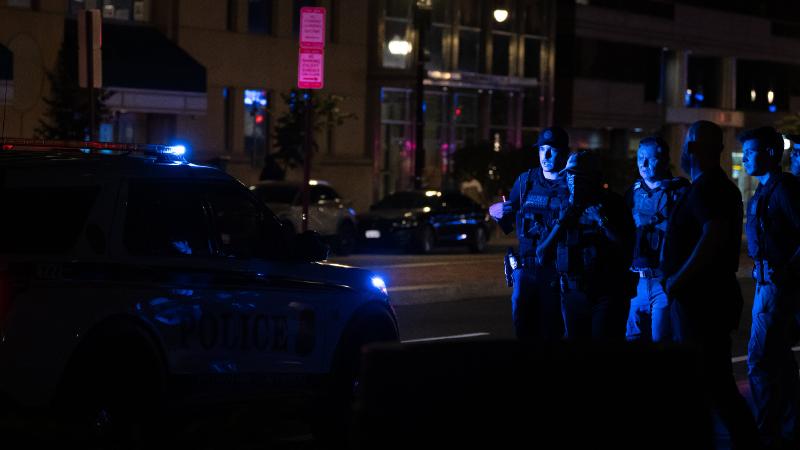
Federal agents patrolling Washington, after Mr. Trump's announcement last week that he would deploy the National Guard and federalize the Metropolitan Police Department in Washington.Credit...Tierney L. Cross/The New York Times
By Erica L. Green
Erica L. Green is a White House correspondent. She reported from Washington.
Aug. 17, 2025
As President Trump made the case for militarizing the streets of Washington, he used pictures of "homegrown terrorists" to illustrate his point that crime in the nation's capital was out of control.
"Look at these people here," Mr. Trump said at a news conference last week, flipping through a handout from the White House containing five mug shots, all people of color.
"They will never be an asset to society," he said. "I don't care. I know we all want to say, 'Oh, they're going to be rehabbed.' They're not going to be rehabbed."
The declaration provided a window into the president's selective view of criminality and redemption. In his eyes, Capitol rioters, a triple murderer, two police officers involved in covering up the killing of a Black man, and an Israeli settler accused of extremist violence all deserve a second chance.
But the people accused of crimes in Washington are irredeemable.
Mr. Trump, himself a felon, has shown particular leniency to criminals he seems to identify with — people who are white or wealthy, or who he believes have been unfairly persecuted, or who rioted in his name on Jan. 6, 2021.
The White House defends the president's actions, pointing to his criminal justice record from his first term, which included signing prison overhaul legislation aimed at rehabilitation and using his clemency powers to release many Black offenders who faced excessive punishments for nonviolent crimes.
But in his second term, Mr. Trump has seized on racial tensions to further his longstanding view that cities are hopelessly dirty, violent and menaced by criminals. In addition to the District of Columbia, Mr. Trump characterized other cities, which have Black, Democratic mayors, in incendiary terms.
Chicago, he said, was "very bad." Baltimore and Oakland were "so far gone."
"When you look at what he's doing, it's very much selective criminality," said Carl W. Tobias, a professor at the University of Richmond School of Law. "A lot of this is the ongoing racialization of crime. It's not an accident that all the cities he's thinking about targeting have either immigrants or they have Black mayors. It's just so obvious."
Harrison Fields, a White House spokesman, said that the president and his administration were not "cherry-picking" criminals to expose, including the ones featured in the handout, but rather were addressing a reality in the Black community.
Washington does have a real crime problem, although Mr. Trump has used exaggerated and inaccurate figures to portray the city as lawless.
"The people most impacted by crime in the inner-city happen to be Black and unfortunately, the people that are perpetuating the crime also happen to be Black," Mr. Fields said. He also argued that comparing the treatment of Jan. 6 criminals with the treatment of others was unfair.
"Jan. 6 was one day in American history," he said. "The crime plaguing D.C., Baltimore, Chicago, New Orleans, all these other cities, is every single day for these people. And it's such a disservice to the feelings of these people every single day that feel like they cannot go to the local 7-11 out of fear of getting assaulted or murdered or carjacked."
Since taking office, Mr. Trump has shown a pattern of characterizing defendants of color, in particular, as deserving the harshest punishments possible, while showing deference to others, including those who align more with his beliefs.
On his first day, Mr. Trump pardoned thousands of his supporters who were arrested and charged for taking part in a violent mob at the Capitol, assaulting the police, smashing windows, ransacking offices and threatening to hang his vice president. Some had prior criminal records, for offenses like rape, manslaughter and possession of child sexual abuse material, according to an investigation by NPR. "They've already been in jail for a long time," the president said. "These people have been destroyed."
Two days later, he pardoned Washington police officers who were convicted on charges related to a car chase that killed a young Black man in 2020, that they later tried to cover up. Mr. Trump suggested the officers were the victims in the case, and falsely claimed that the man was an illegal immigrant. "And I guess something happened where something went wrong, and they arrested the two officers and put them in jail for going after a criminal," he said.
Mr. Trump also removed penalties against an Israeli settler with a history of violence, calling the sanctions "deeply unpopular, inflationary, illegal and radical practices." The settler is now accused of killing a well-known Palestinian activist whose work was featured in the Oscar-winning documentary "No Other Land."
The administration negotiated the release of a man who had been convicted of killing three people from a Venezuelan prison, even as the president ramped up his campaign to deport immigrants in the name of public safety.
And when he pardoned a former sheriff from Virginia — a vocal supporter of his — who was convicted of selling deputy positions in his department, Mr. Trump called him a "victim of an overzealous Biden Department of Justice, and doesn't deserve to spend a single day in jail." Instead, the president proclaimed, he would "have a wonderful and productive life."
For years, Mr. Trump has invoked race when discussing crime.
Mr. Trump famously took out newspaper advertisements in 1989, including in The New York Times, calling for New York State to adopt the death penalty after five Black and Latino teenagers were arrested and later wrongfully convicted of the rape of a white woman. Even after the men, known as the Central Park Five, were exonerated, Mr. Trump never apologized or acknowledged their innocence.
That he was inspired to take action after a white 19-year-old who worked for the Department of Government Efficiency was assaulted this month crystallized the point that Mr. Trump also seems to only care about some victims, critics say.
Mr. Fields noted that the president also referred to Black victims during the announcement, and that he had spoken out against white perpetrators. He disputed that Mr. Trump was spurred into action by the DOGE employee, even though he decried the attack on social media and repeatedly mentioned it in public. Mr. Fields said the president was moved to act after Jeanine Pirro, the U.S. attorney in Washington and a former Fox News host, showed him images of Black teenagers who had been killed.
"The president saw this for himself," Mr. Fields said. "He does not want to see anyone dying or being assaulted on our streets."
But the administration has not pursued justice for victims equally either.
The Justice Department paid nearly $5 million to settle a wrongful-death suit brought by the family of a Jan. 6 rioter, Ashli Babbitt, who was shot and killed by the police while trying to breach a barricaded door by the House chamber. Mr. Trump called the Black officer, who was found to have been justified in the shooting, a "thug."
Two months later, the agency asked a federal judge to sentence a white police officer convicted in the 2020 killing of Breonna Taylor to only one day in prison. Ms. Taylor, a Black, 26-year-old emergency room technician, was shot in her own home after the police executed a botched raid on her apartment.
And in his first term, Mr. Trump took a starkly different view of white and Black protesters.
In 2017, the president defended white nationalists who marched in Charlottesville, Va., to protest the removal of Confederate statues. Some of them chanted antisemitic and Nazi rhetoric in the face of counterprotests, but Mr. Trump referred to "some very fine people on both sides."
In 2020, amid protests over the death of George Floyd, a Black man who died under the knee of a white police officer, Mr. Trump called for "law and order" and asked his top national security officials whether he could order that demonstrators be shot in the legs.
Inimai Chettiar, a longtime criminal justice advocate who supported Mr. Trump's prison reform agenda, said that the president's actions in Washington reflected a common dynamic in tough-on-crime tactics that often target Black and brown communities.
"I think that this is a typical pattern that politicians, especially white politicians, fall into," she said. "They view certain people as deserving and others as not."
But she said sending the National Guard to the streets of Washington was excessive. "The Trump administration is trying to manufacture a domestic enemy in Black and brown people," she said.
Erica L. Green is a White House correspondent for The Times, covering President Trump and his administration.
Trolling, taunting, spamming, and off topic comments may be removed at the discretion of group mods. NT members that are known plagiarists, repeat comments, or continue to disrupt/deflect the conversation risk having all of their comments deleted. Please remember to quote the person(s) to whom you are replying to preserve continuity of this seed. Any use of the phrase "Trump Derangement Syndrome" or the TDS acronym in a comment will be deleted. Any use of the term "Brandon", "Traitor Joe", or any variations thereof, when referring to President Biden, will be deleted. Right wing trolls can expect to have their irrelevant questions and comments deleted. Posting debunked lies will be subject to deletion. Use of the terms "leftist" or "lefty" will also be subject to deletion. ©

Tags
Who is online
237 visitors
The Felon in chief, who says he's tough on crime, is a paradoxical Orange slime on the face of America, and his defenders can't admit as much, as their fealty has them in the Cobra death clutch, as Trumps tiny hands control their big mouths, and they swallow all he spews, as he makes up his on version of the news, that;s gotten so old, the story Trump has attempted and in too many cases, successfully sold,
out US