
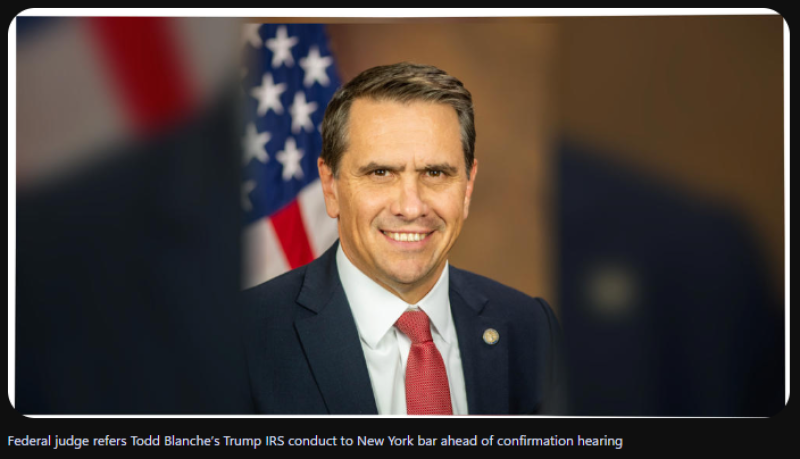
Federal judge refers Todd Blanche’s Trump IRS conduct to New York bar ahead of confirmation hearing

By: Story by IdahoPublicPress Editorial Team


Key takeaways


- Court Criticism: A federal judge sharply criticized Acting Attorney General Todd Blanche for mishandling Trump’s $10 billion IRS lawsuit, calling his explanations misleading and recommending disciplinary action.
- Settlement Controversy: Blanche’s team settled the case without court review, claiming “no judge” was available—a justification the judge deemed disingenuous, highlighting procedural lapses.
- Political & Ethical Stakes: The ruling coincides with Blanche’s Senate confirmation hearing, raising questions about his ethics, potential bar proceedings, and the broader implications for his nomination.
 S E E D E D C O N T E N T
A 56-page ruling from a federal judge puts Acting Attorney General Todd Blanche's courtroom conduct under a microscope just as his confirmation hangs in the balance.
A federal judge has issued a scathing ruling criticizing Todd Blanche, President Donald Trump’s acting attorney general, for his handling of Trump’s $10 billion lawsuit against the IRS — and the timing could hardly be worse for him. U.S. District Judge Kathleen Williams blasted Blanche and other Trump attorneys for failing to submit a settlement agreement for court review, calling his explanations misleading at best.
Per the ruling, Blanche never brought the deal in Trump’s lawsuit over the 2019 leak of his tax returns back before the court, then told a Senate subcommittee there was “no judge” to review it — an answer Williams called, at best, misleading. She recommended disciplinary action, ordered her ruling sent to the State Bar of New York, and the decision lands just as Blanche sits for a confirmation hearing on his nomination.
The simple task Blanche skipped
The core of Williams’ criticism is almost mundane. Blanche’s team settled Trump’s lawsuit without submitting the agreement to the court for review, and Williams centered her ruling on that omission, faulting his justification for leaving the deal unreviewed.
When asked on May 19, 2026, why the “settlement agreement” had never been submitted, Blanche testified that “there is no judge” because the case had been dismissed, so there was “no mechanism” for review. Williams was not persuaded.
“While temporally accurate, this answer is, at best, misleading and, at worst, disingenuous,” she wrote. The court, she noted, “was available to review any pleading by any Party at any time during this lawsuit.” If Blanche believed the dismissal had been granted in error, he “only had to file” the appropriate motion.
Why Trump’s IRS suit was unusual from the start
The underlying case was structurally strange. In January, Trump and his sons sued the federal government for $10 billion, claiming they were irreparably harmed by the 2019 leak of their corporate and personal tax returns — even though a third-party contractor was responsible and is currently serving a five-year prison sentence for the theft.
That put the Justice Department, the IRS, and the Treasury Department — all executive branch agencies answering to Trump — in the position of defending the government against its own boss. As the Los Angeles Times noted in its analysis of the ruling, the Constitution does not allow the same person to sit on both sides of a lawsuit.
The settlement that followed, reached without court review, is what drew Williams’ sharpest fire. The Los Angeles Times characterized the underlying lawsuit as “flagrantly unethical” in its analysis of the ruling, and the judge herself questioned Blanche’s ethics, pointing to his earlier role as Trump’s personal lawyer before joining the Department of Justice.
A bar referral with real consequences
Williams did more than scold. She recommended disciplinary action against Blanche and other attorneys on Trump’s team and ordered that a copy of her ruling be mailed
to the State Bar of New York, where Blanche is a member.
That referral is not theoretical. Blanche already faces an ethics complaint before the New York bar backed by more than 101 former federal and state judges. The new referral adds to that pressure, and any bar response would unfold through the bar’s own procedures.
The Los Angeles Times described the ruling in terms including “blistering,” “stunning,” “scathing,” and “damning” — unusually strong language even in a courthouse culture known for pointed opinions.
Confirmation hearing raises the stakes
The ruling’s timing is what turns a routine sanction referral into a political problem. Blanche appeared before the Senate on Wednesday morning for his confirmation hearing, meaning lawmakers now have a fresh, 56-page judicial document questioning the ethics of the man nominated to run the Justice Department.
Democrats can be expected to press him on his May testimony and the bar referral. Whether Republicans treat the ruling as disqualifying or as partisan noise will likely shape how the nomination proceeds.
A pattern, or a political fight?
Blanche’s defenders point to a longer record. During Trump’s New York hush money case, Judge Juan Merchan told him he was “losing all credibility with the court,” according to The Hill. Former Trump attorney Jim Trusty called that a “bad moment” for any lawyer, while arguing a tongue-lashing does not always lead to lasting damage.
There’s also a counter-narrative from the Justice Department itself. In September, Blanche announced the unusual judicial misconduct complaint against all but one of Minnesota’s federal district judges, filed after most of them spoke with the New York Times about the administration’s immigration enforcement. “We have a right, just like every litigant in court, to have a judge that will be fair and impartial,” Blanche said at the time.
Supporters of Blanche may argue Williams’ ruling is another front in a broader institutional conflict rather than a disinterested ethics judgment. The judge’s own written reasoning, though, rests on narrow procedural ground: a settlement that should have been filed was not, and testimony about why was misleading.
What happens next for Blanche
Several questions remain open. The New York bar must decide whether to open a formal proceeding on the referral, and the timeline for any such process is not yet known. The Senate must decide whether the ruling affects Blanche’s confirmation. And the settlement itself faces renewed scrutiny now that a judge has flagged how it was handled.
What is clear is that Williams put her criticism in writing, on the record, and directed it at the government’s top lawyer at the exact moment his career is on the line. Whether that produces discipline, confirmation, or both will be watched closely on both sides of the aisle.
Trolling, taunting, spamming, and off topic comments may be removed at the discretion of group mods. Respect one another.

Tags
Who is online
83 visitors
Even a first year law student knows one cannot sue oneself.