
Emissions of the powerful greenhouse gas SF6 are rising rapidly

By: Charlotte Edmond (World Economic Forum)


Alternative energy also contributes to global warming. The article highlights only one fluorinated gas used in manufacturing and operating alternative electricity generation. The sun may provide clean energy but the technology needed to harvest that energy isn't clean. Converting to alternative energy likely will not make the problem of climate change go away.
We know that climate change is affected by consumption of energy. That suggests the only viable solution is to consume less energy. Conservation needs to receive more attention.
 S E E D E D C O N T E N T
Cheap, odorless and inert, sulphur hexafluoride is widely used in the electricity industry for its insulating properties. But there’s a problem: it’s also one of the most potent greenhouse gases known to man.
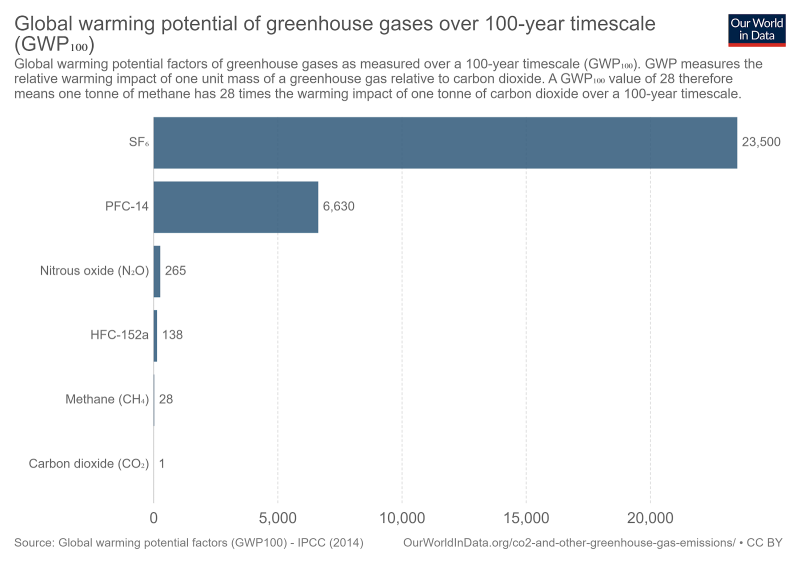
The amount of the gas – known as SF6 – in the atmosphere is minute, only about three parts per trillion by volume, but its global warming potential is significant. It’s 23,500 times more warming than carbon dioxide.
And, according to the BBC, our changing energy make-up – including the growth of renewables – is creating more demand for SF6. The diversity of our energy supply has increased demand for electrical switches and circuit breakers, and some offshore wind turbines also use the gas.
So how bad is it?
SF6 has a number of properties that make it popular throughout the world as a cost-effective insulator. There’s little risk of land or water contamination. And equipment lasts longer, has reduced maintenance and is more compact, requiring a smaller land area.
But some of these properties are also problematic if it leaks into the environment: it is very stable and lasts around 3,200 years, meaning nearly all the SF6 that has been released still exists.
It is difficult to quantify the levels of SF6 that enter the atmosphere through leaks from the electricity industry, as well as its other uses such as magnesium and aluminium smelting and military purposes. A recent study suggests that the UK’s use of SF6 has risen in recent years, and leakage levels are over 1%.
It is estimated that, by 2100, appropriate controls could limit the contribution of SF6 to global warming to 0.2%. In the UK, the gas already contributes this much to its annual global warming potential.
Cutting back
SF6 is one of a number of fluorinated gases the European Union limits, with a view to phasing them down in steps to one-fifth of 2014 sales in 2030. In the US, there have also been efforts to curb SF6 use .
The damage potential of greenhouse gases depends on their concentration in the atmosphere, the length of time they stay there, and the strength of their impact.
By volume the so-called F-gases make up one of the smallest levels of emissions, but have among the greatest global warming potential (GWP).
By far the most emitted gas is carbon dioxide, released from burning fossil fuels and in industrial processes such as cement manufacture.
Methane makes up the next biggest proportion of greenhouse gas, emitted by livestock and farming and landfill decay. It has a greater GWP than carbon dioxide, but much less than that of nitrous oxide, which agriculture and manufacturing also emit.

Tags
Who is online
83 visitors
There isn't a free lunch.