
Criticized by moderates and pressured by their base, liberals fight for a voice in the Democratic Party

By: Sean Sullivan and Rachael Bade (Washington Post)
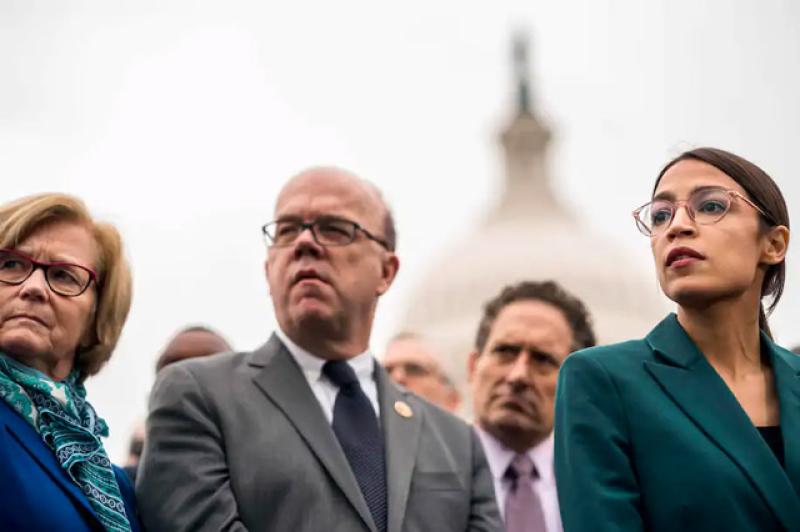


The Democratic Party's typical bait-and-switch political tactics don't seem to be working following the 2020 election. We've seen how the Black vote, particularly in the South, has oversized influence on the Presidential primaries. But for the general election there is a pivot away from those primary promises to Black voters toward suburbia and other identity groups. Following the general election the Democratic Party backslides into a Third Way political agenda that is primarily neo-liberal in its goals. The Democrat's political cycle has become consistent and predictable; racial politics for the primaries, economic politics for the general election, and global neo-liberalism as a governing philosophy following the election.
The activists within the Democratic Party aren't willing to accept the usual pandering pabulum and political fluff as payback for their support. Rejoining COP21, reversing withdrawal from the World Health Organization, repealing bans on Muslim travel to the US, reinstating DACA, and tearing down the border wall are only symbolic measures that will not accomplish very much. The activists are demanding substantive measures that will reshape social and economic life in the United States.
Third way moderates are more concerned about future prospects for the Democratic Party and, ultimately, how to protect their incumbency by balancing appeals to voters with what is acceptable to political donors. But the Democratic base has become more activist and revolutionary in outlook; a pragmatic incremental approach that doesn't rock the boat no longer appeases the base that energizes voter turnout. The Democratic Party is being forced to deal with an activist insurgency similar to how the TEA Party changed the Republican Party.
The Democratic Party does not have the advantage that the Republican Party enjoyed. The Republican Party dealt with the TEA Party insurgency while Barack Obama was President. Opposition to a Democratic President provided an unifying political framework while Republicans fought with each other over political priorities. Republican activists and revolutionaries could remove incumbents and change the party while maintaining Republican unity through opposition to Barack Obama.
Joe Biden winning the 2020 election places the Democratic Party at a disadvantage. The Democratic Party cannot fight with each other to reshape political priorities while maintaining party unity through opposition to Joe Biden. The more activist and revolutionary party base won't be appeased with demands for pragmatic patience. Democrats prevailing in the two Georgia Senate races would be the worst possible outcome for the Democratic Party. A divided party controlling the Presidency, Senate, and House will devolve into an intraparty civil war led by the base of the Democratic Party. Third Party moderates vocally disparaging, demeaning, and dismissing the energized party base are risking the future of the party. Either the Democratic Party changes (which means moderate incumbents have short shelf life) or the Democratic Party breaks apart. There won't be a third way this time.
 S E E D E D C O N T E N T
Jamaal Bowman and Cori Bush were two of the breakout liberal stars of this year’s election, toppling powerful House Democrats on the way to winning their seats.
But now, like much of the left, they are toiling to exert their influence on a party led by President-elect Joe Biden, an avowed centrist, and his moderate allies on Capitol Hill.
During a recent private call with Biden’s team, Bowman urged the president-elect to consider specific Cabinet appointments. Bush has had conversations with House Majority Whip James E. Clyburn (D-S.C.) — a top Biden ally on the Hill — about “defund the police,” a rallying cry that he has called alienating but Bush has embraced.
These efforts illustrate the challenge liberals face as they attempt to shape the party’s direction in the months ahead. After an election in which the country opted for a reset, not a revolution, moderate Democrats hold the power in the party. And many blame the polarizing themes championed by the left for the party’s shrunken House majority and Senate losses. This recrimination from party leaders, along with skepticism from some Biden allies, could limit liberals’ influence.
But liberals offer a starkly different take, arguing that their base won Biden the White House — and now, they must deliver on promises to pass climate change legislation and fight economic inequality. The shifting dynamics in the party have thrust the movement to a crossroad on the eve of the Biden presidency.
“I don't know how, the day after the election, people can start pointing fingers at progressives for somehow ruining things when in fact we never would have won the presidential election if we hadn't turned out people,” said Rep. Pramila Jayapal (D-Wash.), co-chair of the Congressional Progressive Caucus.
She and others have argued that the party needs to listen to its liberal members if Democrats want to energize their base to win in 2022.
“We need people like myself talking to Joe Biden as much as possible. We need AOC talking to Nancy Pelosi as much as possible,” Bowman said. “We have to bridge the gap between the innovation and the energy of the progressives with the wisdom and experience and power of the more moderate and more senior-ranking members.”
Already, liberals have notched some wins, with Biden set to tap former Federal Reserve chair Janet L. Yellen for treasury secretary and former secretary of state John F. Kerry as a special envoy for climate. On Capitol Hill, Sen. Dianne Feinstein (Calif.) is stepping down as the ranking Democrat on the Senate Judiciary Committee after criticism from liberal groups.
But liberals are gearing up to pressure Biden to go much further.
Biden has already promised a wave of executive actions soon after he takes office. He intends to rejoin the Paris climate deal, reverse Trump’s withdrawal from the World Health Organization, repeal the ban on almost all travel from some Muslim-majority countries and reinstate the program allowing “dreamers,” undocumented immigrants brought to the United States as children, to remain in the country.
Liberal officials want him to do even more by executive order, urging him to increase the minimum wage for federal contractors, forgive student debt immediately during the pandemic and possibly even move money around to provide coronavirus relief if they can’t make a deal with Senate GOP leaders.
“The one irony is that Donald Trump may have accidentally established a precedent that gives Joe Biden more power to take unilateral action to move money and achieve bold action on the coronavirus,” said Adam Green, co-founder of the Progressive Change Campaign Committee, referring to Trump’s emergency declaration to build a wall along the border with Mexico that was upheld in court. “Why wouldn't that same exact concept apply to relief for homeowners and relief for student debt?”
Jayapal said she thinks Biden should lay out his priorities and give Congress a short window to pass legislation — warning that if they don’t, he’ll move unilaterally. “I think that it’s important for President-elect Biden to use the bully pulpit of the White House to say, ‘I’m ready to take bold action on all of these things,’ ” she said.
Liberals have also called on Biden to prioritize economic issues that will have an immediate effect for Americans, arguing that Democrats must reclaim the mantle of economic populism to win in the future.
“With a stroke of a pen, the president-elect, Joe Biden, can end the student debt crisis in this country that in my district has caused thousands of young people to have to live at home with their parents and grandparents because they can't afford to live independently,” said Rep.-elect Mondaire Jones (D-N.Y.), who in January will become one of the first two openly gay Black men in Congress, along with Rep.-elect Ritchie Torres (D-N.Y.).
The focus on unilateral action is, however, at odds with Biden’s stated goal of working with Republicans in Congress to pass popular bipartisan legislation. If Democrats don't sweep a pair of Senate runoffs in Georgia, that would give Republicans control of the chamber and even more influence on policy.
As a candidate, Biden repeatedly expressed confidence that once Trump is out of the picture, Republicans would suddenly be willing to cooperate. “I take McConnell at his word. I understand he said that he will make it clear who he’s prepared to support, not support, and that’s a negotiation that I’m sure we’ll have,” Biden said this month, speaking about Cabinet picks.
Many on the left see that as a naive position, particularly in the wake of many congressional Republicans refusing to even acknowledge that Biden won the election, as Trump continues to refuse to concede. They fear such thinking by Biden will result in agreements that will be more favorable to Republicans. And they’re cognizant that many campaign promises can go unrealized once the tough realities of governing set in.
“You turn on the TV and Joe Biden is like, ‘I will work across the aisle.’ And, you know, ‘What we need is unity.’ . . . I don’t know how much of this is just rhetoric and messaging versus how much of this is actually what Joe Biden believes in,” said Waleed Shahid, the spokesman for Justice Democrats.
Shahid said it “makes him nervous” because he feels Senate Majority Leader Mitch McConnell’s chief aim is to “disempower Democrats.”
Many liberals argue that McConnell (R-Ky.) will never be a reliable partner. A new memo from an array of liberal organizations including Justice Democrats titled “The Path Forward for Democrats,” urges party leaders to remember the Obama administration. “Being strung along by McConnell yielded no meaningful Republican cooperation while depressing the base and leading to electoral disaster in the 2010 midterms,” says the memo, which was shared with The Washington Post.
But even as liberals push ahead on their policy priorities, a handful of allies have begun to rethink their political strategies.
For example, some preliminary discussions are underway among alumni of former Senate majority leader Harry M. Reid about forming a new vehicle that would nudge the party leftward but also encourage liberals to be more strategic in their targets and fights, according to people with knowledge of the conversations who spoke on the condition of anonymity to be candid.
Additionally, even the staunchest advocates of Medicare-for-all have focused less on the policy in recent weeks, an implicit acknowledgment that it is unlikely to pass because Biden does not favor it and Republicans are well-positioned to retain control of the Senate.
But the conversation around “defunding the police” shows how challenging it can be to form a consensus view within the Democratic party.
After a series of killings of unarmed Black people triggered nationwide protests and a reckoning over race, some left-leaning politicians embraced the slogan. But Biden allies felt the issue hurt him and moderate Democrats, particularly in the suburbs and in toss-up districts.
Clyburn, who is African American, has said he felt the slogan was harmful to some Democratic candidates who had to distance themselves from it in the face of Republican attacks.
But some of the party’s more-liberal members disagree, arguing the slogan reflects a raw anger with systemic racism and police violence that should not be stifled. “I still respect Representative Clyburn greatly. He and I have had conversations face to face and by phone about this subject, and we will continue to move forward and take care of our districts,” said Bush, a Black Lives Matter activist who got involved locally in protests that followed the 2014 police killing of Michael Brown in Ferguson, Mo.
Ocasio-Cortez has argued that the GOP onslaught on “defund the police” amounted to “racial resentment attacks.” The memo from Justice Democrats and other liberal groups urges the party to link “economic justice to racial justice.” It adds, “A message framing racism as a divide-and-conquer weapon deployed by the wealthy and the powerful against working people of all races polls more effectively than race-blind messaging.”
Bush is part of a wave of newly elected Democrats of color who won landmark victories in heavily Democratic urban areas. In a St. Louis-based House district, she defeated longtime Democratic Rep. William Lacy Clay Jr. by running to his left in the primary. Bush will become the first Black woman to represent Missouri in Congress.
Weeks before her primary victory, Bowman, a former middle school principal, ousted longtime Democratic Rep. Eliot L. Engel in New York. Bowman is close with the “Squad” of liberal congresswomen of color that includes Rep. Alexandria Ocasio-Cortez (D-N.Y.).
Still in recent years, White liberal candidates running nationally or in swing areas have tended to have less success. This year, Kara Eastman, the Democratic nominee in Nebraska's competitive 2nd Congressional District, lost, while Biden won there.
Ironically, those losses may ultimately strengthen liberals’ hand. With Democrats poised to lose about 10 House seats — many elections have yet to be called — the progressive caucus is slated to have even more influence next year in the House. With a narrow margin, Pelosi (D-Calif.) will only be allowed to lose a few Democrats and still pass legislation, giving the left the ability to assert its will by denying her needed votes, if it so chooses.
“A lot of jockeying for influence over legislation,” predicted Shahid.

Tags
Who is online


134 visitors
Democratic third way moderates will be forced to fight both Republican opposition and a growing insurgency in the party base. The coming fight will split the party base over priorities and raise alarm among political donors. The immediate future does not look bright for the Democratic Party.
The Democratic Party is going to change; that is inevitable. But it is beginning to look like that change is going to be very painful in the short term. While unlikely because of institutional inertia, there is a real possibility that the Democratic Party won't survive.