
An Astronomer Checked to see if There's a Secret Message in the Cosmic Microwave Background Radiation

By: Brian Koberlein (Universe Today)
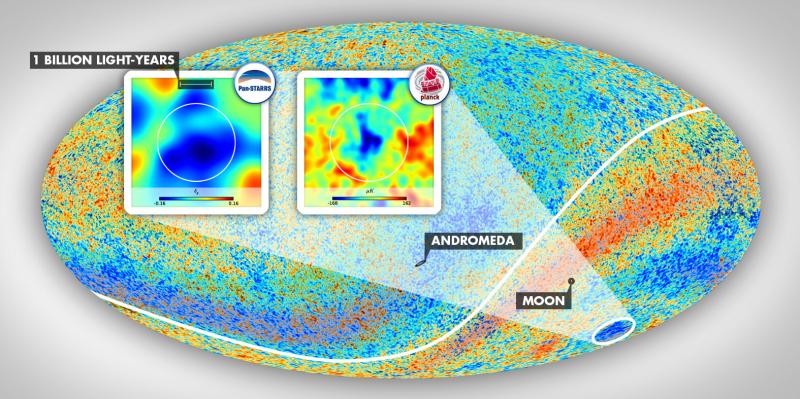


The universe is full of patterns. Repeating and predictable patterns establishing structure have been the foundation of cosmic science. That's why there are physical constants of the universe.
Wouldn't it seem likely that any message embedded in the cosmos would consist of anomalous information that wouldn't fit a pattern? In our universe of many patterns wouldn't such a message stand out if it didn't fit within a pattern?
Life would seem to be an anomaly in the universe. Life does not fit the predeterminate patterns of the inanimate physical universe. What if we are the message?
 S E E D E D C O N T E N T
In the New Testament, the book of John opens with In the beginning was the Word. Whether a poetic musing of philosophy or a declaration of faith, it encapsulates an idea that has been around a long time. If the cosmos was made, either by advanced aliens or a divine creator, might this architect have buried a message within the universe? Some absolute proof of intentional design.
The message wouldn't need to be profound. It could be as simple as Kilroy was here, or as Douglas Adams proposed, Sorry for the Inconvenience. But it would have to be extraordinarily clear and buried in a way that would be impossible for mere mortal civilizations to fake.
Carl Sagan suggested mathematics as a possibility. In Contact he described how a message might be buried deep within the digits of pi. Others have suggested the evidence lies within the physical constants of the universe, arguing that a kind of anthropic principle points to a cosmic designer. Still, another idea is to look for a message in the light of creation itself, the cosmic microwave background.
The idea was first proposed in 2006 with a paper published in Modern Physics Letters. In the work the authors showed how an unambiguous message could be planted in the cosmic microwave background by tweaking the initial cosmic state through what's known as the fundamental Lagrangian. The idea was later popularized in the television series Stargate Universe, where the ancient stargate builders refer to the message as "the destiny of all things."
Astronomers have long searched for structure within the CMB. Whether it's evidence of unusual cold spots, or statistical anomalies, CMB structure could point to both new physics and evidence of parallel universes. So far, these studies have turned up nothing, but that hasn't stopped a new study looking specifically for a message within the cosmic background.
Arguing that a sufficiently advanced civilization could put a message in the CMB is one thing. Trying to find the said message is quite another. One of the biggest problems when looking for patterns is that you tend to see them, even when they aren't there. So this new work takes a very cautious approach. Rather than looking for a particular message, it tests to see whether the hypothetical message deviates from random. The author takes data from the WMAP and Planck surveys and expresses temperature fluctuations as a power spectrum, which is a common way to study the scale of CMB fluctuations. Using an average value as a cut-off point, the fluctuations can be translated into a string of binary numbers.
The author then argues that if this string of about 1,000 bits contains a message, it should at the very least deviate from purely random noise. Testing the string for randomness using statistical tests turns reveals no pattern, nor does a comparison with mathematical constants such as pi or phi. By all appearances, the cosmic microwave background is random noise.
So if the First Ones did leave a message in the CMB, they've hidden it really well. Or they don't exist, and the only messages the universe can provide are the answers to scientific questions we raise.

Tags
Who is online


134 visitors
A message embedded in the universe by a cosmic creator could be as plain as the noses on our faces. Life certainly doesn't fit the patterns of the universe. Life is an improbable certainty, as our existence demonstrates.
Maybe we are the message.
On what basis do you make the assertion life is improbable? Our existence only proves life is a certainty in the universe.
Or even quite likely. It appeared early on and has survived many extinction events.
Life is the ultimate anomaly in an inanimate physical universe. Life does not fit the patterns found in the universe. Life defies physics, thermodynamics, chemistry, and, even, mathematics. Life creates itself.
If life were probable then we should be capable of artificially replicating the emergence of life through simple physics, thermodynamics, and chemistry. We do have the ability to establish whatever conditions we desire.
As the article suggests, a message embedded in the universe by a cosmic creator would need to be clear, unambiguous, and impossible for mere mortal civilizations to fake. The tongue-in-cheek message could be as simple as Kilroy was here.
Aren't we Kilroy?
Emergence of complex behavior in a system given simple rules isn't unexpected - Conway's game of life being a prime example.
If life were probable then we should be capable of artificially replicating the emergence of life through simple physics, thermodynamics, and chemistry. We do have the ability to establish whatever conditions we desire.
We don't have the ability to manipulate time to allow an experiment to have the billions of degrees of freedom nature has in a Universe that is billions of years old and billions of light years in size - but even with our severe limitations in a mere handful of years of civilization we've managed to create very complex artificial intelligences and a variety of artificial cell structures.
Actually we do have the ability to compress time. We were able to create nuclear fusion in less than a century instead of the millions or billions of years required by natural processes. Supposedly we are on the threshold of replicating the sustained fusion of a star. That's what a determinate physical reality described by physics, thermodynamics, chemistry, and mathematics allows.
Yes, we have created intelligence (at least one form of intelligence). We have even manipulated evolution. But we have not replicated the process of the emergence of life. Our mere mortal civilization has been able to fake life.
Again, what do base your asseton that life is an anomaly or inprobable? You offer nothing to support that position other than your own opinion. "Life" is composed of the most common elements in the universe and follows the same laws of physics. It seems obvious you do not understand the laws of physics, thermodynamics, organic chemistry, ect..
Fusion is not a function of time. Its physics. Although, I think you mean fission. Regardless, we've been able to do that because of technological advances. As far as life goes, the Miller-Urey experiments gives an indication how life might have first developed.
There have been 5 major extinction events in Earth's history. The last one was the extinction of the dinosaurs. That event wiped out 75% of all species on earth. And that wasn't even the biggest extinction event. Life does tend to be resilient, which only further increases the likelihood of it existing elsewhere in the universe.
No, I mean thermonuclear fusion. We have replicated the basic physical function of our star within our own atmosphere. To be sure, we have not achieved sustained fusion. Nevertheless we have created a star within our own atmosphere.
All RNA and DNA are composed of the same chemical elements in about the same relative abundance. For life to emerge it is necessary for the proper mixture of chemical elements to be present and in the proper abundance. Phosphorus, in the proper abundance, is necessary for life. Phosphorus is the least abundant element of those necessary for life in the universe. Hydrogen, oxygen, carbon, nitrogen, and sulfur are among the most abundant chemical elements in the universe. Phosphorus isn't nearly as abundant.
So, the probability of life depends upon environmental conditions and the composition of that environment.
Your example was not one of compressing time.
Correct.
The simple act of gathering together materials and combining them manipulates time. We do have the capability of taking shortcuts.
That is not manipulating time. That is making effective use of time.
We more or less have. You just seem to demand A-Z style creation of life - but in a multi-billion year process we've focused on the key milestones. We've created artificial proteins. We've created artificial cell structures. We've created artificial cell membranes, placed artificially created genomes in denatured cells, and all in handful of decades that we've had a handle on molecular biology. We are rapidly expanding our ability to simulate protein behavior. Given a few decades there's little doubt we'll be able to design and build self replicating cell structures from scratch.
That would be a hydrogen bomb.
That's a bit of a stretch.
Given the abundance of simple elements in the universe, it's reasonable to conclude life can be present, if not in abundance itself, in the universe.
To an extent. We know (simple) life can evolve and thrive in hostile environments. We see this on Earth, where life is found and even thriving in all sorts of different environments. Given the variety of environments where life can be found, it's quite possible life is present in other equally hostile environments, along with hospitable environments.
No, that does not alter time in the least. If you want to "manipulate" time, short of inventing a time machine, your best bet is to achieve velocities approaching light speed or hang out in the gravity well of a black hole.
Dr. Neil DeGrasse Tyson explains that notion quite well, and in a philosophical way too.
Human beings are inherently skilled in detecting patterns. So skilled, in fact, that we can see patterns where none actually exist. For example, the patterns we see in clouds or the ancient patterns of astrology.
Throw in emotion or wishful thinking, and people might see exactly what they want to see, regardless if it's really there or not.