
Pre-Nazi Germany tells us the fight to save American democracy is just beginning

By: Michael Brenner (Washington Post)
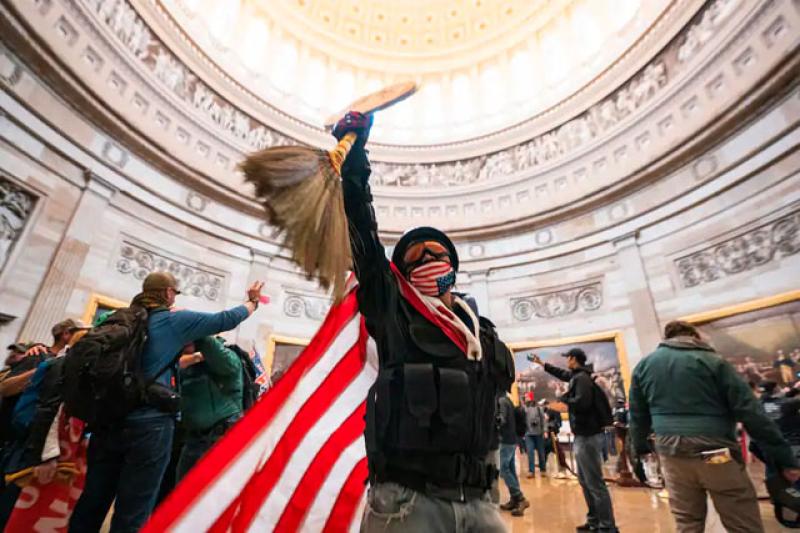


Yes, what happened at the Capitol is obviously very, very, very different than the Munich Beer Hall Putsch. But that doesn't stop these coup-less academics from foisting a contrived, false, and phony narrative onto the public.
The most problematic aspect of these contrived falsehoods is they are promoted by professors of history who are twisting the history of the United States into a caricature of Europe. The history of the United States has never been tainted by regimentation of society imposed by aristocracy and monarchy. Authoritarian control by an elite class has been the status quo in Europe for over a thousand years.
Do these highly sophisticated and highly educated professors of history actually believe that the United States would seek a dictator as a surrogate king? Insurrection is nothing new in the United States. But history really does tell us that those insurrections were motived by the government becoming too authoritarian.
These academics would have us believe that antigovernment insurrectionists would readily and willingly accept the imposition of political correctness and authoritarian regimentation required for Donald Trump to remain in power as a dictator?
If the academic elite can't understand the United States (or America) then we shouldn't waste time listening to their whoopty-coup speculations.
 S E E D E D C O N T E N T
A mob of several thousand outraged people rampaged through the streets of the city after a long rambling speech by their leader inciting them to do so. Some used violence. Windows were broken, shots were heard, there was bloodshed. The leader of the pack demanded the political swamp be drained. After a tumultuous few hours, order was restored and elected officials emerged from their hiding places.
No, this is not Washington, D.C., Jan. 6, 2021. This was Munich, Nov. 8, 1923. The instigators did not come to Munich to support a president who was voted out of office. They did not gather in front of the nation’s seat of power, but rather started their rally in a beer cellar where a young Adolf Hitler seized control after silencing the politicians and the crowd assembled there with a pistol shot to the ceiling. Obviously, the circumstances surrounding the storming of the U.S. Capitol are very different from those of the Munich Beer Hall Putsch. But Germany during the 1920s offers crucial lessons for us today about how democracies become imperiled.
Germany’s democracy was young, but the majority of the population stood behind it in the early 1920s. Yet, humiliated by defeat in World War I and plagued by an unprecedented economic crisis, a growing minority resorted to lies and conspiracy theories, such as the stab-in-the-back myth, which blamed scapegoats like Jews and socialists rather than the military for losing the war.
It was these lies that resonated with Hitler and his followers. They hoped to establish authoritarian rule first in Munich and then in Berlin to restore Germany‘s military strength. But first came the fight against the enemies within. During the night of unrest, the resurrectionists took numerous Social Democrats as hostages, destroyed the offices of the Social Democratic newspaper and broke into many houses of Munich’s Jews. This night represented the first confrontation with the life-threatening horror of Nazi terror — to the day 15 years before the November pogrom known as Kristallnacht.
In the end, the Beer Hall Coup failed. The governor of Bavaria and his closest aides, threatened by the guns of the insurrectionists, initially gave assurances that they’d be hands off. But when morning broke they retracted those statements and after some hesitation got to work suppressing the putsch. Even as 2,000 Hitler supporters began to march to one of the city’s main squares, authorities forcibly stopped them in the center of the city. Fifteen of Hitler’s supporters, one civilian bystander and four policemen lost their lives.
Hitler himself was injured and fled to outside of Munich, where he was arrested two days later. He and some of his associates were put on trial and sentenced to five years of confinement for treason. But Hitler’s claims that he was a strongman who would clean up the political mess and march to Berlin to make Germany great again won him many sympathies among the deprived masses, conservative politicians, business elites and even within the judicial system. He received a mild sentence, was freed after a few months and relaunched his political career. Ten years later he was Germany’s strongman.
What at first blush looked like a failed coup proved successful in the long run because of a justice system that was blind in its right eye and conservative political leaders who fueled the myths that Hitler had tapped into, planted the seeds of political polarization and discredited the legitimacy of elected officials. These leaders were also convinced that they could use Hitler and his mass movement as a vehicle to stay in power, even though they despised him and looked down on him as an upstart. His vice-chancellor, Franz von Papen of the Catholic Center Party, famously claimed he and his moderate cabinet members would keep Hitler and his Nazi troops in check. Von Papen lost this game and so did all the other enablers who made Hitler’s rise possible. But they didn’t decisively move to squelch his movement during the 1920s when they had the opportunity.
This history highlights how the real risk to American democracy came hours after order had been restored in the U.S. Capitol when seven U.S. senators and 138 members of the House of Representatives voted to sustain an objection to Pennsylvania’s electoral votes, giving credence to the lies that nourished the mob’s anger. Further to date, Vice President Pence and members of the cabinet have stood by without invoking the 25th Amendment to remove Trump from power. By doing so, they enable the president — who initially doubled down on lies about the election in subsequent videos and tweets — to cause additional harm to the nation, including his ability to pardon more of his supporters and spread more lies. Even many of those Republican elected officials who during the last days of this presidency have distanced themselves or expressed disgust with the president’s deeds, only a few weeks ago fought to keep him in office for another four years.
The historical example of Germany is often, perhaps too often, invoked. But rarely has it been so close to our reality as it is today. Germany was at a political crossroads in the 1920s. It could have remained a vibrant democracy, but for many reasons it became a dictatorship. The United States, with its long democratic tradition stands on much firmer ground, but since Jan. 6, we can no longer ignore the abyss that has opened up before us. As in Germany, here too, responsibility for the situation lies with those who either passively stood by or those who actively enabled the rise of a political monster.
The lessons of history are clear: Those who precipitated and carried out the attempted insurrection — including President Trump — must face swift and severe consequences for their actions. Further, those willing to ally with Trump, thinking they could contain him, need to see the errors of their way. Enabling the spread of lies and conspiracy theories, as well as the rise of unfit individuals, poses an existential risk to a democracy. On Wednesday, Americans avoided the worst potential consequences. As the German example warns us, however, knocking down an insurrection does not yet mean winning the fight for democracy. This fight will go on until our politicians learn the crucial lessons from the past.
Michael Brenner is professor of History at American University in Washington, DC, and at Ludwig Maximilian University in Munich, Germany. His forthcoming book, "In Hitler’s Munich: Jews, Antisemites, and the Rise of Nazism" will be published by Princeton University Press.

Tags
Who is online
70 visitors
It's much, much less likely that the United States will become Fascist than it is that Michael Brenner is using whoopty-coup fiction to sell a book that few people will be interested in reading.
You mean like "The election was stolen"???
Yeah, like 'the election was stolen'. I have no idea if Trump actually wanted to remain in office. But he has certainly created a lot of chaos.
Now President Joe enters office with political prisoners, using government intelligence agencies to suppress political opposition, and declaring these opposition political groups are terrorists. President Joe seems to have a lot in common with Putin, doesn't he?
Honestly, the situation is so murky and clouded that it's hard to see the future. Certainly the position Trump stands in at the moment has a lot of similarities with Hitler in the 1920's and one can see history possibly repeating itself. But I can also see the Democratic Party using the Ghost of Trump to justify legislation that could end up being just as bad. They are going to use him for a long time to come, even if he dropped dead today. Going after anyone deemed a supporter of Trump, for instance, I see as a favored weapon.
I don't hold out a lot of hope for our nation, to be honest. Too many on the far right and far left, not enough left in the middle anymore.
I agree the situation is murky. But these academic comparisons to Nazi Germany ignores most of the history of the United States. Rebellion and insurrection in the United States has historically sought to remove concentrated government authority imposed on groups of people.
Yes, I see Democrats overreaching using Trump as an excuse. But history suggests that will only result in rebellion and insurrection. If Democrats attempt to impose too many restrictions then there will be a growing motivation to weaken the Federal government. That would be consistent with the history of the United States.
I think the comparisons may be a bit more than academic. It kind of depends on how many hard core supporters he actually has and what they're willing to do. Further, depending on how crazy the Dems get with their legislation, it's not far fetched Dems could push more people into Trump's camp.
Possibly, but there are some aspects of this that are unprecedented that history will not necessarily provide guidance on. Specifically, the internet. Fifty years ago people could not have come up with the million man march with the ease we can now, if at all. Much harder to organize back then than it is now. Before, you pretty much had to be picked up by a newspaper for anyone to hear what you had to say. Now anyone can be heard by everyone with just a few taps of a keyboard. Ideas, attitudes, plans and whatever else is so much easier today.
Also, and again directly attributable to the internet, we are probably as divided now as they were back in the civil war. Too many people, it seems, have opinions and views that seem to have solidified into diamond. People on both sides are willing to come together over large distances in great numbers, all coordinated by the internet.
Point is, history may be only so helpful this time.
The comparison is an emotional appeal fed by the left's infatuation with revolution. Remember Bernie Sanders? If the United States can become Fascist then there is hope the United States can become Socialist. Both Fascism and Socialism are European inventions built upon the authoritarian history of Europe.
There were 115 million fewer people living in the United States 50 years ago. And the notion that the internet is somehow magical completely ignores the Civil War in the United States. How could the Civil War have happened without the internet?
Even the American Civil War was not about overthrowing the Federal government; the American Civil War was about separating from the Federal government.
The United States was never influenced by aristocratic or Roman Catholic authoritarian orthodoxy. South America was settled by people who followed the European aristocratic and Roman Catholic authoritarian orthodoxies. Which is why the history of North America and South America are so different.