
Scientists blow up decades of thinking on why hurricanes are becoming more deadly

By: Alexandra Kelley (TheHill)
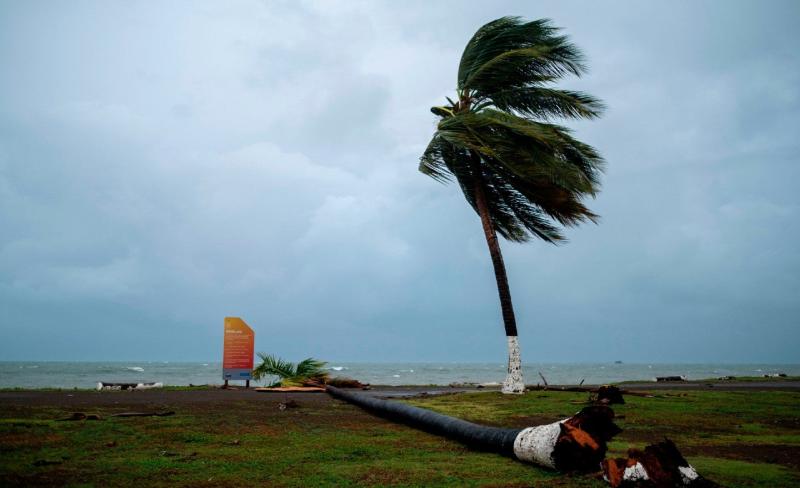


Rewriting science to fit politics.
How very convenient that volcanoes were responsible for variation in hurricane activity before humans invented mass consumption.
 S E E D E D C O N T E N T
When analyzing and tracking hurricanes and storms that develop in the North Atlantic Ocean, meteorologists and scientists have long looked toward the Atlantic Multidecadal Oscillation (AMO) for justification.
Understood as a naturally occurring phenomenon, the AMO is supposed to cycle through warm and cool phases every 20-40 years, which accounts for seasonal hurricane activity.
New research posits that there is no AMO at all, however, and that changes in hurricane activity within the Atlantic are directly related to human-caused climate change.
Published in the journal Science, a team of researchers argue that the AMO is not an entity in and of itself; rather, it is a manifestation of the effects of anthropogenic greenhouse gas emissions, or fossil fuels emitted into the atmosphere from human activity.
In short, the AMO is not responsible for varying hurricane activity — humans are.
"We can more convincingly now conclude that the increases in Atlantic hurricane activity are tied to warming that is human-caused, not natural, in nature," said Michael Mann, a professor of atmospheric science at Penn State University who coined the term AMO. His latest research walks his initial theory about cyclical weather patterns back.
"I was wrong about the existence of an internal AMO oscillation when I coined the term 20 years ago," he told CBS News.
Mann cites pollution data in reevaluating the existence of the AMO, specifically when modeling the countering effects emissions have on global temperatures.
When greenhouse gases are emitted into the atmosphere, they also include sulphate aerosols, which are fine solid particles that have the ability to block light. Greenhouse gases and carbon emissions may work to trap heat in the atmosphere, causing spikes in global temperatures, but the accompanying aerosol particles actually block light from entering the atmosphere, resulting in a cooling effect.
This fluctuation in sporadic cooling and warming runs parallel to the assumed effects of the AMO. Furthermore, the new research adds that preindustrial oscillations in Atlantic Ocean temperatures and weather can be attributed to explosive volcanic eruptions, which can release large volumes of carbon emissions into the atmosphere.
Given these factors, researchers were not able to recreate the effects of the AMO in a controlled climate system with no external forces.
This study has big implications for both meteorology and climate change studies. Primarily, the frequency and severity in hurricanes is likely another adverse effect of human-driven climate change.
Recent weather patterns fall into lockstep with this theory; 2020 had an above-average active hurricane season, with two Category 4 hurricanes touching down in Central America.
Still, not all experts are convinced. Kevin Trenberth of the National Center of Atmospheric Research told CBS News that computer models may not be accurate and Mann's conclusions might be premature.
"There is now great URGENCY in acting on the climate crisis, but there is also AGENCY," Mann told reporters via email. "If we cease adding carbon pollution to the atmosphere, state of the art climate models tell us that the surface warming (which appears tied to more destructive hurricanes) stabilizes within a few years. We can prevent these impacts from getting worse if we act now."

Tags
Who is online
73 visitors
No doubt more research is needed. Just send a blank check.
Statistical correlation derived from fuzzy mathematical models should earn the Dr. Anthony Fauci seal of approval.
MAGA's got a new thing.
Hurricanes more deadly? Probably not. It's just that people don't want to put on a mask when one approaches.
Hurricanes are nature's way of dissipating heat, the hotter the planet the more and larger the storms.
Tropical cyclones are like giant engines that use warm, moist air as fuel. That is why they form only over warm ocean waters near the equator. The warm, moist air over the ocean rises upward from near the surface. Because this air moves up and away from the surface, there is less air left near the surface. Another way to say the same thing is that the warm air rises, causing an area of lower air pressure below.
A cumulonimbus cloud. A tropical cyclone has so many of these, they form huge, circular bands.
Air from surrounding areas with higher air pressure pushes in to the low pressure area. Then that "new" air becomes warm and moist and rises, too. As the warm air continues to rise, the surrounding air swirls in to take its place. As the warmed, moist air rises and cools off, the water in the air forms clouds. The whole system of clouds and wind spins and grows, fed by the ocean's heat and water evaporating from the surface.
://spaceplace.nasa.gov/hurricanes/en/
w.youtube.com/watch?v=VyHGkLhlO_Y
Yep, Earth is a water planet. Not a carbon planet.
Logicly Nerm it seems to me that the thicker the blanket the warmer. Air pollution is a man made blanket, to not expect a warming effect IMO: Is to ignore reality. From my experience ignoring reality usually ends up to be a mistake.
Doesn't the ocean hold carbon dioxide.
Maybe we should be paying more attention to the water cycle than the carbon cycle.
Pollutants can either warm or cool; that's what is highlighted in the seed article. But what responds to either circumstance is the water cycle.
Did you know that burning a gallon of gasoline produces a gallon of water? That water was artificially produced by combustion. Climate science hasn't even acknowledged that water vapor can be a forcing influence.
Warm water holds less carbon dioxide. As the oceans warm, there should be less carbon dioxide in the water.
Of course, plastics can also cause the oceans to warm by forming an insulating layer at the surface. No combustion required.
Yes but when released, it is released into the atmosphere, which it turn warms the planet.
The plastic island is a whole affair in itself.
Carbon dioxide released into the atmosphere warms the atmosphere where heat is trapped by water vapor. The atmosphere isn't as transparent as pop science spouted by political scientists would have us believe.
The Earth is a water planet. And the water cycle regulates the heat of the planet.
Land, water, air, all needed for life,
IMO: We ought to be paying attention to any and everything that sustains our lives on this planet because moving human society elsewhere in the universe in our lifetimes is ludicrous !
Water vapor. In addition to the rest of the heat and CO, CO2 and other compounds that are formed. If you want to take the onus for climate change off of burning carbon, you do not do it by noting that there are other forms of heat released when you do burn carbon fuels.
The onus for climate change points directly to mass consumption. Climbing into the Family Truckster for vacations to Wally World is responsible for human impact on the climate.
Flying to Paris for bad coffee really does have a large polluting footprint. Climate change is about a lot more than oil companies burning fossil fuels for fun and profit.
Agreed. I don't think that you will get any argument that the amount of carbon that the oil companies are putting in the air vs. the amount that consumers are via their actions is even close. Which is why we have to control our own desires and realize that the onus starts with the individuals and the choices that each one of us make.
It goes a step further in that climate change is directly tied to overpopulation.
That is a ridiculous opinion.
Just because volcanos or super volcanos can cause rapid climate change making certain places effectively uninhabitable by humans doesn't mean humans aren't doing the same thing on their own. Just because natural climate does change on its own doesn't mean we don't need to be concerned with human activity warming the oceans and increasing hurricane severity and frequency. In the long run the planet will be fine, it's survived massive meteors, super volcano eruptions and mass extinctions many times, it will most certainly survive us. The question is, how long will we survive if we don't take our effect on the planet seriously.
How do you suggest that "we" should take our effects on the planet seriously. Do you have any practical, doable, and affordable solutions in mind, other than killing the US economy completely.
The US has take great strides on reducing emissions , but we can't control what other countries do, or don't when it comes to cleaning up the air.
Worldwide, coal and petroleum products are not going away anytime soon.
I'm more concerned with GRB, EMP, and CME events occurring in our lifetimes, than some climate changes that would be decades away
Then trump was definitely your man. trump seemed only concerned with NOW.
Fortunately as far as we know the world or humanity does not end tomorrow so many humans do think and plan for more than just NOW.
Climate change caused by humans is a self correcting problem. As climate change kills more humans, those dead humans won't be burning fossil fuels or exploiting resources. Everything balances out in the end.
We're taking a vacation to Wally World. Survival isn't even on the radar. How many bitcoins do humans need to survive?
Hurricanes are nature's way of dissipating heat, the hotter the planet the more and larger the storms.
That's an assumption based on little if any actual data. In the other words, the statement cannot be supported by scientific proof.
Storms might be larger, but not as severe, depends on too many factors. Some years have very few hurricanes or tornadoes .
Right now a snowstorm is brewing over California that is forecast to leave large amounts of snow in Colorado. The storm is expected to move rather slowly, hence the potential heavy snow totals.
No, hurricanes really do carry a lot of heat high into the atmosphere where it can dissipate into space. The phase change from vapor to liquid or solid releases heat; that's the way it works.
Hurricanes are, in effect, giant heat engines. They transfer latent heat energy from the ocean to the atmosphere, transforming some of it into mechanical energy in the process: the maelstrom of hurricane-force winds and giant waves.
If you pump more heat into such a system, warming up the atmosphere and the ocean, it stands to reason that the venting will grow stronger. "High sea surface temperatures lead to the evaporation of moisture, which provides fuel for the storm. Then it gives up the latent heat: that is what powers the storm. Together they provide for stronger storms. The evidence is abundantly clear," says Kevin Trenberth, a senior scientist at the NOAA's National Center for Atmospheric Research in Boulder, Colorado.
www.pbs.org/wgbh/nova/article/hurricanes-climate/
Yes, it is the latent heat that is added to surface temperature of the water that powers the storms.
But your statement does not support the notion that any individual storm will be any more frequent of more severe now....than compared to the past.
I disagree, differences in temperature applied to most anything changes the results.
Try baking a pie at 1000 degrees and see what results ya get (or 100 degrees)
Climate change is not just heat. But more heat changes things as would less heat.