
The math isn't adding up on forests and CO2 reductions

By: Justine Calma (The Verge)


The Net Zero marketplace is being driven by carbon credits that are being mined by computer models, like any other virtual currency, for the purpose of skimming real money off the economy. Net Zero carbon credit trading is all about the money; not about the climate. Why should we be surprised that the carbon marketplace has been rigged to favor big, multinational corporations?
Plant a tree and lie for Microsoft or Google or Apple. Plant a forest and lie for Boeing. Plant a tree and feel good about spewing carbon all over the place.
We're making promises, policy, and spending real money based on ignorance and not based upon science. We are chasing phony solutions to allow ourselves to feel good about the damage we are causing. And, no doubt, the rich will become richer.
But it's not a hoax. We've been told so by climate activists flying around the world. We've been told so by scientists helicoptering into the wilderness to make films about starving polar bears. We've been told so by journalists whose carbon rich lifestyle has been offset by trees, somewhere around the planet. We've been told so by politicians put into office by the rich for the benefit of the rich.
 S E E D E D C O N T E N T
Big polluters can hide behind forest offsets
More evidence surfaced this week that shows that forests are struggling to do humans' dirty work when it comes to climate change. Although companies and countries are increasingly relying on forests to draw down their planet-heating carbon dioxide emissions, the math isn't adding up to show big benefits.
California might have oversold the success of carbon offsets used in its cap-and-trade system, which is often billed as one of the world's most successful market-based mechanisms to tackle climate change. The system appears to be failing because California is actually overcounting how much carbon dioxide forests keep out of the atmosphere, according to a new study by nonprofit CarbonPlan, that's still under peer review, and reporting by ProPublica and MIT Technology Review. (One of the authors, James Temple, was previously a senior director at The Verge.)
That finding follows research published earlier this week in the journal Nature Climate Change that found a giant discrepancy between how much climate pollution countries officially reported and how much pollution independent models calculated for them. In this case, forests mucked up the numbers because countries are attributing more carbon reductions to their forests than independent models do.
Trees do provide a crucial service for people and the planet by "breathing in" and storing carbon dioxide. So protecting forests is important for their health and ours. But schemes devised to sell forests' carbon storage to polluters as a way to cancel out their emissions haven't always resulted in the CO2 reductions they're supposed to achieve. Ultimately, that lets those polluters off the hook instead of pushing them to do more in the race to prevent a deeper climate crisis.
In the US, forest owners can sell their land's ability to store carbon as "credits" to polluters. Since California sets a cap for how much CO2 pollution industries generate, companies can purchase those credits to cancel out some of their emissions and stay below the cap (with each credit representing one metric ton of CO2). But up to 39 million credits, nearly a third in the state's program, didn't actually provide the climate benefits they were supposed to, according to the new analysis by CarbonPlan.
That's because the state was using averages to estimate how much CO2 each parcel of forest could hold. In reality, some pieces of forest can store more than others based on what kinds of trees are there and how dense the forest is. Forest managers also "gamed the system" by selling credits from parcels that inflated how much carbon they stored, ProPublica and MIT Technology Review reported.
The California Air Resources Board disputes the study's findings, which are still undergoing peer review. "We were not given sufficient time to fully analyze an unpublished study and are not commenting further on the authors' alternative methodology," a spokesperson for the Air Resources Board wrote to ProPublica and MIT Technology Review. (This isn't the first time California's cap-and-trade system has come under scrutiny. Previous research found that some "economically disadvantaged neighborhoods" near regulated facilities experienced higher rates of pollution after the carbon trading system began.)
Discrepancies in carbon accounting due to forests show up globally, too, according to the Nature Climate Change study. There was a 5.5 billion ton difference between the amount of carbon dioxide emissions nations report each year and what independent models calculated. That's a big gap, nearly as much as the US's net emissions in 2019. It boils down to the way the US and other countries count up carbon caught by their forests, which doesn't match up with the methods other researchers use. The lack of standardized reporting across the board for countries and scientists could throw a wrench in global efforts to curb greenhouse gas emissions. It's hard to make progress if everyone's taking different measurements.
What's more, countries that are big polluters and that have a lot of forests, like the US, can lean on that asset more than countries without as much forest cover, The Washington Post writes. Countries like the US use forests to subtract emissions, and they end up reporting a smaller "net" footprint as a result. That can make it look like they've made bigger environmental gains even if they're still polluting a lot.
If the US didn't count on forests and other land ecosystems to offset some 12 percent of its emissions, its carbon footprint would actually be much higher. "We are lucky to have those natural carbon sinks," Christopher Williams, a professor at Clark University, told The Washington Post. "However, that carbon uptake is a freebie from nature for which we do not really get to take credit in our battle against climate change."
Despite the risks that come with relying on those freebies, it's getting trendier than ever to invest in forest-based climate solutions. YouTubers and the World Economic Forum have launched feel-good tree-planting initiatives. Tech companies like Microsoft that have made commitments to become carbon "neutral" or carbon "negative" say that they'll draw down at least as many emissions as they release — and are relying heavily on trees to do that. But trees can only do so much — and, if the results of these studies hold up, perhaps much less than people previously thought they could.
Tags
Who is online
149 visitors
Believe whatever you want to believe. Lie to yourself anyway you wish. But don't try to convince the public that your beliefs and lies are facts.
Net Zero carbon accounting is a hoax.
It's not complicated: trees absorb CO2 and release O2 as part of photosynthesis. More trees means less CO2. Of course, the type and size of the tree affects it's absorption ability, as does seasonal effects. Trees absorb CO2 quickly, but not in large amounts. In comparison, rocks absorb large amounts of CO2, but only very slowly. Large, forested regions will better mitigate CO2 levels. So clearly tree planting and forest revitalization initiatives will be quite beneficial and should be supported.
But it's not about the trees. It's about selling carbon credits to avoid actually reducing CO2 emissions. It's about using computer models to over inflate the capacity of carbon sinks and letting polluters buy a green image.
We don't need to reduce carbon emissions as much because we are planting trees. The science actually tells us that increasing the amount of carbon in the carbon cycle still allows atmospheric concentrations to increase. The CO2 emitted by a scientific expedition to the arctic must travel through the air to be available for trees.
Seems at this time mankind walks a fine line.
Humans are the most destructive species on the planet we alone have the power to destroy earth. And from what I see of humanity most of humanity is too greedy, ignorant and stupid to care until it's too late.
I'm thankful that I lived when I did and that am leaving no children behind because I see a steady very quick downhill spiral of the quality of live for the only planet mankind can survive on.
It would not surprise me one bit if eventually mankind turns this plant into one huge fireball in the sky.
As we are advancing to that end one day at a time.
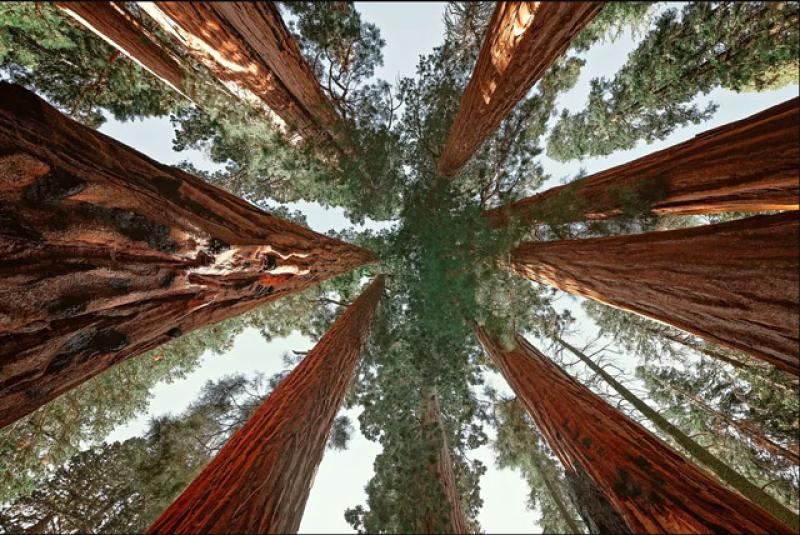
This is a forest, according to advocates for carbon trading.
companies like Microsoft that have made commitments to become carbon "neutral" or carbon "negative" say that they'll draw down at least as many emissions as they release
In my experience as a land development professional, tree planting is just a form of political pandering. I don’t dispute the reality that trees counteract human induced climate change, but the forced planting of them is used as a political brownie point. The degree to which trees are “protected” is absurd in much of the US. A single existing tree can mean the difference between whether a facility gets built or not, if it is of a certain variety or size and in the way. You won’t know until you have spent tens of thousands of dollars on surveys, planners, designers and engineers to prepare a plan for review. If you’re a private developer you may as well forget it, but if you’re the public agency in charge of approving plans by private developers then you’re all good. They will hack down anything to get their own projects built, but will subject the private developers to outrageous conditions to protect one tree and force them to reforest some massive area someplace else in return for removing that one tree. Even foresters laugh about the absurdity of it all, because it is such nakedly political bullshit. If a state can show evidence that ‘they planted’ 20,000 trees last year then they look like they are environmentally responsible. However, ‘they’ did not plant anything, they forced others to plant them in a pay to play game of legalized extortion.