
The Post-Neoliberal Imperative

By: Jennifer M. Harris (Foreign Affairs)

Too long. Too intellectual. Too wishy washy. Too eager to protect sacred cows with smoke screens. Nevertheless, these topics need to be disseminated for scrutiny, whether or not anyone pays attention.
 S E E D E D C O N T E N T

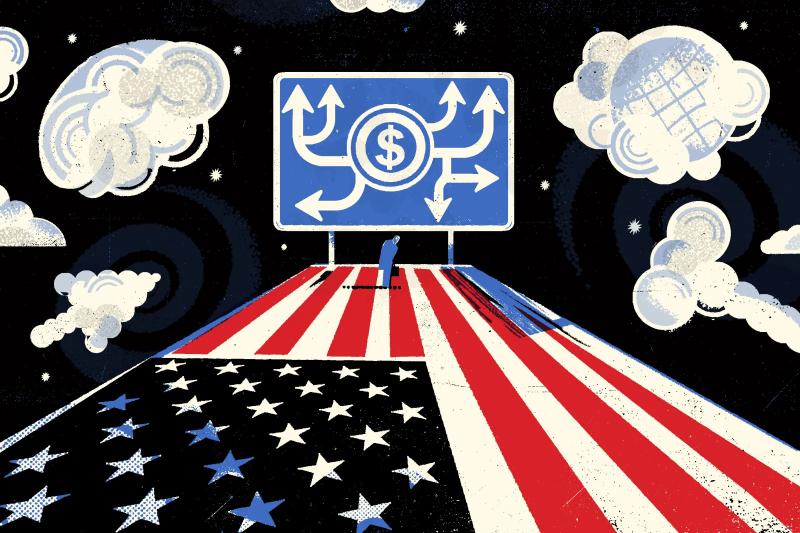
The United States is between scripts. For roughly four decades, the free-market ethos championed by President Ronald Reagan drove economic policy and pervaded American culture. A broad bipartisan consensus assured Americans that the markets knew best: they were not just efficient, but wise and fair. The state, the thinking went, should not encroach on the natural order produced by the churning of free-market forces. And the state did not. Between 1982 and 2015, the market capitalization of all publicly traded companies went from around 35 percent of GDP to roughly 95 percent. The private sector, under what many call "neoliberalism," boomed.
But starting roughly a decade ago, neoliberalism began to lose its hold over American life—and over policymakers in Washington. For many Americans, "globalization" has become a dirty word, a phenomenon blamed for ills as various as inequality, the loss of industrial jobs, the risky ballooning of the financial sector, and the rise of geopolitical adversaries. U.S. leaders have strikingly rejected the assumptions of prior decades. President Donald Trump, in his first term, launched a salvo against neoliberal certainties. He evinced little interest in social spending cuts, imposed tariffs on foes and friends alike, professed sympathy for organized labor, and claimed to protect U.S. companies and workers from foreign competition.
His successor, Joe Biden, broke from the conventional free-market tenets that had framed much of his own political career. He maintained many of Trump's tariffs on China. At home, Biden tried to build a new kind of American industrial policy, one that rested on the premise that the state can and must shape markets. He restored antitrust protections to their pre-Reagan era extent. And he billed himself the "most pro-union president in American history," becoming the first U.S. president to join a union strike when he walked the picket line with workers in Michigan in 2023. By his own account, he "came into office . . . to move [past] trickle-down economics and get rid of it for everyone."
To be sure, not everybody is reading from the same script yet. As much as Kamala Harris, Biden's vice president and anointed successor,embraced many of his economic ideas, her presidential campaign also distanced itself from many of them. She proposed a far lower tax hike on long-term stock market gains for the wealthiest Americans than did Biden and seemed ready to back away from Biden's more forceful antitrust policy.In his second term, Trump has ratcheted up the use of tariffs to a feverish degree, and some of his cabinet appointments suggest deepening sympathy for organized labor, industrial policy, and pre-Reagan antitrust measures. But in other areas, Trump's fiscal policy seems traditionally neoliberal. In its first months, for example, the Republican-controlled Congress looked eager to extend the tax cuts Trump introduced in his first term. Doing so would add between two to four trillion dollars to U.S. debt, depending on spending cuts, another typically neoliberal ambition.
But in the breathless politics of recent years, one can discern the outlines of a new brand of democratic capitalism embraced by leaders and thinkers across the political spectrum. Unimaginatively dubbed "post-neoliberalism" by many, it offers an array of ideas and policies geared toward addressing the power imbalances hardwired into markets, regaining some clarity over what markets can and cannot do, and, not least, revisiting whether present economic arrangements are fundamentally good for Americans and for American society.
Post-neoliberalism's proponents argue that markets tend to concentrate wealth and create power asymmetries. These imbalances create problems for individuals and for an economy as a whole, so it is government's job to correct them. Otherwise, these imbalances can thwart competition, and before long, capitalism slides into corporatism, the domination of the economy by a handful of powerful groups. States have to manage the economy and ensure that imbalances don't affect its proper functioning. Moreover, markets are not ends unto themselves, post-neoliberals say, but tools for societies to pursue worthy national aims.
This post-neoliberal script has adherents on both sides of the political aisle. That makes it different from past pendulum swings. Neoliberalism, and Keynesianism before it, were largely championed by one party in response to the practical challenges of their day. Franklin Roosevelt, a Democrat, ushered in Keynesianism, with its emphasis on state intervention to shore up aggregate demand, to solve the Great Depression and mobilize the country for war. The next Republican to enter the White House, Dwight Eisenhower, did not dramatically roll back Keynesian policies. Decades later, Reagan, a Republican, offered neoliberalism to salve the stagflation of the 1970s. The next Democrat to become president, Bill Clinton, won election in 1992 in part by stressing his adherence to Reagan's free-market dictums. In both cases, a set of ideas became so dominant that the opposing party eventually acceded to them as a matter of political necessity.
The emerging script, however, does not seem to be following this historical pattern. Parallel realignments on both the left and the right suggest the rise of what the New York Times journalist David Leonhardt has called "a new centrism" that recognizes "that neoliberalism failed to deliver." This new centrism unites the Democratic Senator Chris Murphy in Connecticut (a state heavily reliant on the financial sector) and the Democratic Congressman Ro Khanna in Silicon Valley with lawmakers from more purple Congressional districts—upstate New York's Pat Ryan and Pennsylvania's Chris Deluzio routinely issue calls to, in Deluzio's words, "break free from the wrong-for-decades zombie horde of neoliberal economists." Republican Senators such as Josh Hawley and Bernie Moreno claim to support labor and express wariness of free trade and concentrations of wealth. "The economic system of the last 30 years, it's nothing sacred," Hawley has said. "It's not inevitable. It was a choice. And we have it in our power to choose differently now and for the better."
Public opinion surveys consistently bear out the popularity of many post-neoliberal positions, including on industrial policy, unions, and stronger antimonopoly and consumer protections. The economics profession itself is changing, too. The work of several recipients of recent Nobel Prizes for Economics, including last year's winners, focuses on how political power and market power shape macroeconomic outcomes.
The measure of any economic philosophy, post-neoliberalism included, lies in how well it addresses the major problems of the day. And across the gamut of these problems—the return of a peer adversary in China; the need for fairer, faster economic growth; flagging faith in democracy itself; and the urgency of a politically plausible route to decarbonizing—the still emerging post-neoliberal vision fares better than its predecessor. Reverting to the neoliberalism that helped create these problems is not an option. Moments of transition, however, are dangerous. Just as it was hardly clear that Keynesianism would win out over darker, more domineering alternatives in Europe, there are many possible versions of post-neoliberalism that could take hold, not all of them good. Much depends on how societies shape what comes after neoliberalism and how they navigate the turbulence along the way.
BALANCE AND BUILD
At any given time, societies dwell within intellectual constraints. These paradigms determine understandings of how economies function and the values they should serve, and they help define what governments should and should not do. The power of these ideas rests in how they become so taken for granted that they persist for long periods without challenge. Beliefs such as "the king is divine," for instance, ordered every aspect of political and economic life in many parts of the world for centuries.
These narratives are rarely right or wrong in a normative sense. They arise because they help solve pressing contemporaneous problems. As the problems evolve, however, these governing philosophies become less useful, making way for the next script. In many parts of the world, the radical belief in popular sovereignty undid the hold of the notion of the divine right of kings, just as expanding commerce created a wealthy merchant class eager for greater political say. In the nineteenth century, as the United States grappled with the Industrial Revolution and the imperatives of westward expansion, it relinquished mercantilism for the broad permission structure of laissez-faire capitalism to keep pace with galloping technological progress and to settle the country's vast interior. That economic philosophy worked well enough until it didn't; the Great Depression and the mobilization for World War II required different ideas, an opening that Keynesianism filled for another three decades.
By the late 1970s, society again had new problems, including social unrest, energy shocks, and stagflation, which ushered in an embrace of free-market neoliberalism. Neoliberalism can be broadly defined as a deep confidence in the capacity of markets to allocate capital and a corresponding skepticism of government's ability to structure economies, with a tendency to favor deregulation, free trade, and unfettered movement of capital across borders. It spread across the West and, at least in the United States,performed well for a time—growth picked up, inflation came down. But eventually, neoliberal ideas, too, ran their course, proving unable to solve problems such as lagging growth and accelerating climate change, and creating and exacerbating others. From 1980 to the early 2020s, inequality in the United States soared, with the top one-thousandth of the population doubling its share of overall wealth, to around 14 percent. (The top one percent now holds roughly 30 percent of the country's wealth.) Manufacturing shrank from 22 percent to nine percent of nonfarm employment during that period. And these same policies not only hastened the rise of a peer adversary—China—but also left the United States highly dependent on Chinese wares.
The emerging post-neoliberal consensus rests on two ideas, what can be called the imperatives to "balance" and to "build." Those who believe that the U.S. economy needs greater "balance" observe that markets tend to concentrate imbalances in economic power. As asymmetries have grown—between the financial sector and the rest of the economy, between big corporations and their smaller competitors, and between China's state-driven economy and the more market-oriented economies of its trading partners—they have left consumers with fewer options, and workers with lower pay. Most people now have less control over their economic lives. At Amazon fulfillment centers, which employ the majority of the company's 1.5 million workers, vending machines are stocked not just with snacks but with painkillers. The grocery delivery firm Instacart recently unveiled an artificial-intelligence-enabled price-setting service for grocery stores, advertising the ability to set food prices for individual consumers based on their willingness to pay. In aggregate, such imbalances eventually stunt innovation and an economy's growth. Post-neoliberals believe that it is the job of government to address these disparities, not least because they bleed into politics.
Markets are not ends unto themselves.
In policy terms, this quest for balance has led in various directions. It has reenergized support for organized labor and a more aggressive push for antitrust and consumer protection efforts. It has seeded more skepticism of free trade. And it has caused economists and policymakers alike to question the size of the financial sector in the real economy. For instance, across their terms, Trump and Biden both favored closing the carried-interest loophole central to the business models of hedge funds and private equity.
But simply balancing the existing economy isn't enough. Governments need to make their economies more productive to keep growing in the years ahead, figure out ways to decarbonize quickly and at scale, and contend with peer challengers, as the United States must do with China. Leaders cannot merely try to make the economy fairer than it is. They must be willing to build—to use the power and purse of the state to directly increase the supply of certain essentials such as housing, clean energy, and advanced computing. The state can return to the business of building again partly through more affirmative public investment and partly through breaking the chokepoints, including those imposed by government regulation, that make these goods too scarce and costly in the first place. Government should be willing to reclaim its unique role in setting bold societal aims, while also taking seriously the risk of the "million-dollar toilet" problem—so named after a proposed public toilet in San Francisco in 2020 that, thanks to various well-intentioned regulations, was slated to cost $1.7 million and take more than two years to build.
Traditional markets operate well in many areas of the economy, including in the making of furniture, brewing of lattes, and provision of haircuts. But the experience of recent decades suggests that markets can miss some essentials. Only active government policy can properly organize and supplement markets in producing many things the country cannot do without—such as vaccines, a stable manufacturing base, quality housing, childcare, and a decarbonized economy.
Balancing the economy and building more are two sides of a single coin. Neither on its own can fully reckon with the country's urgent to-do list. Simply encouraging production will do little to address how billionaires and $1 trillion revenue companies use political clout to bend economic rules in their favor; addressing those distortions will not speed decarbonization or prepare the United States to compete with a geopolitical peer. A better capitalism must draw from both the impulse to balance and the impulse to build—and be willing to discard the neoliberal nostrums that see such concerted state action as anathema.
THE POST-NEOLIBERAL TURN
Even critics of the post-neoliberal turn in economics concede that some post-neoliberal fiscal policies, such as the Chips and Science Act, boosted national security by aiming to reduce dependence on China for semiconductors and speed decarbonization through the clean energy investments of the Inflation Reduction Act. But when it comes to delivering stronger, more broadly shared growth, skeptics accuse post-neoliberalism of falling "considerably short of its lofty goals," as the Harvard economist Jason Furman wrote in these pages in March. "Inflation, unemployment, interest rates, and government debt were all higher in 2024 than they were in 2019. From 2019 to 2023, inflation-adjusted household income fell, and the poverty rate rose." Such policy missteps, according to Furman, all stem from "a broader unwillingness to contend with tradeoffs."
But looking at the right benchmarks shows that post-neoliberal economic policy—evident to a large degree in the actions of the Biden administration—righted the ship and kept the country afloat and sailing at a reasonable clip. Unemployment in 2022 and 2023 was marginally lowerthan in 2019, for example—no small feat given the COVID-19 pandemic that had transpired in the years between—and unemployment ticked up only in 2024, largely because of higher labor force participation. Inflation-adjusted household income by 2023 was only barely below 2019 levels. (Household income for 2024 is not yet available.) By the first half of 2024, inflation-adjusted wage growth outpaced the same period in 2019.
Perhaps the strongest indictment leveled at the Biden administration is that its COVID stabilization package, known as the American Rescue Plan, was too large. Furman points to various output models to show that a much smaller package could have stabilized the economy. But those same models significantly underestimated the need for stimulus in the wake of the 2008 financial crisis. The Biden administration insisted that it would not make the mistake the Obama administration had by spending too modestly and that it regarded the harms of overshooting as preferable to the damage of undershooting. It was as clearly stated a tradeoff as one could conjure.
It proved a good trade. Yes, overshooting contributed to inflation—but not much. Most estimates have found that all the demand-side policies made by Biden, Trump, and the Federal Reserve during the pandemic raised inflation only by about two percent on average. The Federal Reserve Bank of San Francisco, for example, determined that Biden's rescue package contributed just 0.6 percentage points to inflation across 2021 and 2022, the recent years of high inflation, which peaked at around seven percent (using the Federal Reserve's preferred measure of year-over-year personal consumption expenditures inflation). Inflation was overwhelmingly caused by supply-side shocks that were out of the administration's control. In the meantime, the United States returned to pre-pandemic levels of growth faster than other rich countries.
It also gained a strong labor market. From spring 2022 to 2024, the country enjoyed its longest stretch of unemployment rates below four percent in over 50 years. Employment of people between the ages of 25 and 54—known as "prime-age employment," a better metric of labor market strength than unemployment since it incorporates the labor force participation rate—was higher under Biden than under Trump. For the architects of these Biden-era policies, including me, this was no small point. Drawing people into the labor market was seen as crucial to overcoming the sluggish aggregate demand and productivity of the years before COVID.
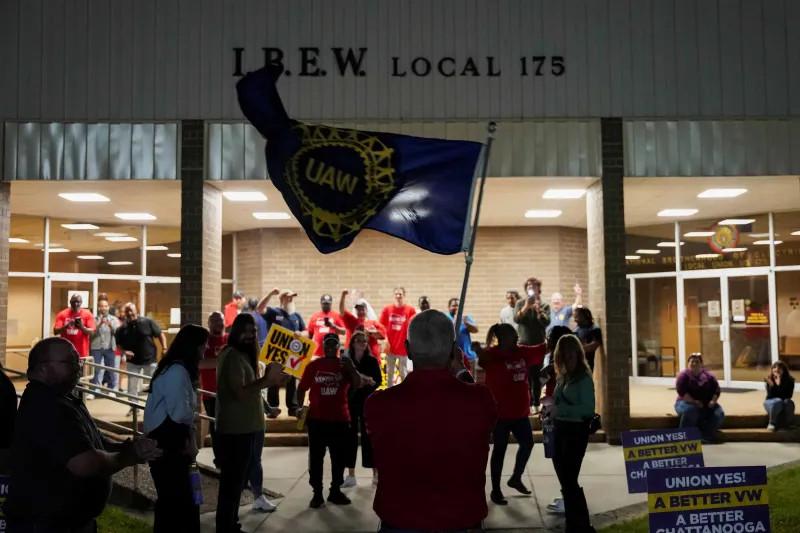
Newly unionized workers at Volkswagen’s assembly plant in Chattanooga, Tennessee, April 2024 Seth Herald / Reuters
In the end, Biden's macroeconomic experiment helped the United States outpace all other G-7 nations in GDP growth, as well as pre-COVID projections. Inflation-adjusted wages went up and rose most for low-wage earners. According to research by the economists David Autor, Arindrajit Dube, and Annie McGrew, wages at the bottom rose so much that wage inequality shrank, undoing one-third of its rise since 1980. The past five years' economic track record has been far more good than bad.
Furman is quite right, however, to caution policymakers against reverting to conventional approaches and to call for a "renewal of economic policy thinking." U.S. macroeconomic policy must now shift to more aggressively tackling high prices. Here again, the task of keeping prices down is suited to post-neoliberal policies.
Not all kinds of inflation are the same. It is worth recovering the monetary policy tradition of distinguishing between supply-side and demand-side drivers of inflation. This distinction was standard practice among academics and Federal Reserve policymakers before the neoliberal economist Milton Friedman's insistence that "inflation is always and everywhere a monetary phenomenon." In Friedman's view, the source of inflation did not matter. All that was needed to address it was to constrict the money supply by raising interest rates.
Economic policymakers should instead isolate the causes of inflation and deal with them accordingly. Global inflation since 2021 has come primarily from supply-side inflationary forces—pandemic-induced supply chain bottlenecks, climate change-induced crop failures, transit routes blocked by geopolitical upheaval, and shortages of energy and housing. If anything, the world is likely in for more supply-side shocks. The standard method of dealing with inflation—raising interest rates—is at best irrelevant and in many cases actively counterproductive. Instead, governments should address root causes: they should build more buffer stocks to get ahead of crop failures, find ways to keep housing and energy costs from spiraling out of control, and tax companies' windfall profits to curb price gouging during emergencies.
The post-neoliberal economic experiments of the past few years in the United States yielded the strongest GDP and productivity growth of any G-7 country, the strongest labor market in decades, and striking declines in inequality. This is good news, not least because the pressing tasks to come—notably tackling the ballooning costs of essentials such as health care, contending with supply-side inflation, and maximizing the net benefits of new technologies such as artificial intelligence—all require more post-neoliberal policy, not less.
NO FREE LUNCH
Nowhere is the break with neoliberalism clearer, or more bipartisan, than in foreign economic policy. China's trade surplus with the rest of the world reached nearly $1 trillion in 2024. This fact helps explain the strong bipartisan consensus, now entering its second decade, that unfettered free trade is not an obvious good. Both parties largely agree on the need to strengthen the country's economic and technological competitiveness with respect to China. And they worked together in laying the conceptual tracksto rid the United States of dependence on China for economically and strategically vital inputs, such as ingredients for many generic pharmaceuticals and rare-earth minerals for smartphones, and imposing many rounds of tariffs, export controls, and safeguards against economic coercion.
But significant fissures remain. Thus far, the second Trump administration has not clarified what vision its tsunami of tariffs on China is meant to advance, or how, if at all, allies fit in. In the view of the Biden administration, the challenges the United States faces—lagging growth, the hollowing out of its industrial base, inequality, damage to democracy, competition with China, and the need to decarbonize to combat climate change—are hardly unique to the United States. U.S. policymakers must construct answers that work for the United States, but not the United States alone.
"The new Washington consensus," as it became known—the Biden administration's offer to its friends, articulated over two major addresses in 2023 and 2024 by National Security Adviser Jake Sullivan—amounted to a major reorientation of U.S. foreign policy. The United States' investments in physical, technology, and energy infrastructure, Sullivan insisted, would create positive global spillovers. But Washington would still need its friends to join in, adopting their own versions of technology- and decarbonization-minded industrial policies.
In exchange, the United States would reconstitute its foreign policy to better help its partners. U.S. policymakers understood that many of their allies are not nearly as wealthy and able to match the kinds of investments the Biden administration was making in industrial policy. But it could better support friends by supplying them with more nimble financing—be it through expanded World Bank lending, a more muscular U.S. International Development Finance Corporation (which finances new infrastructure projects around the world), a new U.S. sovereign wealth fund, or a new clean energy financing authority. This fiscal firepower would be developed alongside a new generation of multilateral arrangements, including a critical minerals club; a trade pact for clean steel and aluminum; a G-7 clean infrastructure financing entity to compete with Chinese overseas investments in infrastructure; and a common carbon border adjustment.
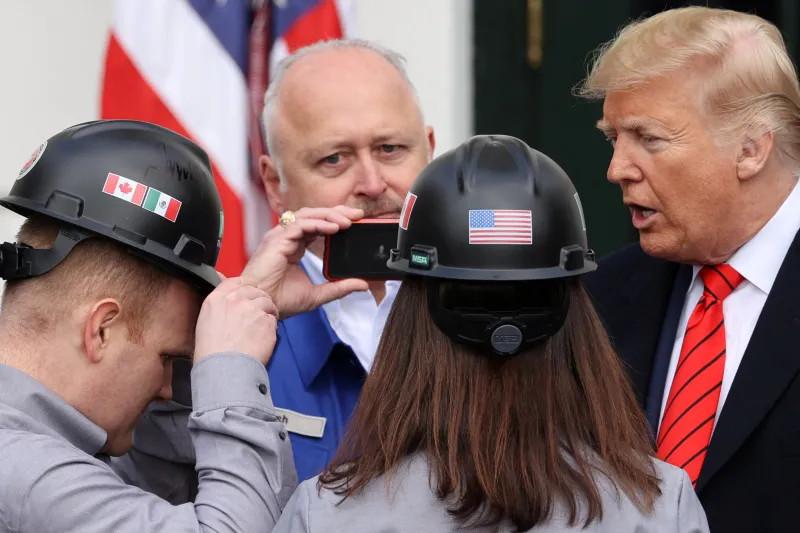
Trump at the signing of the U.S.-Mexico-Canada Agreement, Washington, D.C., January 2020 Jonathan Ernst / Reuters
A new global minimum tax would also generate badly needed revenue. More important, it would mark the world's first meaningful collective step toward taming financial globalization, which has freed capital to hopscotch across the world in a way that workers cannot. As capital grew light on its feet, companies squeezed labor by threatening to move abroad. After a few decades of gawking at the problem, Washington, under the Biden administration, rallied 139 countries to do something. The resulting agreement, which set a 15 percent minimum tax on multinational corporations, has been implemented by roughly 90 countries. It failed to gain Senator Joe Manchin's support during negotiations about the Inflation Reduction Act, however, preventing the United States from joining the pact—a position Trump has signaled he will maintain.
Alongside the global minimum tax, the Biden administration showed other signs of treating globalization not as an unalterable force of nature but as something shaped by policy choices. When autoworkers were organizing at Volkswagen and Mercedes plants in Tennessee and Alabama in June 2024, the White House warned Germany that German companies should not interfere with unionization votes in the United States. It brought new labor cases under the terms of the United States' trade pact with Mexico and Canada, alleging harms to Mexican workers in sectors such as telecommunications, steel, and food production. Although small and halting, these steps showed that governments can reassert democratic control over the forces of globalization, but only by cooperating with others.
Reorienting U.S. foreign policy in this way is a long-term project. Prospects for progress over the next four years are dim, but the Trump administration might sustain momentum on at least some fronts. In his first term, Trump created the Development Finance Corporation. Through a mix of reforms and greater funding, he is now working to vastly increase its lending muscle. He is also considering standing up a sovereign wealth fund. Both entities are likely to invest in several areas of bipartisan interest—such as in enhancements to electric grids, in nuclear and geothermal power, and in critical minerals and battery supply chains. For all the chaos and strife of the tariffs in the opening act of his second term, Trump's U.S.-Canada-Mexico trade deal, which went into effect in 2020, and his negotiations with China during his first term indicate some ability not just to pick economic fights but to try to settle them.
The biggest drag on post-neoliberalism is the failure of ambition and imagination of its architects, including me. In 1944, a group of countries led by the United States established the Bretton Woods system, remaking in a single summer the entire global economic and financial architecture. Apart from developing the global minimum tax with the Organization for Economic Cooperation and Development, the Biden administration opted against mounting confabs of the scale and significance of Bretton Woods. When the administration did make efforts toward anew generation of multilateral arrangements, such as the Indo-Pacific Economic Framework and its Latin American counterpart, Americas Partnership for Economic Prosperity, these were insufficient—not because they did not involve tariff reduction, as many of their critics argued, but because their obligations were mostly not binding and their incentive structures were weak . In other cases, such as the global minimum tax and the U.S.-EU Global Arrangement on Clean Steel and Aluminum, the problem was not so much insufficient ambition in the design, but that Washington was ultimately unwilling to jeopardize broader transatlantic relations to pressure Europe to sign on within the available political window. It turns out there are no free lunches in post-neoliberal economics, either. Real solutions, although cost-effective, still cost something.
ALL THAT MONEY CAN'T BUY
Perhaps the most important question about what should follow neoliberalism is one that societies have largely forgotten how to ask. Four decades of neoliberalism have so thoroughly taught policymakers that the role of government should be limited that public debates about the economy are now constricted to discussions about growth and distribution—the overall size and proportionate slicing of the pie. But what of its contents? Governments should also concern themselves with encouraging the economic arrangements that best enable democratic self-governance and serve to buttress civic life.
In this sense, Biden's brand of post-neoliberalism fed the body but not the soul. It focused on material economic questions. It also warned of the dangers to democracy. But for the most part, these were separate endeavors. It never posed the question of what the good life is or sought to guarantee the economic necessities of shared self-rule—the collective participation of citizens in shaping their economic and political institutions rather than having those structures determined by markets or technocratic elites.
To ask this question is to dust off an age-old debate in American political thought—between liberalism (confusingly named since it draws adherents from across the political spectrum), which defines freedom more in individual terms as the capacity to choose one's own ends, and republicanism (distinct from the American political party), which suggests that freedom depends on sharing in self-government. The two are not inherently in tension; they have coexisted in different proportions throughout the country's history. In the mid-twentieth century, however, liberalism began to predominate to such an extent that republicanism, and its concern with the civic consequences of economic choices, largely faded from view.
Fundamentalists rush in where liberals fear to tread.
The arrival of neoliberalism and its "markets know best" ethos proved a handy companion for liberalism's discomfort with adjudicating debates over the public good. It was much easier to outsource them to the market. Charles Schultze, who chaired the Council of Economic Advisors under President Jimmy Carter, celebrated this turn to the market as a source of comity: "Democratic majoritarian policies necessarily imply some minority who disapprove of each particular decision," he wrote in 1977. By contrast, "relationships in the market are a form of unanimous-consent arrangement," where "individuals can act voluntarily on the basis of mutual advantage."
But now, over 40 years later, the cost of leaving these questions to markets is clear. Americans have never had more choice—and they are miserable. They suffer from loneliness, addiction to opioids and to technology, and an acute vulnerability to conspiracy theories. The longing for what the philosopher Michael Sandel calls a "public life of larger meaning" hasn't gone away, and that desire can find undesirable expressions in authoritarian populism or other forms of extremism. Fundamentalists rush in, Sandel warns, where liberals fear to tread.
Liberalism and republicanism, then, are perhaps more codependents than competitors. Liberalism without republicanism fails to deliver on its aims of bolstering individual choice. It leaves larger questions of meaning unanswered and allows authoritarians to propose their own solutions. It neglects the extent to which people want a say in shaping the economic forces over their lives. In short, bringing liberalism and republicanism back into closer balance may be the key to saving liberalism.
Some American politicians are attempting such a revival. In 2023, Murphy, the Democratic senator, called on his fellow leaders to return to square one: "What makes a good life, filled with purpose, meaning, and happiness? And what does government need to do—and not do—so that more people have access to this life?" Conservatives, such as Hawley, Senator Tom Cotton, and Secretary of State Marco Rubio, have criticized surrendering civic reasoning to markets and called for a capitalism that enlists markets to serve families, not the other way around.
Just how this spirit becomes flesh isn't straightforward. Still, there are a few broad aims to consider, starting with giving people more say in the economic forces governing their lives. Legislation that would curb the power of both algorithmic pricing and addictive social media now sits before Congress. That would be a fine place to start.
INEVITABLE AND YET UNCERTAIN
One of the hallmarks of economic scripts, whether Keynesianism, neoliberalism, or the dawning post-neoliberalism, is that they tend to spread across the ideological spectrum such that they become synonymous with society's understanding of capitalism overall. In truth, capitalism leaves room for near-limitless permutations of forms of government action. Neoliberalism has no greater claim to the capitalist mantle than Keynesianism had before it or that neoliberalism's successor will have. Even so, what supplants neoliberalism could well prove darker than what it replaced.
But there is no going back, not to the heyday of neoliberalism in the 1980s and 1990s or to some sepia-tinted vision of Roosevelt's Keynesianism. The best outcomes for the United States presume that Americans focus not on denying the coming economic dispensation but on shaping it.

Tags
Who is online
517 visitors
Sadly, the purpose for the article may have only been to reframe the political legacy of Joe Biden. Attempting to claim that Biden killed neoliberalism doesn't change the fact, neoliberalism is dead.
The voters are responsible for demanding a post-neoliberal change in direction.