
Alarming bells ringing: Scientists warn Atlantic cycle may flip cool by 2025, triggering global weather shocks

By: Business Today
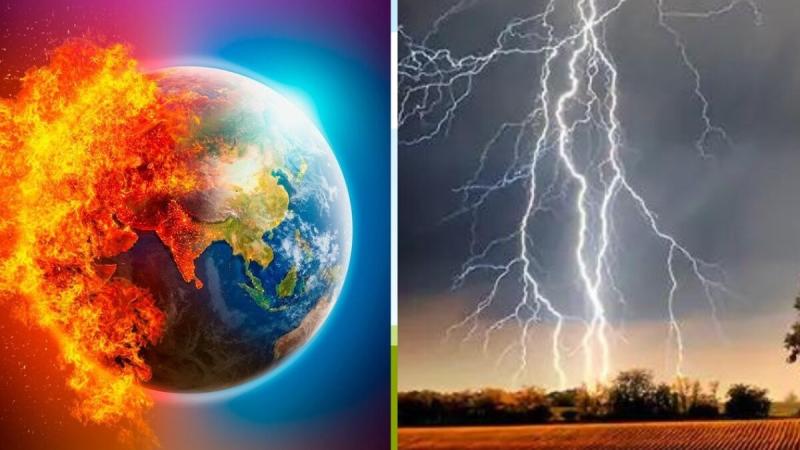


The science approved opportunities for green-washing may be coming to an end. Is this why Greta Thunberg is looking for a new gig?
 S E E D E D C O N T E N T
It doesn’t announce itself with thunderclaps or raging winds. It doesn’t trend on social media or get name-dropped in climate summits. But for decades, it has quietly choreographed the rhythm of storms, droughts, and rainfall across continents.
The Atlantic Multidecadal Oscillation — AMO, for short — is a vast oceanic cycle most people have never heard of. But if current forecasts are right, that could change as soon as next year.
Researchers are warning: the AMO may be about to flip.
And when it does, the consequences could ripple through agriculture, disaster response, and entire economies — starting in 2025.
An ocean's heartbeat
Unlike El Nino, which stirs headlines every few years, the AMO moves at a glacial pace, shifting phases roughly every 60 to 80 years. But its impact is anything but slow.
When the AMO turns warm, Atlantic waters heat up, hurricanes strengthen, and weather patterns intensify. When it turns cool, those patterns reset. Storms ease off, but rainfall redistributes — some regions get wetter, others, parched.
The AMO has been in a warm phase since the late 1990s, overlapping with some of the most destructive hurricane seasons on record. Katrina. Harvey. Irma. All emerged during this period of heightened ocean heat.
But now, subtle dips in sea surface temperatures are catching the eyes of scientists. Climate models — powered by supercomputers at NOAA and the UK Met Office — are aligning on a new prediction: there's a strong chance the AMO could turn cool by 2025.
History's overlooked signals
This isn't the first time the AMO has reshaped the world. Back in the 1960s, when the cycle last cooled, the African Sahel plunged into a prolonged drought. The fallout was devastating — crop failures, famine, mass migration. The dry spell stretched into the 1980s, displacing millions.
Then came the warming flip of the '90s. Suddenly, hurricanes surged. The 2000s brought storms like Katrina and Rita. While climate change supercharged their impact, the AMO set the stage.
Scientists from NOAA and across academia have pored over decades of climate records, drawing clear lines between the AMO's rhythm and regional climate shifts.
Their warning today? This cycle isn't theoretical. It's due.
A global reshuffling
If the AMO turns cool, the headlines could shift. Fewer hurricanes might sound like good news for Gulf Coast communities. Insurance premiums might dip. Emergency funds might stretch further.
But the changes won't stop there.
Models suggest Europe and parts of the US might get wetter. The Midwest, for instance, could see more rain during key planting seasons — good for crops, if the fields don't flood. Meanwhile, the Amazon and West Africa may dry out again, recalling the crises of past decades.
A 2023 study published in Nature Climate Change puts the likelihood of a cool phase by 2025 at 70%. That's not just a forecast — it's a wake-up call.
Cost of looking away
We've seen what happens when we ignore slow-moving threats. The Dust Bowl. The Sahel famine. Hurricanes devastating unprepared cities.
What makes the AMO unique is its scale and stealth. It doesn't show up in weather apps. It doesn't get the attention of melting glaciers or record heat waves. But it works in the background, rearranging the climate chessboard.
"We have to stop thinking of it as background noise," one NOAA scientist noted. "It's more like the bassline in a song — you don't always notice it, but it sets the tone for everything else."
The AMO's next note may already be playing. Whether we listen — or wait to feel the beat drop — is up to us.

Tags
Who is online


273 visitors
Ocean cycles. Solar cycles. Natural cycles reasserting themselves. What's an environmental activist to do?
In a pinch the activists can talk about chemtrails and flat earths to prove they're really, really smart.
Chem trailers & flat earthers are idiots. They only prove their own ignorance.
Low hanging nuts?
More like fallen to the ground and rotting.
What is between the legs of the Dems favorite female athlete for 1000? Alex
Read the scientific literature instead, even the 10+ year old papers are better than this when dealing with AMO.
Wait, you mean the environmental activists are uninformed? They haven't read the scientific literature? The environmental activists don't know what they have been talking about?
Greta Thunberg did demonstrate a refusal to become informed, after all. Some truths are just too inconvenient for activists.
Many of them yes, as are environmental denialists. The literature either way is too vast for any activist of any shade if they are not fluent in the terminologies used.
As to Ms. Thunberg, she's too young to be tarred and feathered as a monster, she is an idealist, a stage of intellectual development the vast majority humans goes through.
At 22 she is the same age as Thomas Fugate ...
There are other slow moving periodic atmospheric/oceanic cycles.
julian madden oscillation - Search
Rossby wave - Wikipedia
Kelvin wave - Wikipedia
This is a little late, isn't it? After all, the next Ice Age was supposed to hit back in the 1970's.