
This tax testifies to the utter corruption of conservative thought

By: Matt Bai (The Washington Post)

TEA baggers shouldn't be allowed to gaslight their way out of their obligations and responsibilities this time. TEA baggers gotta lie about everything so they appear to be the victim and shift the burden onto everyone else. This the TEA Party version of DEI.
The EV tax is not like the Federal gas tax and it's not a property tax. Those an outright bogus lie out of the the TEA bagger playbook. The Federal government really does impose similar taxes.
The TEA Party is selling their mother's testicles again. Don't buy 'em this time.
 S E E D E D C O N T E N T

There’s so much wrong with the sprawling budget bill that the House just passed and the Senate is debating — I refuse to call it by its cringey name — that it seems myopic to fixate on a provision that probably wouldn’t make anyone’s top 10.
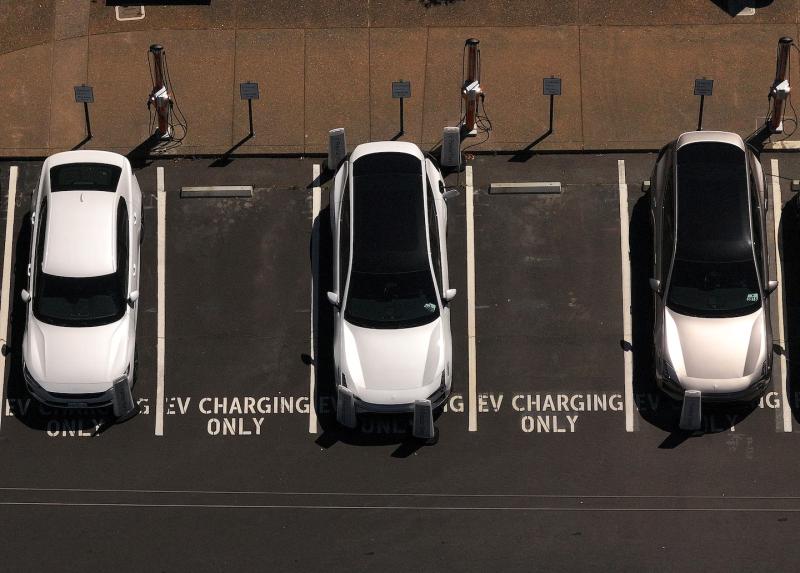
And yet I find myself stuck on this new tax Congress would impose on electric cars. Not because of the policy itself, but because the way it’s being enacted testifies to the utter corruption of conservative thought.
Technically speaking, the proposed $250 annual levy on EVs (and $100 annually for owners of hybrids) isn’t a tax — it’s a fee. Congressional Republicans say the policy is analogous to the federal gas tax that you pay at the pump, which is used for highway maintenance. There’s no reason, they argue, that electric car owners, who add at least as much wear to the roads, shouldn’t shoulder some portion of the cost.
Which might be a reasonable argument, if only they meant it. In reality, this is a punitive tax consistent with President Donald Trump’s general fear of electric cars. (He bought a Tesla when he was still enamored with Elon Musk, but now he’s talking about selling it, like half my friends.) Instead of incentivizing the changeover to EVs, which American car companies have endorsed and which any rational policy would support, Republicans aim to roll it back.
But that’s fine — my issue here really has nothing to do with whether EV owners should pay more to use the roads. It’s entirely about how they’re being asked to pay.
Think about this: Congress is proposing that the federal government slap a tax on something you have already purchased, whether you drive it or not, just because you own it. It’s no different from saying you now have to start paying an annual tax on that second refrigerator in your basement or the computer in your backpack.
Not a single tax expert I spoke to this week could name another product that the federal government penalizes in this way. When you pay a federal tax at the gas pump, you’re being taxed on a purchase; you know the rules going in. If Congress were levying that same kind of tax on electricity streaming from EV chargers — or if it were limiting its tax only to cars bought in the future — then I’d have no issue with it.
But that’s not the case. Congress proposes to tax all EVs, no matter when they were purchased. Which means that if you bought, say, a Nissan Leaf a couple of years ago, and your monthly car payment is $400, then Congress has arbitrarily decided to raise your annual cost by more than 5 percent. That’s significant.
You may say, “Well, government is always raising fees.” But here’s a critical point: Unlike the state in which you live, Washington has no actual jurisdiction over your car. This isn’t like the fees imposed on aircraft and firearms and radio spectrum — all things for which you have to periodically obtain a federal license, so of course government can amend the terms when you come back for a renewal.
You don’t need any federal registration to own your car. So how does Congress get to suddenly charge you for owning it?
Ironically, the only idea I can think of that’s philosophically consistent with this EV surcharge is the wealth tax proposed by some on the left, which would slap new taxes on all kinds of things that rich people already own, such as stocks and nice jewelry and works of art. You know why it’s only theoretical? Because no Republican in the United States would ever support it (and neither would a lot of Democrats). Opponents see it as a stunning example of federal overreach.
Which leads to my larger point about the collapse of conservative theory. Strictly speaking, is the EV tax constitutional? Yes — although you have to reach back pretty far to justify it. John Brooks, a Fordham University law professor, explained to me that the best precedent is a federal tax on horse-drawn carriages in 1790, which the Supreme Court upheld (along with a bunch of similar taxes on household items, most notably whiskey). As a lawmaker, you always know you’re blazing a trail to the future when you’re relying on laws about carriages.
Legal or not, though, modern conservatives have long disdained this kind of selective taxation. For as long as I can remember (and well before that), Republicans have unified against Washington’s casual use of tax policy to pick winners and punish success. The whole point of intellectual conservatism was that markets ought to sort themselves out, rather than being tipped one way or the other by an imperious Congress. I haven’t always agreed with that ideology, but I did respect the conviction.
Actual conservatism, though, is dead, replaced by cowering, shiftless Trumpism, and this dumb EV tax stands as yet more proof. If you’re looking for a party to check the expansion of federal taxing power into new and previously unimagined terrain, you’ve come to the wrong city.
There will come a time very soon — mark my words on this — when Democrats, armed with the precedent of the EV tax, will turn around and try to impose their own punitive taxes on previously purchased household items they’d like to stamp out, like that gas range in your kitchen. I’m sure that in some quarters of the left, the lightbulb has already clicked on.
Unless that, too, is suddenly taxable.
Tags
Who is online
334 visitors
TEA baggers pose a greater threat to the MAGA movement than DEI Democrats.
I'm not sure I follow the objection.
Are you saying EV owners should be exempt from supporting road maintenance?
Or that the tax should be collected some other way?
Plus because of their weight, EV's do more road damage than their lighter brothers and sisters do. so like Semi's should pay more for road maintenance.
Not to mention the weight's effect on tires. Where are the tree huggers on that?
AI Overview
It's a tax. That's the one and only objection that matters to TEA Party Republicans. Their Grover Norquist purity test is to oppose all taxes (that they might have to pay). It's Reagan's 'government is the problem' mantra taken to a radical extreme.
So you appear to be opposed to the tax and also opposed to the people who oppose taxes.
You'll understand how that seems a contradiction.
Taxes must be increased. There's no way to avoid a default on government debt without tax revenue.
I'm not complaining about the tax. There's nothing wrong with the tax. I'm complaining about the TEA Party. We cannot go back to the TEA Party status quo. And I'm warning that the TEA Party is a greater danger to the MAGA movement than DEI Democrats.
I don't know how to say it more bluntly.
Got it.
One way that has been floated here that has met with great resistance is charging by hub mile, be it annual , semi annual or quarterly.
no matter what, a loss of revenue in fuel taxes used for maint, will be made up, and likely paid for by those the loss was incurred with.
Which seems fair.
They're driving on roads and using heavier vehicles. Roads don't maintain themselves.