
Israel's assumption US would get drawn into Iran war is being put to the test

By: Julian Borger (the Guardian)
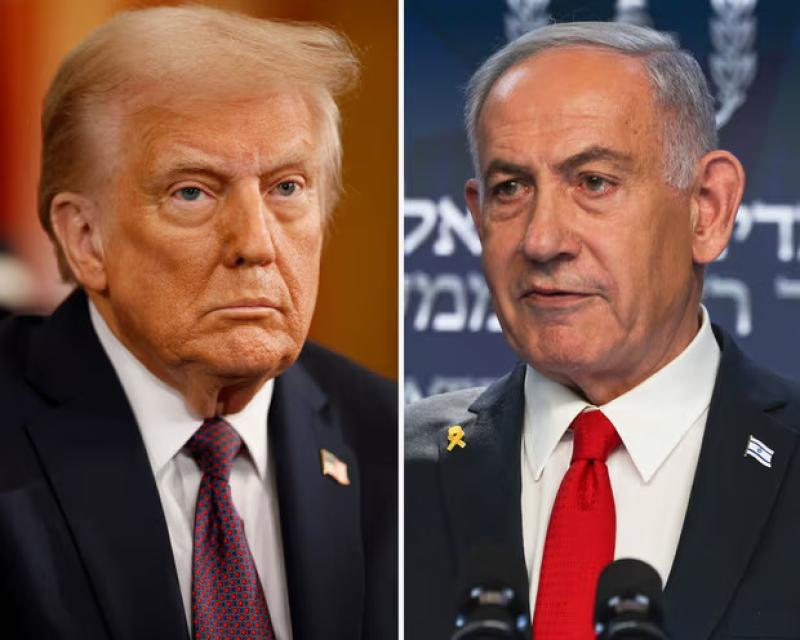


The United States is Iran's lifeline. If the United States enters the fight then Iran no longer has a lifeline and becomes very, very dangerous. If the Iranian government sees no path for survival then they will burn the Middle East.
The US becoming an active combatant will require neighboring Qatar, UAE, and Oman to decide whether to side with Israel or Iran. At present they are mediators taking a neutral position. Forcing them to choose sides disrupts the balance of power in the Persian Gulf. Russia has allied itself to both Israel and Iran and is trying to stay out of the situation by offering to mediate. (Sort of a French approach.) Turkey has been an off and on rival of Iran; a weakened Iran may encourage Turkey to move on Syria and northern Iraq. Underlying all the geopolitical hazards is the possibility of igniting confrontations between Shia and Sunni Muslims.
Western journalists view the world in terms of military might and killing people. The United States has already targeted Houthi threats against shipping in the Gulf of Aden and Red Sea. (Which benefited Israel, too.) The United States could also become involved in keeping the Straits of Hormuz open for shipping. (Which would also benefit Israel.) But at this juncture United States diplomatic efforts are far more important than the US capability to kill tens of thousand of people.
We don't need a ceasefire, we need an end to Iran's nuclear ambitions. Destroying facilities and further isolating Iran won't change those nuclear ambitions. That only creates an incentive to acquire nuclear weapons on the black market. The only way to end this conflict is with a negotiated agreement and stringent enforcement.
 S E E D E D C O N T E N T
Israel's attack on Iran was carried out with Donald Trump's approval, government officials in Israel claim, and it appears to have been unleashed in the expectation - but not certainty - that the US would ultimately get drawn into the war.
That assumption is now being put to the test as the US president weighs a decision on whether to join an assault he has increasingly embraced in his public pronouncements.
Israeli officials have said it would have been unthinkable for prime minister Benjamin Netanyahu to have ordered the attack in the early hours of Friday morning against Trump's wishes, and that there was little ambiguity about the US leader's preferences.
"This president makes it pretty clear what he wants," one of the officials said during a visit to a bomb site near Tel Aviv this week.
In the Israeli version of events, an agreement in principle dates back to a letter Trump sent to Iran's supreme leader, Ayatollah Ali Khamenei, in March, giving Iran 60 days to accept tight constraints on its nuclear programme. The clock started ticking on 12 April, the date of the first round of US-Iranian negotiations in Oman.
Netanyahu seems to have accepted the same 60-day window to hold off on military action and to give diplomacy a chance. He has said that Operation Rising Lion had originally been planned for April. It was postponed and last Thursday marked day 61 on Trump's calendar. That night about 200 Israeli planes took off on their first sorties.
As the deadline approached, the US withdrew non-essential personnel from embassies in the Middle East, but Trump appeared to discourage an Israeli attack, saying it might "blow" the chances for a sixth round of negotiations due on Sunday.
It is unclear whether this was a ruse to put Iran off its guard, as some Israeli officials claimed, or a genuine call for a few more days leeway. If the latter, it was already too late.
Reported Israeli airstrikes on Iran in June 2025
The Israeli attack plan involved precise coordination. Mossad commandos and drones had been pre-positioned, and waiting several days for talks - which Trump was pessimistic about anyway - would have compromised the prospects for the whole operation as well as the safety of Israelis already behind Iranian lines.
The diplomatic option was almost certainly doomed from the start. After some initial wavering immediately after the Israeli attack began, Trump stuck to the inflexible and maximalist position that Iran stop enriching uranium permanently - now one of Israel's primary war aims.
Once the operation had begun, Trump quickly swung his support behind it, noting on his Truth Social platform: "Two months ago I gave Iran a 60-day ultimatum to 'make a deal.' They should have done it! Today is day 61. I told them what to do, but they just couldn't get there. Now they have, perhaps, a second chance!"
The "second chance" seemed to be an option to return to the table and bow to Trump's demands, using the leverage of Israel's military might to produce a diplomatic triumph for the president.
With every passing day of Israeli battlefield success however, Trump has warmed to a military solution, declaring himself on Tuesday to be "not too much in the mood to negotiate", and even claiming ownership of the campaign, announcing: "We now have complete and total control of the Iranian skies."
Iranian missile strikes on Israel in June 2025
Israel is counting on Trump to stake a direct claim to glory and join the operation, now that the risks of failure and downed planes have been minimised.
"The whole operation is premised on the fact that the US will join at some point," an Israeli official told CNN.
"We are waiting for the decision of the president," another senior official told the network.
Israel has yet to attack Iran's most secure enrichment facility, at Fordow, which is built into a mountain with up to 100 metres of rock above it. Only the US Air Force has penetrating bombs of the size that have the best chance of making a dent in such defences, although even with those 13,000kg (30,000lb) munitions success is not guaranteed.
As the war has progressed, so has the clamour in Israel for US involvement, along with uncertainty over whether Netanyahu has a plan B if Trump opts to watch from the sidelines.
"We need to hope that this actually happens, and possibly very soon," the veteran commentator, Ben Caspit, wrote in Ma'ariv newspaper on Wednesday. "Take all the credit, Donald. The important thing is that you ultimately decide to join."
Writing in Yedioth Ahronoth, Shimon Shiffer argued: "Without the involvement of the United States, the war with Iran will not reach a decisive conclusion that justifies our assault on the ayatollahs' regime and the heavy price that Israeli citizens are paying with their lives and property.
"Mr President, come save the world," Shiffer wrote. "Come save us from Iran. Come save us from ourselves."

Tags
Who is online
334 visitors
The United States is Iran's only life line.