
Europeans make bid for diplomacy as Trump delays decision on bombing Iran

By: Ellen Francis (The Washington Post)


Time for Europe to rush in and snatch defeat from the jaws of victory. European diplomacy looks an awful lot like the Democratic Party searching for relevance.
 S E E D E D C O N T E N T
GENEVA — Key European foreign ministers will hold talks with their Iranian counterpart in Geneva on Friday in a bid to find an off-ramp from the conflict between Israel and Iran before President Donald Trump decides whether the United States will bomb Iranian nuclear sites.
European leaders have been thrown off balance by Trump, who denied U.S. involvement in Israel’s attack only to warn days later that he may join the Israeli military campaign, which has spiraled into a deadly tit-for-tat with mounting civilian casualties and a risk of inflaming the region.
Trump had promised to reach a deal with Iran over its nuclear program and lambasted the era of U.S. interventions in the Middle East, but he has since demanded Iran’s “unconditional surrender” and on Thursday said he now would decide within two weeks whether to join the conflict.
Friday’s meeting in Geneva — involving France, Britain, Germany and the European Union, which all had a central role in negotiating the 2015 Iran nuclear agreement along with Russia, China and the United States — could pave the way for a more prominent mediation role for European officials who have been sidelined under Trump.
America’s traditional European partners are deeply wary of getting drawn in to a widening conflict and have been working the phones in a bid to contain the rhetoric and carve out a diplomatic path.
European officials cast the latest diplomacy as an 11th-hour scramble to influence the crisis: to extract greater concessions from Iran, whose position they believe has now been weakened, and to find an off-ramp from Trump’s threats of a bombing campaign and suggestions of regime change.
The Europeans acknowledge it is a tall order on both fronts. It is far from clear that Trump will heed — or is even listening to — their calls for restraint. And Iran, which says it will not negotiate until there is a ceasefire, may not be willing to accept any ultimatum, officials concede.
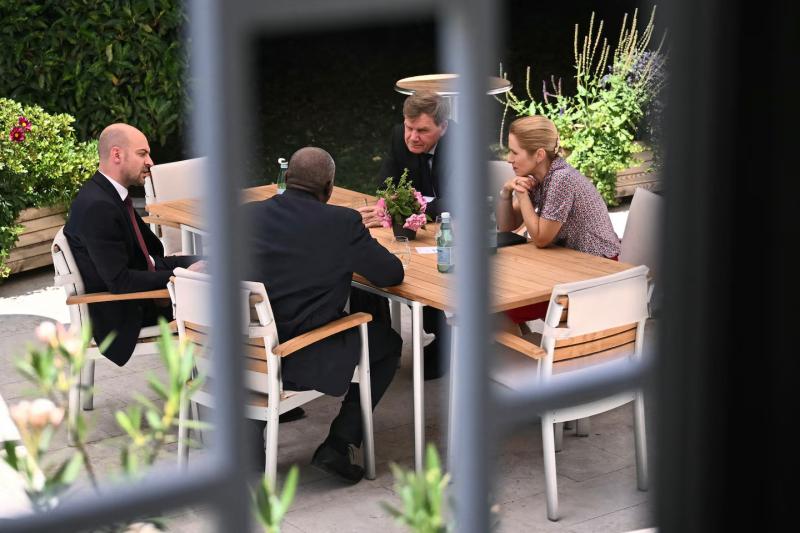
At about midday Friday, the Europeans — France’s foreign minister Jean-Noel Barrot, Britain’s Foreign Secretary David Lammy, Germany’s Foreign Minister Johann Wadephul and the European Union’s foreign policy chief, Kaja Kallas — gathered at the German consulate in Geneva where they conferred around a table on an outdoor terrace. They planned to meet later Friday afternoon with Iranian Foreign Minister Abbas Araghchi,
But after Trump on Thursday seemed to create a two-week deadline for his own decision on striking Iran, his wavering gave the European bid for diplomacy a small opening, with White House officials watching the Geneva talks for a signals of Tehran’s openness to a deal.
The talks were being coordinated with Washington, four officials familiar with the planning said, speaking on the condition of anonymity to discuss sensitive diplomacy.
“A window now exists within the next two weeks to achieve a diplomatic solution,” British Foreign Secretary David Lammy said late Thursday after a trip to Washington, where he met with Secretary of State Marco Rubio.
At his next stop — Geneva for the Iran meeting — Lammy “will be clear on the need for a diplomatic solution to resolve the nuclear issue for the long term,” his office said in a statement.
Araghchi, in a TV interview Thursday, took a tough line on Trump, saying that he would meet with the three European countries’ ministers but that Tehran would not negotiate “with America as a partner in this crime.”
“We have clearly said that there is no room for dialogue until the aggression stops,” Araghchi said. “If others request to talk with us, we have no problem.”
The Europeans, who join Washington in saying that Iran must not obtain a nuclear weapon, are expected to try to persuade Tehran to give guarantees that its nuclear activities would be restricted to civilian purposes, the officials said. Iran previously pledged never to acquire nuclear weapons under the 2015 deal that Trump abrogated in 2018.
One official said the talks would broach the U.S. demand that any deal would have to result in zero enrichment of uranium by Iran. Tehran has rejected this, maintaining that under international treaties, it has the right to enrich nuclear fuel for civilian use.
The official said the meeting was as an effort to avert U.S. involvement that could escalate the conflict, and to gauge whether the Iranians’ stance may be shifting under the pressure of nightly Israeli attacks and heavy losses.
A second official said the Europeans will seek to broker a “take it or leave it deal” with Iran, in exchange for “regime survival.”
Previous talks contemplated allowing Iran to continue a limited amount of uranium enrichment for civilian energy purposes, but the requirement now would be for “zero enrichment,” the official said.
French Foreign Minister Jean-Noël Barrot said Thursday that France was ready “to resume negotiations on the condition that they can lead to a substantial and durable rollback of Iran’s nuclear program, of its ballistic missile program and its regional destabilization activities.” Barrot said Iranian authorities have expressed a clear “will to resume talks, including with the Americans on condition that a ceasefire can be reached.”
France, Germany, Britain and the European Union were central to negotiations that resulted in the landmark 2015 deal to contain Iran’s nuclear activities in exchange for sanctions relief under the Obama administration. After Trump abandoned the deal and reimposed U.S. sanctions, Iran responded by gradually increasing the quality and quantity of its enriched-uranium production.
The Trump administration mostly shut out the Europeans when he came into office again this year and instead kick-started unilateral negotiations with Iran, which included promises of peace until the Israeli strikes began last week.
French President Emmanuel Macron said at a Group of Seven meeting early this week that Trump had indicated he would seek discussions to stop the hostilities. Soon after leaving the G-7, Trump denied that he was working on a “ceasefire” and warned Iranians to “immediately evacuate Tehran” — the nation’s capital with 10 million residents — putting the world on edge.
Tehran has warned it would retaliate against a U.S. attack by hitting American bases in the region.
Kallas, the E.U. foreign policy chief, has warned that deeper U.S. involvement in the conflict would “definitely drag the region into a broader conflict, and this is in nobody’s interest.”
Kallas told reporters this week that “the European Union can play and will play its part in reaching a diplomatic solution,” noting that the bloc was in contact with Iranian and Israeli counterparts. “I will spare no efforts in this respect.”
The European calls for de-escalation also do not appear to be moving Israel, which launched its strikes despite Trump’s stated opposition in what appeared to be an effort to derail the U.S. negotiations with Iran.
Though the Europeans all urge de-escalation and agree on restricting Iran’s nuclear program, they are not speaking with a single voice. German Chancellor Friedrich Merz this week praised the Israeli attacks and described them as “the dirty work Israel is doing for all of us.” Macron, meanwhile, warned against “regime change because nobody can say what would come after that” and asked whether anyone had learned from the 2003 U.S. invasion of Iraq.
Claire Parker in Cairo and Natalie Allison in Washington contributed to this report.

Tags
Who is online
294 visitors
Pay close attention. Trump has been specifically targeting Iran's nuclear program. Trump has not been calling for regime change. Trump has been threatening an overwhelming military response only if Iran retaliates by attacking US troops, embassies, and business assets in the region. Trump has threatened a military response if Iran attacks shipping in the Persian Gulf, Straits of Hormuz, and the Gulf of Oman. IMO (but do not know and have not seen reporting) Trump has been privately been making security assurances to Bahrain and UAE, as signatories to the Abraham Accords.
Trump has not been threatening a wider war. Trump has indicated that the US will provide capabilities that Israel does not possess. (That's no different than Barack Obama assisting France in its war with Libya.) Trump has tossed the ball into Iran's court. Now it really is up to Iran to choose how much destruction will occur.
As usual Europe has pushed its way into the mix and, no doubt, Iran will try to play Europe against Israel and the United States. But it looks like Trump won't be as accommodating as Obama or Biden. Europe meddling in the situation now could make regime change a necessity -- for Europe's security. But Trump may not pull that trigger. Trump may stick Europe with a pissed off Khomeini and hoards of Iranian immigrants. Good luck and good hunting.