
Opinion | The Looming Shutdown Is About Obamacare

By: Steven Rattner (The New York Times)



The government shutdown over Obamacare continues, a few salient facts are cynically obscured. This is not a fight to create subsidies, but to decide if a temporary, massive expansion should be allowed to expire.
The expansion of the Premium Tax Credit were put in place to overcome design limits that prevented addressing pandemic related economic issues. That fundamental change in the ACA design dramatically increased subsidies for low-to-middle-income enrollees (100% to 400% of the poverty level) and, crucially, eliminated the subsidy cliff for higher earners (above 400% poverty level).
The expanded Premium Tax Credit did more than double ACA marketplace enrollment 11.4 million to a record 24.4 million which alleviated economic stress caused by the pandemic. But this surge has been costly for taxpayers, with the average Premium Tax Credit reaching approximately $6,400 per enrollee and more than doubling the government's total subsidy expenditure.
But the most significant omission in this debate is the original intent of the ACA's design.
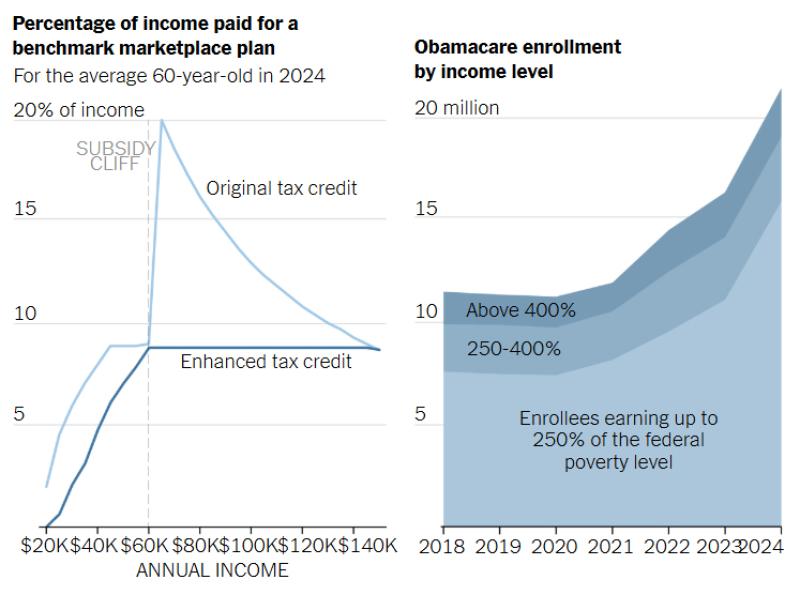
The initial ACA purposefully created the subsidy cliff above 400% poverty level to encourage workers to utilize employer-sponsored insurance. The goal was to prevent direct, costly competition between the new government-subsidized plans and the established employer provided insurance market. The pre-expansion ACA premiums that could reach 20% of income established a clear financial incentive to utilize employer provided insurance. Capping out-of-pocket premium cost to 8.5% of income undermined the original intent of the subsidy cliff.
The expanded Premium Tax Credit intentionally undercut this balance. Stripping enrollees away from employer supported insurance will likely increase those premiums. The result could destabilize the employer supported insurance market increasing the overall cost of insurance. Is the new, more expensive government-subsidized system, which draws millions away from employer sponsored insurance, sustainable? And should a temporary measure that competes directly with employer-provided benefits really become permanent policy?
On top of that, the expanded Premium Tax Credit created a static cost limit of 8.5% of income. As the price of insurance premiums increase due to inflation, government outlays for the Premium Tax Credit will also increase. The lack of fiscal indexing means the cost of ACA can quickly become an overwhelming burden on taxpayers. Doesn't that suggest the expanded Premium Tax Credit needs serious scrutiny and modificatons before it can become permanent policy?
 S E E D E D C O N T E N T
All the political skirmishing around the looming government shutdown has obscured the critical reason for it in the first place: Republicans have essentially stopped saying they want to repeal Obamacare, but quietly, they are doing exactly that.
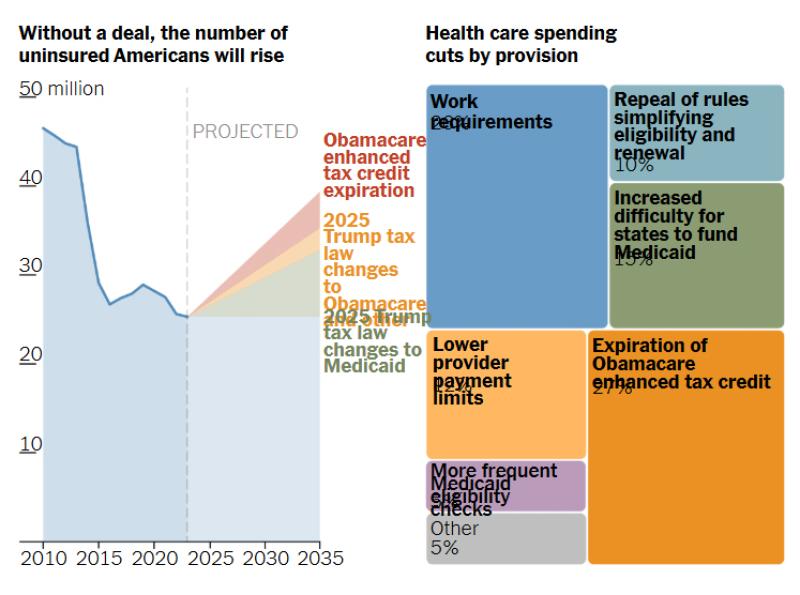
Over the past nine months, Republicans have gone a long way toward dismantling key Obamacare provisions under the misleading guise of reforming or improving our health care system. As a result, more than 20 million Americans face higher insurance premiums next year. And almost 14 million Americans could lose their health insurance altogether over the next decade — an estimated 3.3 million in 2026 alone.
That's more than 70 percent of those who gained coverage since Obamacare went into effect.
You may be forgiven for missing this headline. There wasn't one. In 2016, Donald Trump ran on a promise to abolish the program and kept up his crusade throughout his first term, only to have the effort deep-sixed by Senator John McCain. This time around, Mr. Trump has rarely — if ever — mentioned the Affordable Care Act by name. Nor have his fellow Republicans.
But they never stopped trying. And this year they have made substantial progress. The outcome of the looming shutdown will determine whether Democrats can gain back at least a modicum of ground.
Death by Many Cuts
Note: Obamacare enhanced tax credit expiration indicates spending avoided rather than spending cut. Source: Congressional Budget Office; KFF
By The New York Times
Since most of its provisions went into effect in 2014, Obamacare has been stunningly successful at reducing the ranks of the uninsured: from 44.4 million in 2013 to 26.7 million in 2016.
Then three months ago, Congress passed its huge tax and spending package (known as the One Big Beautiful Bill). Tucked into that legislation were a number of granular, difficult-to-comprehend changes to the government piece of our health care system, particularly Medicaid.
One of them, a work requirement for able-bodied adults, is likely to strip health care coverage from millions of Americans who lack the resources to navigate government bureaucracy. According to the Congressional Budget Office, over the next 10 years, that provision will cost 5.3 million people their coverage.
Other changes were so obscure that only dogged health care aficionados can understand them.
Today Americans making less than $150,000 a year who bought insurance on one of the Affordable Care Act’s exchanges can receive a tax credit to offset part of the cost of their coverage. Republicans chose not to extend that tax break in the tax and spending bill. Now, without government intervention, it will expire at the end of the year. That could be responsible for more than a quarter of the lost coverage, and it’s likely to be the focal point of any negotiations during a possible shutdown.
Affordable Care
Sources: The Commonwealth Fund; KFF By The New York Times
Passed during the Biden administration, this tax break has helped many of the 24 million Americans who purchased their insurance through the exchanges in two ways. It has slashed existing premiums for lower-income Americans. Plus, it has capped premiums for those earning from just above $60,000 to $150,000 annually — a group that under the prior system suffered a huge premium jump — at 8.5 percent of income.
Not surprisingly, people rushed to take advantage of this new benefit; more than 19 million now receive the tax break, up from 10 million before the enhancement.
How Much More?
Source: KFF By The New York Times
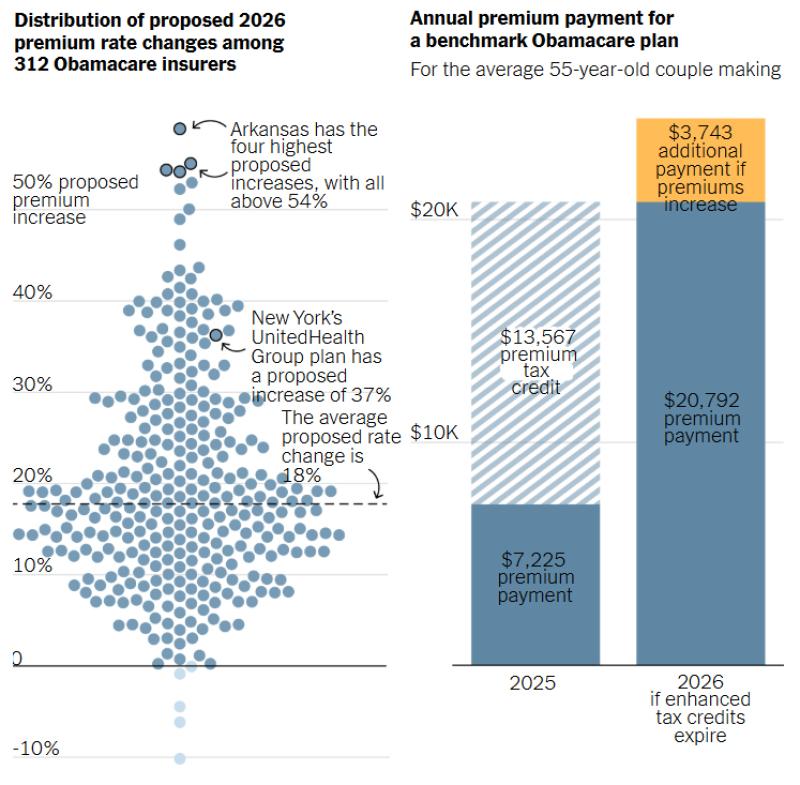
Even upper-income Americans who buy insurance on the Affordable Care Act exchanges will be hurt by the repeal of this tax break. That’s because as coverage gets more expensive, healthier people drop their insurance first, forcing companies to raise premiums on their remaining customers to maintain profitability.
And those increases will be big. Premiums are expected to soar an additional 18 percent , based on the planned rate increases insurers have filed (assuming the loss of the break). That compares with a 7 percent increase imposed a year ago.
Thanks to Republican legislators, a 55-year-old couple making $85,000 annually could see their health insurance cost more than triple , to $24,535 a year. Obviously that’s unaffordable, which is why so many will drop coverage.
And that will just add to the tragedy of tens of millions of Americans lacking what should be a basic benefit in the richest country in the world. Whether you agree with a shutdown or not, it’s good to understand that it’s not over nothing.
Be a good human. Grossly derogatory comments, blatantly inflammatory comments, excessive trolling, mean-spirited taunting and insults, scamming, spamming, and off topic comments may be removed in compliance with the site's Terms of Service and the Code of Conduct. The moderators have the final word.

Like it or not, Democrats screwed up ACA when they expanded the Premium Tax Credit. The expanded Premium Tax Credit needs scrutiny and modification before it can become permanent policy.
Democrats are doing the stupid thing that's going to become extraordinarily expensive in the not-to-distant future. Pick the wrong way to do things and that's what Democrats seem to favor.
Obamacare was a failure, by any measure, and its become a massive sinkhole for tax dollars trying to keep people on board. Even the Washington Post recognizes it:
You do realize WaPo has moved to the right: