
Biofuel Policies Are Likely to Drive Future Demand for U.S. Corn and Soybeans

By: Editor (Grain Journal)


Global demand for corn and soybeans has spurred a worldwide expansion in production, as shown in Chart 1. The United States was experiencing increased competition in export markets before Trump's tariff policies were put in place, as shown in Chart 3. While biofuels might absorb some of the excess capacity of the United States, this seems like a golden opportunity to renew efforts to develop bioplastics and biopolymers.
 S E E D E D C O N T E N T

Chart 1: Global production and inventories for corn and soybeans have increased over the years. Chart shows average production and beginning stocks in different time periods. Image courtesy of the Federal Reserve Bank of Kansas City.
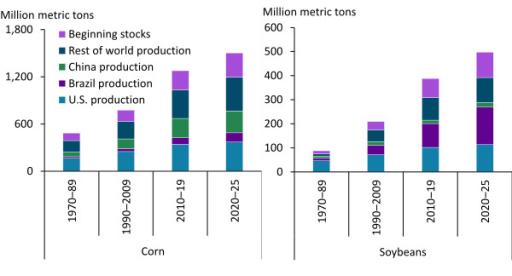
The supply of U.S. corn and soybeans has grown over the past decade and is projected to increase further in the coming years. In the past, large supplies have been partly absorbed by both export markets and biofuel production. However, going forward, exports are unlikely to grow sufficiently to offset projected supply increases. Instead, demand driven by changes in biofuel policies will be critical to absorbing increased corn and soybean availability and supporting prices for these crops.
Productivity gains and larger planted areas worldwide have expanded corn and soybean supplies over time. The USDA projects that U.S. corn and soybean yields have risen more than 20 percent from 2010 to 2025, along with a 10 percent increase in corn acreage and a 2 percent increase in soybean acreage. Chart 1 shows that similar gains in productivity and acreage in net exporting countries, such as Brazil, and importing countries, such as China, have doubled global corn and soybean supplies over the past 30 years.
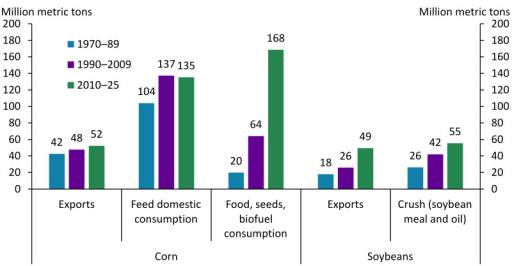
In the United States, expanding corn and soybean supplies have been partly absorbed by a greater use of crops for biofuel as well as rising exports. Chart 2 shows that over the past 30 years, the sharpest growth in corn demand has come from ethanol production. Much of this growth occurred after Congress passed the final version of the Renewable Fuel Standard (RFS) in 2007, which required gasoline and diesel refiners to acquire a quota of biofuels. The RFS and other subsidy programs that promote biofuels also boosted demand for soybean oil, a byproduct of soybean crushing used in biofuel production. At the same time, increased exports helped absorb corn and soybean supplies. The right side of Chart 2 shows that average soybean exports doubled between the 1990-2009 period and the 2010-25 period as China's demand for soybeans surged.
Chart 2: Growth in biofuel production and exports has driven demand for U.S. corn and soybeans. A bushel of soybeans (60 pounds) produces around 11 pounds of soybean oil. Image courtesy of the Federal Reserve Bank of Kansas City.
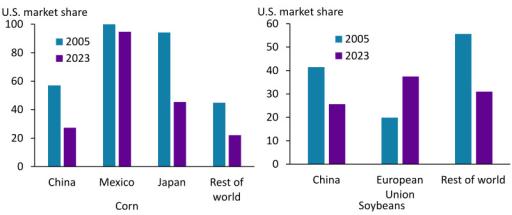
However, export demand is unlikely to grow enough to absorb the expected increase in crop supplies moving forward. Although the United States has expanded corn and soybean exports since the early 2000s and secured major trading partners such as Mexico, its overall share of global trade has declined. Improvements in infrastructure have allowed other exporters to capture large shares of key markets such as China, Japan, and the European Union. Brazil, for example, sharply increased soybean exports to China and has replaced the United States as China's largest soybean source. Looking ahead, trade disputes and intensifying competition from other exporters could further limit export growth as a driver of U.S. crop demand.
Chart 3: The United States has lost overall market share in export markets. Shares for European Union and rest of world include intra-trade. Image courtesy of the Federal Reserve Bank of Kansas City.
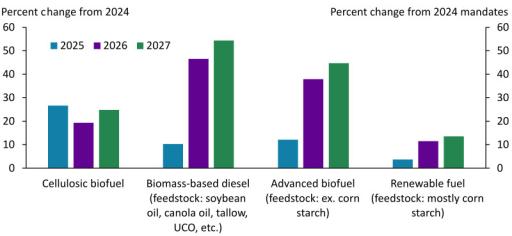
Instead, proposed changes to biofuel policy are likely to be the main driver of demand growth for corn and soybeans going forward. Chart 4 shows proposed changes to the RFS quotas for biomass-based diesel and advanced biofuel (which relies heavily on soybean oil) and renewable fuel (which uses corn ethanol), alongside other fuel types. If approved, the 2026-27 quota for biomass-based diesel would increase by 50 percent from its 2024 levels, while also increasing quotas for renewable fuel (corn ethanol) and advanced biofuels (biofuels other than corn ethanol with high greenhouse gas reductions). In addition, proposed changes to the RFS would count foreign inputs toward biofuel mandates at half the rate of North American inputs, boosting demand for domestic feedstock such as corn and soybeans. The Environmental Protection Agency (EPA) estimates that biodiesel producers would need, on average, an additional 250 million gallons per year to meet the RFS mandate—equivalent to more than 5 million metric tons of crushed soybeans, or roughly 4 percent of current U.S. soybean production.
Chart 4: Proposed changes in RFS volume obligations by the EPA. Image courtesy of the Federal Reserve Bank of Kansas City.
Recent changes to the federal per-gallon income tax credit for clean fuel producers, known as the Clean Fuel Production Credit (45Z), will further encourage refineries and processors to use North American feedstock. The One Big Beautiful Bill Act (OBBBA) extended the 45Z provision through 2029. Only production using feedstock from the United States, Canada, or Mexico qualifies for the credit, which can reach up to $1 per gallon. In addition, the OBBBA adjusted calculations of the environmental benefits of biofuels to exclude indirect land-use penalties, which could favor crop producers and further boost demand.
In the past year, U.S. crop producers have faced tight profit opportunities amid an oversupply of crops relative to demand. Rising competition and recent trade disputes may further weaken export markets for corn and soybeans. However, biofuel production offers potential alternative sources of demand. Recent proposed and enacted federal biofuel policies are likely to create new demand for U.S. corn and soybean crops, partially absorbing production and supporting prices.
Source: Federal Reserve Bank of Kansas City Economic Bulletin, Sept. 26, 2025
Be a good human. Grossly derogatory comments, blatantly inflammatory comments, excessive trolling, mean-spirited taunting and insults, scamming, spamming, and off topic comments may be removed in compliance with the site's Terms of Service and the Code of Conduct. The moderators have the final word.

The global market for plastics is significantly larger than the global market for corn and soybeans. Using excess corn and soybeans for bioplastic and biopolymer production would give the United States a comparative advantage. Bioplastics would be more competitive with conventional plastics than biofuels competing with fossil fuels.
Unfortunately developing bioplastics and opening the market would likely require government assistance. That seems unlikely since political attention has been focused on high tech and basic science during the 21st century.
Not if Trump gets a higher cut than the one from Argentina.
What the hell does that even mean? The only thing that comment tries to accomplish is to throw mud, raise a stink, start a fight. That violates the Red Box rules for the article.
Argentina is already cashing in and China is the beneficiary. Happy now?
Argentina can thank who for that, the same one who is offering up $20B to them? ... toss in another $10-20B to subsidize america's soybean farmers ... O DOGE, DOGE wherefore art thou now?
The Argentinian government paused it's export tax of 26%. Cutting taxes dramatically lowers the price of goods. Since China is the worlds largest importer of soybeans, the lower price benefits China both economically and geopolitically.
The IMF has approved a $20 billion loan to Argentina. The Trump administration has offered a $20 billion currency swap line to Argentina (to prop up Argentina's currency) on condition that Argentina cancels its existing $18 billion currency swap with China. The Trump administration is not giving Argentina any money. The intent is to stabilize Argentina's economy and support President Javier Milei's free-market reforms.
Would it help if farmers were marginalized? Or maybe the support should only be extended to trans farmers? Too bad Michael Bloomberg can't teach the inner city folk how to farm so they could get some of that free government money. But that would require some sweat equity.
Not needed now that Democrats have handed the chainsaw to Russ Vought. It's a golden opportunity.
But also
I didn't realize farmers were commenting on the seed. The comment was raising an objection to farm subsidies for soybeans. What would make farm subsidies more acceptable? Would those subsidies be more acceptable if farmers were marginalized? Or trans? Or inner city?
What is your point about the Red Box rules?
My point is your sarcastic comment regarding trans, inner city (code for Black), and other marginalized populations is not in keeping with your own Red Box Rules.
How? Those who advocate for government support for marginalized, trans, and inner city use these labels. So, the labels cannot be derogatory. Is using preferred labels inflammatory? Is contrasting advocacy for these groups with objections to advocacy for farmers too provocative?
Neither Argentina, support for the Argentine economy, or Trump were mentioned in the seeded article. The OBBB was mentioned in the article to point out that government support for biofuels were continued in the legislation. So the other commenters on the seed have been attempting to derail the discussion to off topic issues. That's not surprising considering the common support for fossil fuels and traditional plastics.
We all know your comment was sarcastic in nature, and was not meant to be complimentary to those groups. Playing innocent is dishonest and trollish.
The Red Box rules do not limit sarcasm. Please, stop trying to derail the discussion with meta issues.
The one about "being a good human" should limit this particular instance of sarcasm.
You asked for clarification.
Except this particular instance of sarcasm was directed toward the objection to soybean farm subsidies. No disparaging or derogatory terms were used. You have tried to twist the comments into something derogatory but that's on you.
No. I asked what is your point about the Red Box rules? You haven't answered that question. Is your point to further discussion? Is your point to refocus attention on the topic of discussion? What is your point about the Red Box rules?
Sure, Nerm. Nobody's buying your bullshit. You meant to make a condescending comment by way of sarcastically bringing marginalized people into the discussion, and don't want to be held responsible for it.
I answered your question about RBRs. The fact that you don't like the answer is irrelevant.
Own your shit.
My comment did no such thing. It is Trump's trade machinations that have led to this boondoggle.
Meanwhile in Milei's Argentina:
It was sort of amusing, reading the article. It's clear the author knows that Trump is the reason US corn and soybean farmers lost their buyers, but can't actually come out and say so, so they dance around on eggshells, trying to say it without saying it. They know their audience, and they know they'll face retaliation if they come right out and say that Trump screwed US farmers yet again.
He Who Must Not Be Named, when the shit hits the fan.
Trump was not President during 2021 to 2024. The provided data covers much longer time frames than 2025. The data also indicates that the Trump administration is expected to allow the EPA renewable fuel standards to continue and expand while Trump is in office.
The article does not mention Argentina. Chart 1 suggests that Brazil should be of greater concern for competition in exports.
The link only proves that the Financial Times is a paywall site. The link only provides a title, nothing else. That may be useful for those who only read titles but isn't very useful otherwise.
Trump was not President from 2021 to 2024. The article is discussing trends that were emerging while Biden was President. The article is discussing alternative markets for corn and soybeans now that international export competition has increased. The data also indicates that China, the largest market for soybeans, has taken steps to increase domestic production over a number of years.
The data presented in the article suggests that US market share for corn and soybeans has been eroding for a number of years because of a global oversupply.
The trends indicated in the presented data suggest that eliminating Trump's tariffs won't fix the problem of global oversupply. And Trump is not responsible for limiting the ability of the United States to lower costs to become competitive in international markets. US farmers cannot buy cheaper fertilizer from Russia. US farmers can't sell corn and soybeans in markets that prohibit GMO crops. Trump's trade policies (including tariffs) are intended to overcome those trade barriers.
Trump is doing what needs to be done to address the shifts and trends in international trade. Where was the alternative when we needed it?
Yes, his disastrous trade policies continued after the end of his first term. Hardly surprising. China is smart enough not to rely on us anymore. Who can blame them?
Yes, because that's accomplished by driving away customers and propping up competitors.
Why is it condescending to highlight a contrast in political priorities using preferred labels? How is my response to a condescending comment about subsidized farming any more condescending?
There are government farm subsidies. There are government subsidies for marginalized people, trans people, and inner city people. Those are facts.
Well, no you didn't. My question is what is your point about the Red Box rules? So far you've only insinuated some sort of condescending comment toward generalized groups of people who are not participating in the discussion. That's a political motivation that suggests a use of the Red Box rules to promote political narratives, derail the discussion by deplatforming participants, and appealing to authority to avoid logical discussion of facts.
Stop throwing shit at the wall, hoping something sticks.
Willful obtuseness and reliance on not-at-all-plausible deniability are neither convincing nor admirable.
Who's being willfully obtuse? I haven't denied making the comment. In fact, I've repeated the salient points of the comment several times. What we are discussing is comment @1.1.2 and my response @1.1.3.
Comment @1.1.3 is what you are falsely accusing me of denying. You have provided no creditable argument that would encourage me to alter that comment. I have challenged your assumptions and provided supporting arguments for the comment. That doesn't seem like obtuse denial to me.
Biden continued and expanded upon Trump's 1st term trade policies.
It was the Biden administration that supported Argentina's President Javier Milei. Biden's policies supported Argentina's shift away from President Alberto Fernández's more socialist policies toward free-market economic reforms introduced by President Javier Milei. Biden sought and obtained support from Argentina for Ukraine under both the Fernández and Milei governments. Trump has only continued Biden's policies concerning Argentina.
China has pursued domestic economic policies to reduce dependence upon foreign suppliers. The global market has also expanded available supply of corn and soybeans. China can now use trade to assert geopolitical influence around the world.
Trump's trade policies share similarities with those used by China to reduce dependence upon foreign suppliers. If China is that smart then why shouldn't the United States emulate China?
The pattern emerged during Biden's term, did it? Was Biden POTUS in 2018, when soy exports to China tanked?
Yes, the pattern emerged during Biden's term as shown by the data in the seeded article and by the data in the link you provided. (The link you provided is very good, thanks for that.)
The graph you provided shows that Trump's trade war did not persist. Some other interesting info provided by your chart shows that the US supplies less than a third (at its highest) of China's import needs. The chart also shows China has reduced imports somewhat after Trump's trade war. The US may have been China's largest supplier of soybeans in previous years but the US was never the dominant supplier for China. The data in the chart you provided demonstrates that China is quite willing to use trade to assert global influence.
Your chart confirms that Trump did not permanently damage soybean sales to China. Figure 2 of your link shows that China is the largest buyer of US soybeans but not the only buyer. Figure 4 & Figure 6 of your link shows that Brazil became the largest global competitor for US soybeans during the Biden administration. Figure 12 of your link shows that projected above average yields in the US and China exiting the futures market has caused a dramatic reduction in price of soybeans. (While not mentioned, the global oversupply will also lower prices. Previous data showed that Brazil's production increases have put downward pressure on prices.) Figure 14 of your link show that production costs are rising above what market price can sustain. (That's the old saw that the US can't compete because it costs too much in the US.)
The soybeans kerfuffle demonstrates that disruptions in supply chains have an oversized impact on an international liberal order held together by trade. The system of interconnected interdependencies lacks resilience, is extraordinarily fragile, and has weakened the security of the entire world. Trump may not be handling trade policy with desired finesse and flattery but nevertheless Trump's trade policies are what is needed to improve the security of the US. The situation will not correct itself and kicking the can is not a solution.