
Microsoft Analog Optical Computer: AI Efficiency Breakthrough

By: Robin Mitchell (electropages)


Research on artificial intelligence is not following a linear path of development. While the emergence of AI is, itself, disruptive there are now disruptions within the progress of development. The seed article is rather dry and somewhat repetitive. But the reported alternative technology does seem to leapfrog developments in the field. The feasibility of the analogue approach looks promising but still may not be commercially viable.
 S E E D E D C O N T E N T
Key Things to Know:
- Microsoft has introduced an analogue optical computer (AOC) that blends light-based computation with analogue electronics to achieve exceptional energy efficiency.
- The AOC performs AI inference and optimisation tasks up to 100 times more efficiently than leading GPUs, projecting performance around 500 tera-operations per second per watt at 8-bit precision.
- By merging compute and memory within a single optical-electronic framework, the system bypasses the von Neumann bottleneck that limits traditional digital architectures.
- Demonstrations included image classification, MRI reconstruction, and financial optimisation, highlighting potential applications in sustainable AI and data-intensive industries.
While digital logic has fuelled remarkable advances in computing, the long reign of binary systems is beginning to show its age. The rigid 1s and 0s that once enabled exponential growth are now bumping up against physical and practical limits, particularly as demands from AI, quantum simulation, and optimisation tasks continue to grow. With Moore's Law slowing and binary architectures struggling to keep pace with new workloads, researchers are now exploring alternatives that rethink how computation itself is performed.
Recently, Microsoft unveiled a compelling example of this shift: an analog optical computer designed not just to speed up AI workloads, but to drastically improve energy efficiency compared to traditional GPUs.
What's driving this departure from binary logic? How does Microsoft's analog system work, and what could it mean for the future of AI and high-performance computing?
The Challenge With Traditional Digital Systems
Binary logic has been the cornerstone of modern computing for decades. Two states, on and off, make for simple mathematics, robust logic, and circuits that are relatively easy to design and verify. From microcontrollers to supercomputers, binary has delivered extraordinary results, proving that simple foundations can support complex architectures.
But as Moore's Law grinds toward its physical limits, the scaling that once fuelled performance growth is fading. Shrinking transistors further no longer guarantees faster, cheaper, or more efficient logic. At the same time, the types of workloads now dominating research and industry, such as artificial intelligence, machine learning, and quantum simulation, are not naturally suited to binary operations. In many cases, forcing these problems through conventional digital logic is like translating poetry word-for-word into another language: the meaning is preserved poorly, and the process is inefficient.
This digital squeeze is evident across all hardware domains, where even memory technologies, which once relied strictly on binary states, have resorted to multi-level encoding (storing multiple bits in a single cell by distinguishing several voltage levels). This increases density but at the cost of reliability and complexity, a reminder that binary's dominance is already being stretched to uncomfortable limits.
The question, then, is what comes next. Will computing migrate toward architectures that blend analog and digital? Will non-binary logic systems emerge as practical solutions? Or will advances in materials and design somehow keep binary viable beyond its natural horizon? Whatever the outcome, it's clear that the binary model that carried us through the last half-century may not be enough to carry us through the next.
Microsoft's Analog Optical Computer: Energy Efficiency Beyond GPUs
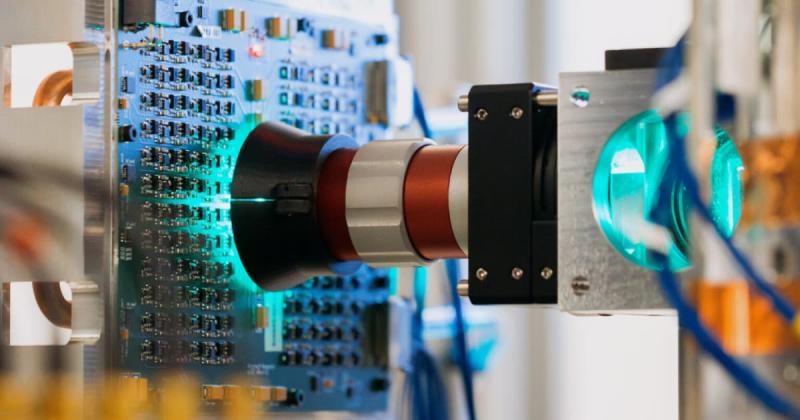
Recently, Microsoft researchers have unveiled an analog optical computer (AOC) designed to tackle one of digital computing's biggest weaknesses: energy efficiency. The system combines analog electronics, microLED arrays, and photodetectors to accelerate both AI inference and combinatorial optimisation on a single platform. In testing, it demonstrated energy efficiency projections up to 100 times greater than leading GPUs, an extraordinary claim in a field dominated by power-hungry hardware.
According to the study published in Nature, Microsoft's AOC demonstrates a hybrid feedback loop where light-based matrix operations and analogue signal processing work together in real time. Each loop iteration lasts around 20 nanoseconds, minimising latency and improving noise resilience. This fixed-point approach allows the system to process both artificial intelligence inference and combinatorial optimisation tasks without requiring energy-intensive digital conversions.
Optical-Electronic Synergy in Microsoft's AOC
The AOC performs matrix-vector multiplications optically, while nonlinear operations, subtraction, and annealing are handled in analog electronics. By keeping much of the workload in the analog domain, the design avoids the constant digital-to-analog conversions that drag down traditional architectures.
The research highlights that by maintaining computations in the analogue domain, the AOC reduces conversion overheads common in digital accelerators. Its opto-electronic structure merges memory and compute functions, eliminating the von Neumann bottleneck. The device's optical core uses microLEDs as light sources, spatial light modulators to store and weight signals, and photodetectors to translate optical data back into the electrical domain, achieving fully parallel processing across three dimensions.
Case studies that Microsoft demonstrated working with the hardware included image classification and MRI reconstruction, handling datasets like MNIST and Fashion-MNIST while also solving industrial optimisation tasks.
Real-World Validation Through Case Studies
Demonstrations of the AOC extended beyond simple datasets. The system carried out nonlinear regression and optimisation routines, including MRI image reconstruction and financial transaction settlement, both traditionally compute-heavy tasks. Results from these case studies showed that the analogue architecture could converge to accurate solutions in microseconds, underscoring its potential for real-time processing in data-intensive fields such as healthcare and finance.
What makes the AOC particularly interesting is its attempt to bypass the von Neumann bottleneck entirely by merging compute and memory, and that its projected performance sits around 500 tera-operations per second per watt at 8-bit precision. Such efficiency figures, if achieved in production, would put digital accelerators to shame and genuinely change the AI industry forever.
Microsoft's prototype achieves its efficiency through modular, three-dimensional optical design and mature consumer-grade components. With projected scalability to billions of weights, the team estimates around 500 tera-operations per second per watt at 8-bit precision, roughly two femtojoules per operation. For comparison, current high-end GPUs operate at about 4.5 TOPS W⁻¹. If replicated in production, this efficiency would mark a major advance in sustainable AI computing.
Could Analog Systems Be the Future of AI?
The idea of using analog electronics for AI isn't new; researchers have explored components like memristors for years, seeking ways to emulate the brain's spiking neural networks in silicon. These approaches promise orders-of-magnitude improvements in energy efficiency compared with traditional digital architectures. By processing information in ways closer to how neurons operate, analog systems could make AI models far less power-hungry and more scalable.
But there are very serious practical hurdles. For example, programming analog hardware is inherently more complex than writing software for deterministic digital logic. Noise, drift, and component variability also need to be carefully managed, and existing frameworks for training and deploying AI aren't built with these systems in mind. Even optical implementations, like Microsoft's analog optical computer, face challenges in scaling, integration, and long-term reliability.
At this stage, no one can say which technology, if any, will dominate the AI hardware landscape. Analog computing has potential, particularly for specialised inference tasks, but the path to widespread adoption is still uncertain. For now, it remains an experimental frontier: promising, intriguing, but far from a guaranteed revolution.
Robin Mitchell is an electronic engineer who has been involved in electronics since the age of 13. After completing a BEng at the University of Warwick, Robin moved into the field of online content creation, developing articles, news pieces, and projects aimed at professionals and makers alike. Currently, Robin runs a small electronics business, MitchElectronics, which produces educational kits and resources.
Be a good human. Grossly derogatory comments, blatantly inflammatory comments, excessive trolling, mean-spirited taunting and insults, scamming, spamming, and off topic comments may be removed in compliance with the site's Terms of Service and the Code of Conduct. The moderators have the final word.

Tags
Who is online
186 visitors
At this point it is very difficult to make predictions about the future of AI. Some have warned of an AI investment bubble. But what is happening now with AI bears little resemblance to the dot com bubble of the late 1990s.
The big players in AI are all profitable. But you have to ask what happens to NVDA as MSFT develops a computer that doesn't need their chips. And eventually this will become a bubble. The question is just when and how elevated will the share prices be.
I doubt the necessary shift in AI architecture will bleed over to personal computing. My expectation is that the developments to advance the architecture for AI won't be commercially viable for small scale, personal use. That's one of the major differences I see with the dot com bubble; there's less dependence on public adoption to achieve profitability. There isn't any uncertainty about the path to profitability for AI as happened during the dot com bubble.
You may know this better than I do, but isn't the majority of AI computing done on the server side? Don't our PCs or mobile devices just operate as thin clients?
Nvidia's GPU business is massive to data centers. It's also big on laptops and PCs, but if they're not able to keep up on the data center side, that's a huge shift in valuation. Don't you think?
What am I missing?
Yes, that is the current model. But a few computers with Neural Processing Units (NPUs) for local application of AI are being shipped now. But NPUs are still digital architecture.
The industry(?) seems to be resolving itself into two types of applications. Large Language Models (LLMs) operating in large data centers providing a cloud based service. And Small Language Models (SLMs) deployed locally for less computationally taxing routine tasks. The deployment of SLMs has only just begun. I'm not sure how the SLMs and LLMs will interact or even if that would be necessary.
Microsoft and Nvidia are partners in a consortium so Nvidia has an edge for producing new technology, too. Development of an analogue architecture wouldn't lock Nvidia out of the market.