
The future of electric farming is taking shape at John Deere [video]

By: Jo Borras (Electrek)
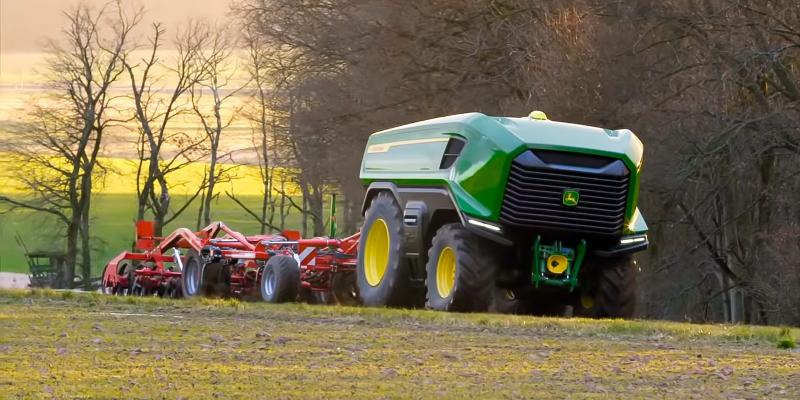


Not the Johnny Pops I grew up with. The autonomous tractors are really amazing.
 S E E D E D C O N T E N T
Energy independence and cost control are top of mind for farmers, and more companies are rolling out electric equipment that can be charged by solar, wind, or even on-farm biogas. With the debut of its latest next-generation electric tractor at Agritechnica last month, John Deere is signaling that it intends to lead that revolution.
John Deere says the E-Power electric tractor prototypes that it's been quietly teasing since 2022 will be as quiet as a car, as easy to drive as a golf cart, and require minimal upkeep - and all while providing the same performance as the company's beloved diesel tractors.
"Our goal with the E-Power tractor is to ensure it performs the same jobs as its diesel counterparts and works with the same implements, while unlocking incremental value," explains Derek Muller, business manager for battery electric vehicle systems at John Deere. "Through our electric lineup, we'll look to reduce operational and maintenance costs, deliver powerful and reliable performance, and intuitive operation."
The latest electric John Deere tractor prototype, recently unveiled at Agritechnica, is equipped with a 100 hp drive motor and two, additional motors. One 130 continuous hp electric motor for the PTO, and a third for the hydraulic pump. They'll draw power from up to five KREISEL li-ion battery packs, allowing customers significant pricing flexibility based on their ability to determine how much power and run time they need (and are willing to pay for) to get their jobs done.
Electric John Deere tractor
130 hp electric tractor shown at Agritechnica; by John Deere.
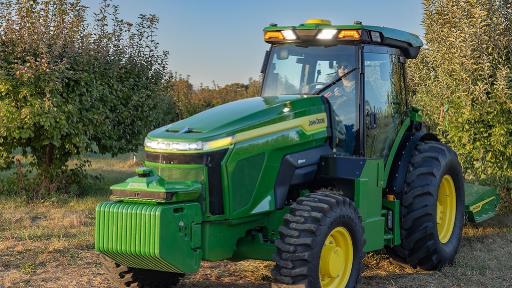
The customization will go well beyond just battery size. Deere plans to offer customers a number of different tractor and equipment options, and keep costs competitive by basing them on a vehicle common architecture.
"John Deere aims to develop a single electric concept that customers can configure to their own needs," writes Bob Karsten, at Future Farming . "Buyers will be able to choose the number of batteries (up to five, totalling 195 kWh), the axle type (narrow or wide track), and the cab (either an orchard cab or the familiar 5M cab). In essence, buyers select their preferred battery capacity. With the largest battery (195 kWh), the tractor can operate for eight hours. The target is to enable fast charging up to 80% in 30 minutes."
Deere revealed one version of that upcoming electric tractor (above) at Agritechnica last week, but despite being an early prototype, it's a fully functional piece that's already seen duty with some of John Deere's most trusted customers.
- Daniel , an orchard customer from California, said his experience with the electric tractor led him to believe it could help ease training new operators, "I do think the tractor is much easier for drivers to understand it and to drive it. It would take less time to teach them [operators] how to use it."
- Tyler , a vineyard customer in California, believes that a new electric tractor could help his operation meet its sustainability goals, "When we look at our carbon footprint, greenhouse gas emissions, we want to try and reduce those as we run our equipment to farm our vineyards, we want to be conscious of the community at large."
There's no official word yet on when the new John Deere electric tractor platform will start reaching customers, but Big Green's recent purchase of battery manufacturer KREISEL and its continued push into more global markets means that it can't afford to take things slow.
You can check out a quick, virtual walkaround of John Deere's E-Power electric tractor concept in this (admittedly older) video released around the ACT Expo, and expect more details and possible configurations at the upcoming CON/AGExpo conference in March.
John Deere E-Power configurations
SOURCE | IMAGES : John Deere.
If you're considering going solar, it's always a good idea to get quotes from a few installers. To make sure you find a trusted, reliable solar installer near you that offers competitive pricing, check out EnergySage , a free service that makes it easy for you to go solar. It has hundreds of pre-vetted solar installers competing for your business, ensuring you get high-quality solutions and save 20-30% compared to going it alone. Plus, it's free to use, and you won't get sales calls until you select an installer and share your phone number with them.
Your personalized solar quotes are easy to compare online and you'll get access to unbiased Energy Advisors to help you every step of the way. Get started here .
FTC: We use income earning auto affiliate links. More.
Be a good human. Grossly derogatory comments, blatantly inflammatory comments, excessive trolling, mean-spirited taunting and insults, scamming, spamming, and off topic comments may be removed in compliance with the site's Terms of Service and the Code of Conduct. The moderators have the final word.

Tags
Who is online
105 visitors
What someone needs to develop now are portable charging stations. That doesn't seem like it should be technically challenging. But the cost may still be prohibitive. The promise of cheap charging remains elusive. Until that obstacle is overcome EV adoption will be slow.
What someone needs to develop now are portable charging stations.
We have them now, diesel powered generator sets. But for now, since our equipment is still ICE, a pickup with a fuel tank in the box.
A diesel generator set makes the electric tractor pointless; just stick with ICE & power fuel. My point was that for electric tractors to be practical there will be a need for portable rechargers. Who wants to run the tractor back and forth to a fixed recharging station?
There are a few people trying to use shipping containers for building solar powered charging stations but the examples I've found are not mobile.
Another solution, make the batteries in the tractors easily removable and swap them out with charged ones and return the ones needing a recharge back to the barn for recharging. Of course this would mean buying an extra set of batteries.
You couldn't put enough solar panels on a shipping container to do any good. My brother has 36 panels up just to run his house a tractor would require 10 times that much to do field work.
Well, it is possible to put 640 square feet of solar panel on a 20 ft container (1 panel on the top and a trifold array on the side). A 40 ft container would double that to 1280 square feet but a 40 ft container might be too impractical. A 20 ft container configured with 640 sq. ft. of solar panels would be 12W generation capacity and would produce about 50 to 60 kW/hr of electricity in a day. That would allow rapid charging by itself. But a larger storage battery in the container would allow that. The biggest problem would be cooling the container.
That is workable. Typical panels are 3' x 5' so you could cover the top with 10-11 panels and if you fold one down and one up that would be 30-33 panels and to get to 640 sqft. you would need another 6'x24' on each end which would add another 14 panels, so 44-47 panels for a 20' container. As long as we never mind the wind load, this would be just more than what my brother powers his house with. A house can be powered with a 8-10 HP generator, the tractor described above, running full output, is 240 HP and may only run 6-8 hours on a full charge. Being autonomous to get the best value per hp you would run it 24/7, that will take acres of panels to keep powered. So the best bet to run one of these is to recharge from the grid.
Either that-- or the development of better storage batteries and transmission lines.
The nature of farm work makes grid access problematic. Using a diesel generator set kind of makes the electric tractor pointless. Portable batteries could be transported to grid access for recharging but that's not labor efficient. A mobile charging station would be more practical (and would have more uses than just field work) but might be cost prohibitive.