
Americans Favor Spending Cuts Over More Taxes to Cut Deficit

By: Megan Brenan (Gallup. com)


The Democratic Party's priority to protect spending levels is the least popular way to manage public finances. Democrat's reliance on "tax the rich" is not broadly accepted as the best way to increase government revenue. Republicans will obviously oppose efforts to only increase taxes. Simplifying the tax code by eliminating loopholes receives much more support across the board. So, if Democrats are really serious about "taxing the rich" then they should consider tax code reforms that accomplish that.
The Republican focus on cutting Medicaid and food assistance would not free up enough revenue to service the interest on the Federal debt. This is TEA Party nonsense that won't accomplish much at all. And treating defense spending like a sacred cow does nothing to address supply chain vulnerabilities and our withering industrial sector. Defense spending is not a hedge against economic competition.
 S E E D E D C O N T E N T
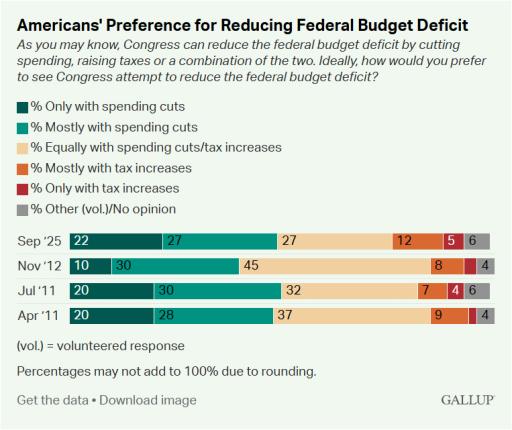
WASHINGTON, D.C. — Before the latest government shutdown, nearly half of U.S. adults said Congress should reduce the deficit either "mostly" (27%) or "only" (22%) by cutting spending, whereas 17% favored relying mostly or only on tax increases. Another 27% said they prefer an equal mix of spending cuts and tax hikes.
These findings are from Gallup's Sept. 2-16 poll, which was conducted amid fiscal disagreements between Republican and Democratic lawmakers that led to the Oct. 1 partial shutdown. The last time Gallup asked this question, in November 2012 as the country faced a year-end "fiscal cliff," more Americans also favored spending cuts over tax increases, but the plurality favored a combination of the two.
Two readings in April and July 2011 were taken prior to negotiations over raising the federal debt limit — and, like today, pluralities favored deficit reduction through spending cuts.
Republicans Focus on Cuts, While Democrats Want Combined Solution
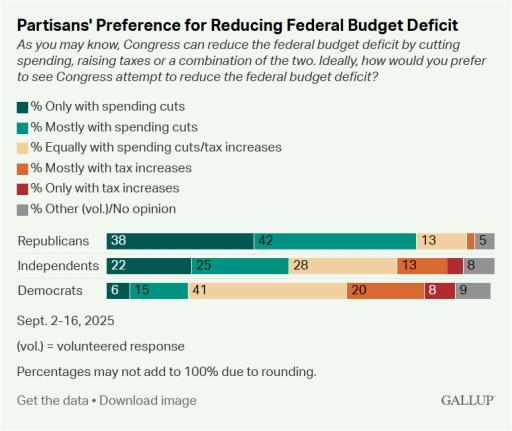
Partisans' preferences for reducing the federal budget deficit have differed sharply in the past and continue to today. Democrats have historically been most likely to prefer equal spending cuts and tax increases, and a 41% plurality of Democrats now favor that approach. Another 28% favor cutting the deficit at least mostly through tax increases and 21% at least mostly through spending cuts.
Conversely, the broad majority of Republicans continue to favor spending cuts, either exclusively (38%) or mostly (42%). Independents' preferences are currently roughly in line with the national average, as they have been in prior readings.
Increasing Taxes on Wealthy Favored Most to Reduce Federal Debt
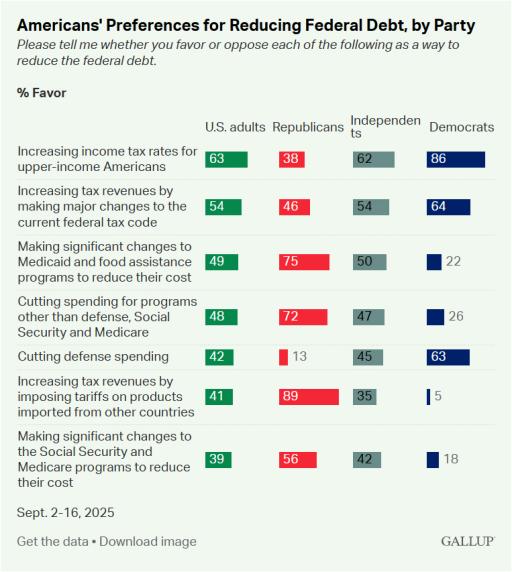
Another question in the September poll asked Americans whether they favor or oppose seven possible actions to reduce the federal debt. Just two of the seven options garner majority-level support among U.S. adults: increasing income tax rates for upper-income Americans (63%) and increasing tax revenues by making major changes to the federal tax code (54%). Both of these concepts earn majority support from Democrats and independents but not Republicans. Just one other option, cutting defense spending (63%), is favored by a majority of Democrats, whereas less than half of Republicans and independents agree.
Conversely, majorities of Republicans support increasing tax revenues by imposing tariffs on products imported from other countries (89%); making significant changes to Medicaid and food assistance programs (75%); cutting spending for programs other than defense, Social Security and Medicare (72%); and making significant changes to Social Security and Medicare programs (56%). Each of these measures is supported by no more than half of independents and 26% of Democrats.
Bottom Line
Americans' desire to rein in government spending, paired with their reluctance to reduce major entitlement programs or raise broad-based taxes, mirrors the same clash of views preventing lawmakers from reaching a budget agreement. Republicans are focused on spending cuts, and Democrats lean toward a combination of spending cuts and tax increases. The fiscal gridlock now driving the government shutdown reflects not only partisan differences in Congress but also a divided public that offers little clear guidance for bipartisan compromise, something that Americans want.
Be a good human. Grossly derogatory comments, blatantly inflammatory comments, excessive trolling, mean-spirited taunting and insults, scamming, spamming, and off topic comments may be removed in compliance with the site's Terms of Service and the Code of Conduct. The moderators have the final word.

Tags
Who is online
101 visitors
Democrats cannot raise taxes enough to protect current government spending. Republicans cannot cut spending enough to eliminate the deficit.
Right now servicing the public debt accounts for about 13% of the Federal budget. And only 20% of Federal spending is discretionary. We're spending more to service the debt than were spending on military defense.
Democrats and Republicans can continue to kick the can but the United States is running out of road.
Yep, I've been commenting on this for a while now and nobody really seems to want to acknowledge it. The debt has grown to IMO a national security issue yet all people can seem to do is blame either the current or past administrations, or play the Red v Blue partisanship games. Congress is no better, it seems they would rather have the weapon to beat the other side over the head than actually try to fix the problem.
Lots of sound bites get tossed around but it doesn't seem like people look beyond the sound bite to see the downstream ramifications of it. Take for example, tax the rich and make them pay their fair share. Except the top 10% of wage earners already pay around 72% of all federal taxes. So it would appear that they are already paying more than their fair share.
Or the idea of a wealth tax. We're gonna tax and take 10% of your holdings if your net worth is greater than $100 million. Except rich people don't have that $10 million just laying around in cash, it's invested in stocks, bonds, land and property, etc. So they would have to sell possessions to pay that tax. What's the downstream impact of all that suddenly going on the market? Will they all be able to find buyers for that?
We rely on Congress and the White House to govern yet it appears they are all more interested in self-enrichment. I don't know where it's going to end but I doubt it will be pretty.
Nothing will ever be done until we have a collapse.
One party tries to slow the rate of spending growth, not even really "cut" anything and they get called murderers etc...
The easiest way to win election is to promise people free stuff at the expense of others. The type of change that is required to bring our finances to within even seeing a balanced budget are simply no longer feasible.