
Americans End Year in Gloomy Mood

By: Megan Brenan and Jeffrey M. Jones (Gallup. com)
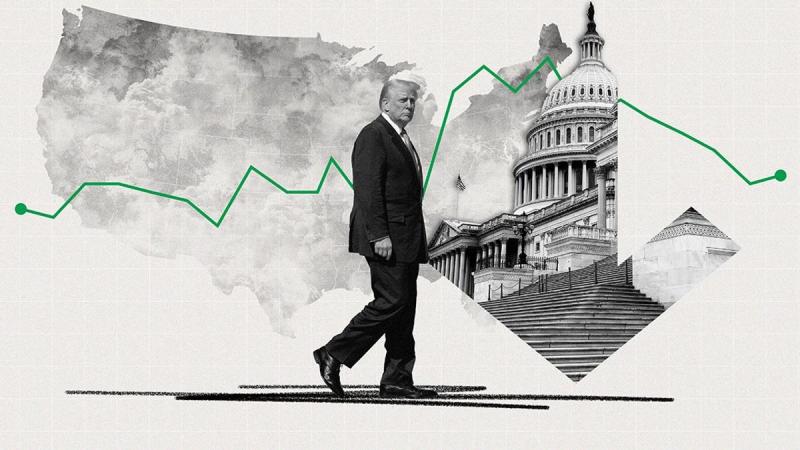


Looks like a "not Trump" strategy is failing. Everyone knows Trump's failings (see the chart) but the numbers show that Democrats don't approve of their own Congressional leadership.
 S E E D E D C O N T E N T
Story Highlights
- 24% approval rating for congressional Democrats, 29% for Republicans
- Satisfaction with direction of the country is 24%
- 47% say current economic conditions are "poor," 31% "fair"
WASHINGTON, D.C. — After enduring the longest federal government shutdown in U.S. history amid persistent affordability concerns, Americans are closing out the year with a bleak view of the country, its leaders and the economy.
Approval Ratings of Congress Are Weak
Gallup's Dec. 1-15 poll, conducted several weeks after the shutdown ended, finds that ratings of Congress, including both parties, are weak and sharply politically polarized. Approval of Congress is at 17%, with 37% of Republicans but only 12% of independents and 6% of Democrats approving of the Republican-led legislative branch. Congressional approval is statistically similar to November's 14% and only slightly better than the historical low of 9% in November 2013.
When asked separately about the job the Republicans and Democrats in Congress are doing, Americans give both groups poor marks. Approval of Republicans in Congress stands at 29%, while Democrats in Congress receive a rating of 24%. Congressional Republicans are buoyed by support from their own party, with 69% of rank-and-file Republicans approving of their party's representatives and senators. In contrast, less than half of Democrats (49%) approve of their own party's members of Congress.
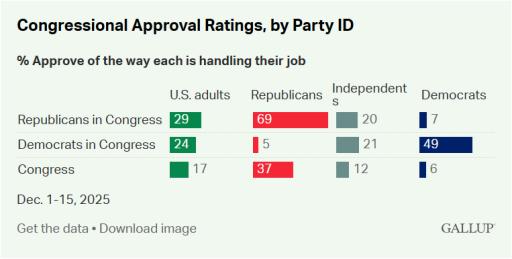
Historical comparisons are complicated because Gallup has not measured approval of the parties in Congress since February 2020. Republicans in Congress have previously recorded lower approval ratings, including 20% in September 2017, but congressional Democrats' current rating is lower than any prior Gallup measurement.
National Mood Sour Amid Worsening Economic Evaluations
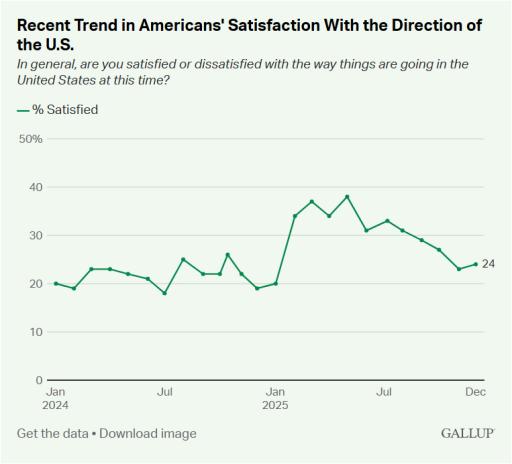
The poll also finds 24% of Americans satisfied and 74% dissatisfied with the way things are going in the country, which is unchanged from November but more negative than all other readings since January. As recently as May, 38% of U.S. adults were satisfied. Satisfaction levels remain slightly higher than at the end of the Biden administration.
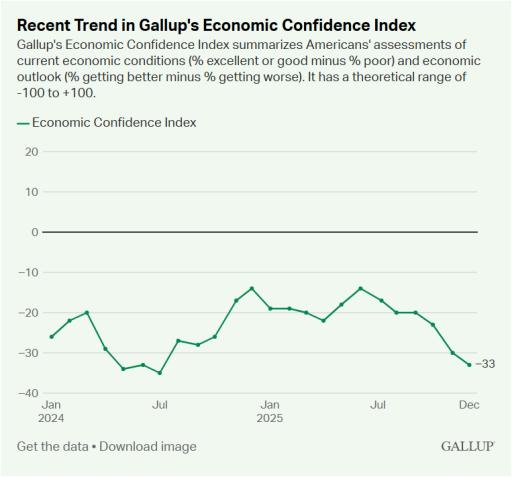
Declining satisfaction has coincided with worsening views of the economy in recent months. Gallup's Economic Confidence Index currently sits at -33, which is down 10 points from October and 19 points from June, and is the lowest it has been since registering -35 in July 2024. The index summarizes Americans' evaluations of current economic conditions and their perceptions of whether the economy is getting better or getting worse. It has a theoretical range of -100 to +100.
Nearly half of U.S. adults (47%) now describe current economic conditions as "poor," up from 40% in November and the highest since September 2024. Just 21% believe economic conditions are either "excellent" or "good," while another 31% describe them as "only fair."
Meanwhile, 68% say economic conditions are getting worse, compared with 29% who say better. Americans have consistently been more pessimistic than optimistic about the economy's direction in recent years, but the current figures represent a deterioration from earlier this year. In May, 58% thought the economy was getting worse and 37% thought it was improving.
Consistent with those worsening economic evaluations, Americans are more inclined to name economic issues as the most important problem facing the country. Currently, 35% do so, up from 24% in both September and October. This increase is mainly because more people name the economy in general and inflation as the top U.S. problems. Mentions of the economy in general are up to 17% from 10% in September, while mentions of inflation have increased to 11% from 6% in September.
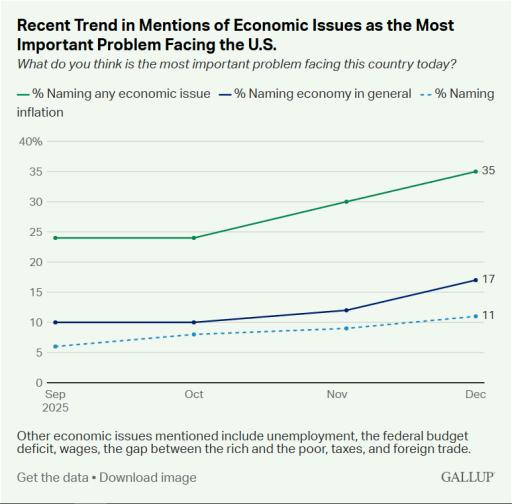
Both the economy and inflation are named less often than the government or poor leadership (26%) and immigration (19%) as the most important problem.
The government has ranked first on the list each month since November 2024, while immigration has mostly been second during that time but has ranked third (behind the economy in general) in a few surveys.
Political, Economic, Judicial Leaders Also Earn Low Approval Ratings
A steady 36% of Americans approve of Donald Trump's job performance, including 89% of Republicans, 25% of independents and 3% of Democrats. The president's approval rating is unchanged from last month, when it fell to the lowest of his second term, just barely above his personal low of 34% in January 2021.
None of 12 other U.S. leaders from Congress, the Cabinet, the Supreme Court or the Federal Reserve earn majority-level approval either. Just two — Federal Reserve Chairman Jerome Powell (44%) and Secretary of State Marco Rubio (41%) — are rated above 40%. Meanwhile, Senate Republican Leader John Thune (34%) and Senate Democratic Leader Chuck Schumer (28%) rank at the bottom of the list.
Ratings range from 35% to 39% for eight others, including Speaker of the House Mike Johnson, Defense Secretary Pete Hegseth, Attorney General Pam Bondi, House Democratic Leader Hakeem Jeffries, Treasury Secretary Scott Bessent, Supreme Court Chief Justice John Roberts, Secretary of Health and Human Services Robert F. Kennedy Jr., and Vice President JD Vance.
Majorities of Republicans approve of all of the Republican leaders on the list, but not Powell or the two congressional Democrats. A majority of Democrats approve of only one of the two Democratic leaders rated, Jeffries, while less than half also approve of Powell. Notably, just 39% of Democrats approve of the job Schumer is doing, while 56% disapprove.
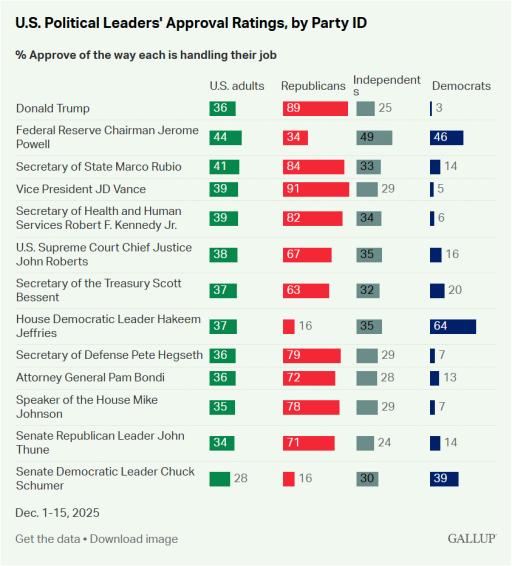
Schumer's rating among his own party has worsened markedly. Two years ago, 76% of Democrats approved of his job and 20% disapproved, but now 39% approve and 56% disapprove.
At the same time, Schumer's House-side counterpart Jeffries' rating has seen a smaller erosion among Democrats, from 80% approval/16% disapproval in 2023 to the current 64% approval/35% disapproval.
Trump Rated Highest for Leadership, Lowest for Honesty
The poll also updated Americans' perceptions of Trump's presidential qualities for the first time in his second term. Of seven characteristics tested, being a "strong and decisive leader" is Trump's highest-rated attribute, as 48% of Americans say this applies to him.
Four in 10 Americans say Trump can bring about changes the country needs, while 39% think he can manage the government effectively. Just over one-third of Americans believe Trump keeps his promises (37%), puts the country's interests ahead of his own (35%) or cares about the needs of people like them (34%). Only 30% of U.S. adults view Trump as honest and trustworthy.
Opinions diverge sharply by party on Trump's leadership and competence, with between 89% and 94% of Republicans saying the president is strong and decisive, can bring about needed changes, and can effectively manage the government. Far fewer independents (29% to 42%) and Democrats (7% to 15%) agree.
Trump is rated less positively by all party groups on the qualities related to character. While still largely praising him, smaller majorities of Republicans see him for his leadership and competency traits (between 77% and 85%). Between 19% and 27% of independents think Trump embodies any of the character traits, while Democrats' agreement is only in the single digits.
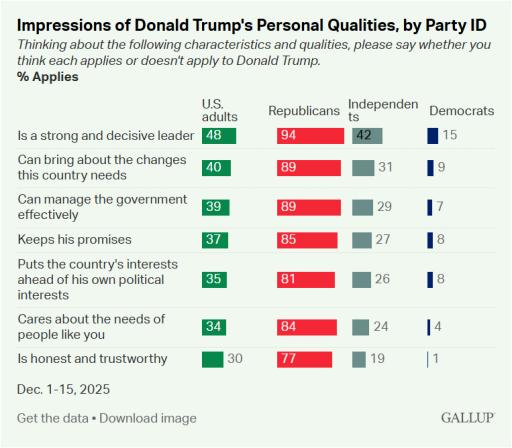
Trump's ratings on these elements are at or near the lowest he has earned in the periodic measurements taken since 2016. Character ratings of presidents tend to follow the trajectory of the incumbent's job approval rating.
Bottom Line
Americans head into 2026 deeply dissatisfied with the nation's direction, offering worsened economic assessments and broadly negative views of political leadership following the historic government shutdown. Approval of the president, Congress and key national leaders from both parties remains weak and intensely polarized, providing evidence of a continued government shutdown hangover.
Be a good human. Grossly derogatory comments, blatantly inflammatory comments, excessive trolling, mean-spirited taunting and insults, scamming, spamming, and off topic comments may be removed in compliance with the site's Terms of Service and the Code of Conduct. The moderators have the final word.

IMO the most surprising aspect of these poll results is how far Democratic support for their own Congressional leadership has cratered. Conventional wisdom would tell us that Chuck Schumer has to go. But politics is no longer conventional, is it?
Nor is it "wise" it would appear.
The numbers make it clear that we are losing our republic to a form of elective despotism that permeates even those institutions/branches that were meant to keep each other in check. Elected officials today at all levels, and in all branches, are more beholden to party than they are to the people. That is a major problem that founders like Jefferson and Madison feared as you can read from their many writings.
It could be argued that to the extent that we have let the parties drift to their often irrational extremes, we are getting the government we deserve. To get back on track we must all seek to be better informed as an electorate, make rational decisions based on facts, logic and reason, and hold our elected officials accountable when they put party and power ahead of the needs of the electorate. We need to break the stranglehold of party loyalty when it comes to electing our leaders. The current levels of corruption and grift that infect our executive and legislative branches can only be remedied by insisting on proper non-partisan oversight, exposure, and prosecution of those who have belied our trust. Then going forward elect only those leaders who are on board with that. We best get busy!
Perhaps. But that seems to overlook the abnegation of responsibilities. IMO we have more of a performative government where the elected public servants focus attention on the theatrical aspects of governing as rather than actually attempting to govern in an intelligent manner. Like it or not, that mix of despotism and abnegation has resulted in a conventional practice of minority rule simply because it is easier to put on a big show over abstractions without deep scrutiny of policy failures disguised by the distracting pomp and ceremony.
The evolving political conventional wisdom of the ruling class over the last 70 or 80 years has stagnated into a cycle of threats against all and promises of benefit for some, justified by abstractions and, essentially, phony moral gaslighting. That has resulted in a perverted form of noblesse oblige intended to establish an electorate dependent on the ruling class. Any sort of non-partisan oversight would vest even greater autocratic authority into an unelected ruling body that could eventually assume totalitarian control over society. (That is the fear Jefferson and Madison warned about.) How can we cure self serving despotic impulses with a more potent form of autocracy? Those who have such power do not want to relinquish it and those without such power want to obtain it. IMO the goal should be to disperse power rather than further concentrate it.
Today's political unrest and turmoil appears to be the result of entrenched interests and dynastic politics (the political parties) losing control over the electorate. Basically the voters have become too independent and the ruling class fears too much democracy. IMO politics is unsettled because of voter rebellion rather than voter complacency. (That is slightly different than Jefferson's and Madison's fears of despotism because the electorate can also pursue a populist despotism that ruling class cannot control.) The electorate are not just complaining any longer. The electorate is making demands that the government work on their behalf. And the electorate are not being distracted by theatrics and moral gaslighting. The electorate seems to be reasserting its authority.
Good points for sure but at the end of the day these "public servants" are putting on a show that traps the voters into making party line choices based on that theater rather than voting in an intelligent or well informed manner. How many times do we hear that folks say that they are simply choosing between the lesser of two evils? Problem is that both are bad choices and that is reflected in the satisfaction poll numbers.
Indeed! And that is a result of the electorate falling for the theater rather than taking the time to understand the issues and the impacts of policy disguised as noble, but actually aimed at securing power via fear and dependency.
Not sure I follow. Jefferson and Madison feared primarily the loss or erosion of the separation of powers and checks and balances as they pertain to the executive, legislative, and judicial branches of the new republic. They feared a return to the despotism they saw in Europe. The two modern parties have grown to become the despot generating power hungry machine that is precisely what they feared. Proper oversight was supposed to be part of the system design but has now become just another weapon in the partisan arsenal, each party weaponizing the oversight of its enemies while overlooking the misdeeds/failures of their own party or policies.
The oversight needs to be impartial and based solely on the facts and the law, not on who is friend or foe. How can we do that while trapped in the two party power pendulum that we find ourselves in? We need to start by electing leaders who are not beholden to the two parties and are committed to real and intelligent policy and oversight. Perhaps a citizens commission of sorts could help, somewhat like the citizens redistricting commission that was established here in California to prevent both parties from gerrymandering to manipulate the electorate and maintain power. Yes the same one that Newsom and the ruling class in CA recently overrode to gain more power, proving that such oversight is a threat to their maintenance of power and the state of dependency they have created.
Have they really lost control of the electorate though? You mentioned above that they have successfully established an electorate dependent on the ruling class. That certainly seems evident to me when the electorate is manipulated first by gerrymandering, then by propaganda and fear about the other party who wants to end democracy and ruin your life, and then by convincing the electorate that voting for them is the only way to save the country. I do agree that we are seeing a trend away from two party voter registration and have seen a concerted move toward independent status which is great to see. But as independents we need to break free of the feeling at the polls that we must vote for the lesser of two evils, lest we waste our vote. All that does is lock us into the two party paradigm. We need to find, cultivate, and support candidates who will put the people ahead of party and be fully behind proper legal oversight and cleanup of a Federal Government that is itself out of control.
I'm not sure that is happening quite yet, but agree that at some point it must.
Didn't Thomas Jefferson also suggest that the remedy for concentrated despotic authority at the Federal level was a guarantee of state's rights and dispersed authority among the states? Establishing some sort of citizen tribunal does not avoid the implicit undemocratic nature of priorities to guide the tribunal's actions. Replacing a partisan despot with a non-partisan despot doesn't really appear to solve anything.
The increasingly militant factions within both parties suggests a loss of control by the party establishment. These factions are now exerting their influence/authority by primarying incumbents. I believe we are beginning to see state parties reassert their authority over central party establishment. I think the party charters are being used (and challenged) to reassert state authority within each party and strip away some of the centralized authority in each party. Efforts to lessen the power of at-large delegates (Superdelegates in the Democratic Party) seem to suggest that power within the parties is being decentralized. The emerging interest in ranked voting during primaries is intended to break the influence of outside money and national level party influence. There is already noise going around to allow state party operations to function as a quasi-Super PAC to recapture influence and power at the state level. If the trends continue, IMO we should expect to hear more noise about election finance reforms to allow state parties more freedom from national party influence.
Yes he did, that is correct. However, the reality is that State governments can become despotic as well, especially when they turn a blind eye to corruption often involving both state and federal taxpayer funds, when they engage in profligate spending without proper tracking and oversight, or when they actively or purposefully impede or obstruct longstanding federal law.
I hope you are right about that! And you might be right as evidenced by several Republican state legislatures who are bucking the Trump push for redistricting prior to the next couple of elections (aka gerrymandering), while blue states like California are going all in on such partisan gerrymandering. The leaders of the California Citizen's Redistricting Commission and the left leaning Cal Matters were both urging a NO vote on Prop 50, so it seems at least a few on the left side of the spectrum were bucking Democratic gerrymandering too. Sadly Newsom and his minions in the state were able to pull the wool over the eyes of the electorate using their dreaded enemy's very tactics.