
The elimination of the penny shows signs of unforeseen costs

By: Daniel Nuccio (Washington Examiner via MSN)

How does a market economy function without cash? Businesses refusing to accept US currency is the logical next step to a grifter TEA Party economy.
 S E E D E D C O N T E N T

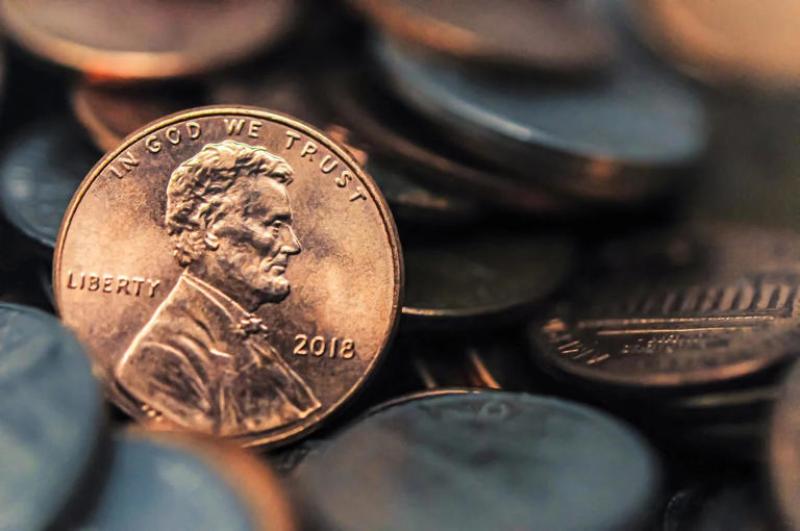
When President Donald Trump announced the discontinuation of the penny in February, responses ranged from a resounding “meh” to borderline celebration.
Outside circles of nostalgics, dedicated hobbyists, and amateur numismatists, nobody really cared. Nobody shed a tear. The only negative word anyone could muster typically came in the form of a couple of lines from commentators wondering what this would mean for disenfranchised individuals, namely the elderly and impecunious, unfortunate enough to find themselves using physical currency in the 21st century
And, to a large extent, such indifference, if not casual approval, is understandable. Practically speaking, the number of people who still use cash with any regularity, although not strictly limited to the elderly and the poor, is declining. Meanwhile, even those who do use it seldom use change and almost certainly never use pennies.
Moreover, there has long been a perennial complaint and indisputable bit of trivia that pennies cost more to make than they are actually worth, meaning if penny production were a business, it would be a failure. For those wondering about fun facts for trivia night, according to a 2024 report by U.S. Mint, America’s one-cent coin actually costs $3.69 to produce. Thus, for fiscal conservatives, the end of the penny is a much-needed cut to what seems like obvious government waste. Some are even now looking to nix the nickel. Once more, for trivia night, our five-cent coin costs a whopping $13.78 to make.
However, the elimination of the penny is not without its downsides, which should have been obvious to anyone who bothered to think this through. Namely, the loss of the penny makes maintaining a working cash system less tenable and less desirable.
If you have a monetary system in which the smallest meaningful unit of value equals one cent, but the smallest available piece of currency is five times that, or perhaps 10 if the nickel nixers get their way, your monetary system no longer works, or at least doesn’t allow for a workable cash system without placing a penalty on cash transactions.
Subsequently, given the absence of official guidance on how to cope with this latest development, which may still require final approval by Congress, many retailers now report uncertainty over how to manage cash transactions.
As penny purgers blithely have suggested, businesses can round such transactions up or down, while whichever party is on the losing end can simply shrug off the loss. Yet, in practice, customers might feel a little cheated, while businesses might be reluctant to lose money every time a customer pays in cash.
Consequently, some businesses have started limiting cash transactions to exact change. My local Panera has signage asking customers to refrain from using cash unless absolutely necessary. Alternatively, others might opt for a cashless system altogether. During my most recent trip to my local AMC, I was informed by an employee that the chain had taken this route, possibly due to the discontinuation of the penny. However, AMC has not responded to my email requesting confirmation.
And, even though some countries have seemingly extirpated their penny equivalents without going completely cashless, this option might be the most reasonable choice for most businesses, barring the penny’s resurrection or legislation requiring them to accept cash. However, before we allow ourselves to be nudged closer to becoming a cashless society, perhaps it’s worth considering what this means: more surveillance, coupled with the possibility that one’s ability to engage in basic financial transactions can be shut off. Hence, perhaps before we allow the penny to fade into history, it’s worth rethinking the costs of its disappearance.
Daniel Nuccio is an independent journalist and a spring 2026 College Fix fellow. He is a regular contributor to the College Fix and the Brownstone Institute. He earned his doctorate in biology in 2025.
Be a good human. Grossly derogatory comments, blatantly inflammatory comments, excessive trolling, mean-spirited taunting and insults, scamming, spamming, and off topic comments may be removed in compliance with the site's Terms of Service and the Code of Conduct. The moderators have the final word.

Tags
Who is online
100 visitors
Banks own your asses now. In a cashless society, banks control every purchase -- and -- take a cut. A cashless society would be the ultimate grifter economy. The TEA Party must be ecstatic with the prospect that people will just hand them money for doing nothing productive.
The Tea Party had really nothing to do with eliminating the penny. what a bizarre association
The TEA Party champions of fiscal responsibility are disassociating themselves from cutting government spending? That's certainly a different colored sky.
How much does it cost to make a penny?
Then why aren't people melting down pennies to recover the metal? The facts are that the penny contains 0.85 to 0.95 cents worth of metal. The rest of the cost includes cost of manufacturing bi-metal blanks, profit for the manufacturer of the blanks, and production and administration costs by the mint. (Remember the TEA Party telling us why the US can't compete in manufacturing?)
You are relying on rigged TEA Party facts.
How does a market economy work without cash? Money produced by government is a public good. Eliminating cash privatizes our money supply and allows private enterprises to profit from intermediary controls over transactions. In a cashless economy the government isn't needed any longer so can be removed from the marketplace.
Digitized transactions with government (paying taxes, fines, etc.) already allows private businesses to scrape profit from the transaction. The EBT cards used by government already support a less visible market for financial intermediaries that enrich themselves by scraping profit from delivery of a public good. ACA insurance providers are not delivering a charitable service; they expect to enrich themselves by being the gatekeeper between the public good and the recipient. Just think how much money can be made by being the intermediary middleman in every transaction that occurs in our economy.
The government producing the money we use as a currency of exchange is a public good. It's no different that building highways to transport goods and supply the marketplace. Allowing private enterprise to control the transactions in our economy is no different than allowing private enterprise to charge tolls to use highways.
Should the penny be a public utility or a private profit center?
That's an insult and one you should apologize for. Everybody here knows I'm not TEA party.
Doesn't matter what you are (or are not). You are still spreading rigged TEA Party facts and misinformation. You are doing the TEA Party dirty work.[✘]
Trout's numbers are correct. They are not TEA party numbers, they are facts.
It costs almost 4 cents to produce a penny coin. Go ahead and try to dispute that.
Well, that depends on the cost of labor, the manufacturing process, the feedstock, and the amount of profit being extracted. Producing a penny from steel would reduce the cost to less than a penny by simplifying the manufacturing process and using a lower cost feedstock. And steel has been used for pennies in the past.
Yeah, those numbers are not correct.
The first link there actually goes to the 2024 report from the US Mint and it includes the table showing to breakdown of costs. Whoever wrote the seeded article incorrectly showed the cost as dollars rather than cents.
But any way you look at it, when it costs more to make the coin than the actual value of the coin, something is wrong in the state of Denmark.
From you, I will accept that.
Frankly, I could care less about pennies. But please don't take away my nickels, dimes, and quarters or I will have to play with matchsticks when playing poker
Then why aren't people recovering the metal from the coins? The facts are the value of the metal in the coins is less than the face value of the coins. A penny is still worth more than the metal it contains.
The cost of production is more than the value of the coin. Which proves US production cannot compete in the global marketplace because the cost of production is so high.
But that argument deliberately hides that the high cost of production is a direct result of non-productive financial activities debasing our currency. Today's dollar has the equivalent buying power as 13 cents in 1971 (when our money became a fiat currency). We cannot afford to produce pennies because Wall Street, banks, and the TEA Party sold out the US.
Because one cannot recover the cost of production from the coin. Plus the cost involved to melt, prepare, and sell the metal further reduces the return.
As an aside, it is also illegal.
Bottom line, this is one area where I agree with Trump. It makes no sense to spend almost 4 cents to produce a penny coin.
Dissolving the zinc in hydrochloric acid would leave the copper behind as scrap metal. Both the metals can be recovered electrolytically or by selective dissolution/precipitation. That's why leach pads are economically profitable.
So is hacking catalytic converters out of cars or cutting the cables off recharging stations. When has illegal been a barrier?
BTW, altering US coins to defraud or counterfeit is what is illegal. The coins, themselves, are not protected by law. That's why the novelty penny press machines were legal; there wasn't an intent to defraud or counterfeit. Recovery of metal from pennies and nickels can be illegal but that only requires crossing the border to avoid the law. (The labor would be cheaper, too.)
Then it follows that it makes no sense for the government to provide any public good that cannot recover costs. A national park that cannot pay for its own operation should be closed. If the weather service cannot collect sufficient revenue to pay its costs then the government should cancel the service. If a NASA rover on Mars costs more than the monetary value it provides then the program should be curtailed.
The penny represents more than just money. The country has saved nothing by ending production of the penny. The banks own all our asses now.
Isn't that basically the reasoning to stop producing and using the coin? If we cannot produce it for less than the face value, why continue to produce it?
I did not write that it cannot be done, I wrote that it is not economically feasible. You have not demonstrated economic feasibility.
Being illegal is another reason why people do not do this. You asked why and I provided an answer.
Looks like you are yet again (this is old) arguing for the sake of argument.
I made no such argument nor do I agree with your uber-generalized logic. Focus on the penny, Nerm. The value of the penny monetarily is almost meaningless. Given its lack of utility with today's prices the cost to produce it makes further production a stupid idea.
We save almost 4 cents per produced coin. Change happens, Nerm. Conditions sometimes cause us to end practices that are no longer sensible. This IMO is one of them.
The damned bankers are not eliminating pennies on paper, are they? The credit card companies are still counting pennies. So, obviously, the penny performs an important and necessary function in the marketplace. We should continue producing pennies because they underpin the public good of the marketplace.
What is being eliminated are informal transactions between individuals that rely on a currency of exchange. If the currency of exchange is eliminated in the formal marketplace then currency won't be available for peer-to-peer commerce that trades in used goods, handcrafts, spot labor, and a myriad of other activities that require exchange of currency. How do you pay the neighbor kid to clear snow off your driveway without cash?
You know damned well that the cost to produce one particular item can be shifted and dispersed across the entire product line. Isn't that one of the ways that China cheats?
The justifications being given to eliminate production of pennies does not demonstrate any skill at running a business.
Correct, bankers and merchants are still using pennies. You can use pennies, it's only at this point that the government has stopped producing them. Didn't Canada go thru this same issue where they stopped producing pennies but were still used by merchants and the public. Over time businesses rounded purchases to the nearest nickel. It's my understanding that you can still use pennies in Canada if you use them to make a nickel and they can be turned in to banks for deposit. I don't know how long it took for that change to occur up there, haven't been to Canada for too many years I'm afraid. But we will likely go thru the same transition here.
One last statement, when has the federal government ever demonstrated any skill at running a business with the sole exception of running it into the red.
Yep and if you are paying cash you can still use pennies, however if not then the amount is rounded up or down to the nearest nickel