
Abraham Lincoln signs the Emancipation Proclamation | January 1, 1863

By: (HISTORY)


 S E E D E D C O N T E N T
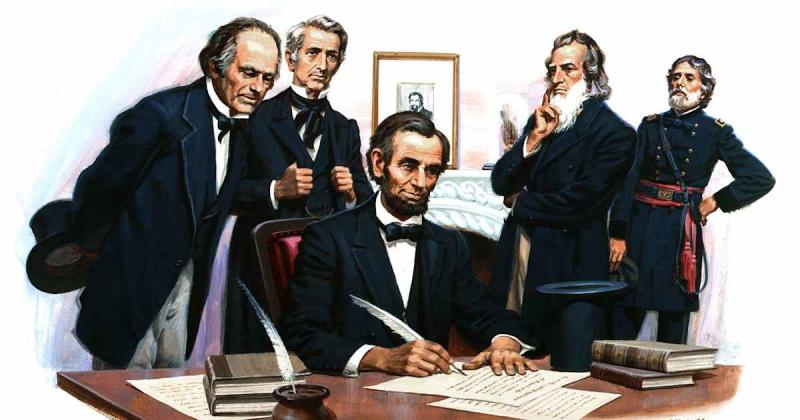
On January 1, 1863, Abraham Lincoln signs the Emancipation Proclamation. Attempting to stitch together a nation mired in a bloody civil war, Abraham Lincoln made a last-ditch, but carefully calculated, decision regarding the institution of slavery in America.
Emancipation Proclamation
By the end of 1862, things were not looking good for the Union. The Confederate Army had overcome Union troops in significant battles and Britain and France were set to officially recognize the Confederacy as a separate nation. In an August 1862 letter to New York Tribune editor Horace Greeley, Lincoln confessed "my paramount object in this struggle is to save the Union, and it is not either to save or to destroy slavery." Lincoln hoped that declaring a national policy of emancipation would stimulate a rush of the South's enslaved people into the ranks of the Union army, thus depleting the Confederacy's labor force, on which the southern states depended to wage war against the North.
Lincoln waited to unveil the proclamation until he could do so on the heels of a Union military success. On September 22, 1862, after the battle at Antietam, he issued a preliminary Emancipation Proclamation declaring all enslaved people free in the rebellious states as of January 1, 1863. Lincoln and his advisors limited the proclamation's language to slavery in states outside of federal control as of 1862, failing to address the contentious issue of slavery within the nation's border states. In his attempt to appease all parties, Lincoln left many loopholes open that civil rights advocates would be forced to tackle in the future.
Republican abolitionists in the North rejoiced that Lincoln had finally thrown his full weight behind the cause for which they had elected him. Though enslaved people in the south failed to rebel en masse with the signing of the proclamation, they slowly began to liberate themselves as Union armies marched into Confederate territory. Toward the end of the war, enslaved people left their former masters in droves. They fought and grew crops for the Union Army, performed other military jobs and worked in the North's mills. Though the proclamation was not greeted with joy by all northerners, particularly northern white workers and troops fearful of job competition from an influx of formerly enslaved people, it had the distinct benefit of convincing Britain and France to steer clear of official diplomatic relations with the Confederacy.
Though the signing of the Emancipation Proclamation signified Lincoln's growing resolve to preserve the Union at all costs, he still rejoiced in the ethical correctness of his decision. Lincoln admitted on that New Year's Day in 1863 that he never "felt more certain that I was doing right, than I do in signing this paper." Although he waffled on the subject of slavery in the early years of his presidency, he would thereafter be remembered as "The Great Emancipator." To Confederate sympathizers, however, Lincoln's signing of the Emancipation Proclamation reinforced their image of him as a hated despot and ultimately inspired his assassination by John Wilkes Booth on April 14, 1865.
Also on This Day in History
Discover more of the major events, famous births, notable deaths and everything else history-making that happened on January 1st
45 bc -- The Julian calendar takes effect for the first time on New Year's Day
In 45 B.C., New Year's Day is celebrated on January 1 for the first time in history as the Julian calendar takes effect. Soon after becoming Roman dictator, Julius Caesar decided that the traditional Roman calendar was in dire need of reform. Introduced around the seventh century B.C., the Roman calendar attempted to follow the […]
1781 -- Mutiny of the Pennsylvania Line
On January 1, 1781, 1,500 soldiers from the Pennsylvania Line—all 11 regiments under General Anthony Wayne's command—insist that their three-year enlistments are expired, kill three officers in a drunken rage and abandon the Continental Army's winter camp at Morristown, New Jersey. The insurrection, dubbed the Mutiny of the Pennsylvania Line, reflects the challenges General George […]
1804 -- Haitian independence proclaimed
Two months after his defeat of Napoleon Bonaparte's colonial forces, Jean-Jacques Dessalines proclaims the independence of Saint-Domingue, renaming it Haiti after its original Arawak name. In 1791, a revolt erupted on the French colony, and Toussaint Louverture, a formerly enslaved man, took control of the rebels. Gifted with natural military genius, Toussaint organized an effective […]
1818 -- Mary Shelley's "Frankenstein" is published
Frankenstein; or, The Modern Prometheus is published. The book, by 20-year-old Mary Wollstonecraft Shelley, is frequently called the world's first science fiction novel. In Shelley's tale, a scientist animates a creature constructed from dismembered corpses. The gentle, intellectually gifted creature is enormous and physically hideous. Cruelly rejected by its creator, it wanders, seeking companionship and […]
1835 -- The U.S. national debt reaches $0 for the first time
On January 1, 1835, President Andrew Jackson achieves his goal of entirely paying off the United States' national debt. It was the only time in U.S. history that the national debt stood at zero, and it precipitated one of the worst financial crises in American history. The elimination of the national debt was both a […]
1863 -- A Nebraska farmer files the first homestead claim
A farmer named Daniel Freeman submits the first claim under the new Homestead Act for a property near Beatrice, Nebraska. Signed into law in 1862 by President Abraham Lincoln, the Homestead Act essentially legalized the long-standing American practice of squatting on the vast federal landholdings in the West, much of it taken from Native American […]
1892 -- The first immigrants arrive at Ellis Island
On New Year's Day 1892, Annie Moore, a teenage girl from Ireland, becomes the very first immigrant to be processed on America's Ellis Island. Annie, along with her two younger brothers, kick off an immigration era that, over the next 62 years, brings more than 12 million immigrants through Ellis Island, located in New York […]
1915 -- A preview of "The Birth of a Nation" is shown to audiences
On January 1, 1915, audiences file into the Loring Opera House at 3745 7th Street in Riverside, California, for a sneak preview of D.W. Griffith's first full-length feature film, The Clansman. Later renamed The Birth of a Nation, the controversial Civil War epic would become Hollywood's first blockbuster hit. After making more than 450 short […]
1923 -- Rosewood Massacre decimates Black Florida community
On the first day of 1923, white vigilante mobs begin their descent upon the predominantly Black community of Rosewood, Florida. In an attack that would last several days, they shoot and beat Black residents, set buildings aflame and raze the small, but prosperous mill town that was home to approximately 200 people. Earlier that day, […]
1942 -- 26 WWII Allies declare themselves "United Nations"
President Franklin D. Roosevelt and British Prime Minister Winston Churchill issue a declaration, signed by representatives of 26 countries, called the "United Nations." The signatories of the declaration vowed to create an international postwar peacekeeping organization. On December 22, 1941, Churchill arrived in Washington, D.C., for the Arcadia Conference, a discussion with President Roosevelt about […]
1958 -- Johnny Cash plays San Quentin State Prison
The prison that Cash was most closely associated was San Quentin.
1959 - Batista forced out by Castro-led revolution
Fidel Castro and his 26th of July Movement forces Cuban dictator Fulgencio Batista to flee the island nation.
1980 - Sherry Lansing named first female studio production head
In an article datelined January 1, 1980, under the headline "Sherry Lansing, Former Model, Named Head of Fox Productions," The New York Times announces the first woman to head production at a major movie studio. Selected to lead the production department at 20th Century Fox, Lansing signing a three-year contract at a minimum of $300,000 […]
1994 -- The North American Free Trade Agreement comes into effect
On January 1, 1994, one of the largest and most significant trade pacts in world history comes into effect. The North American Free Trade Agreement between Canada, the United States and Mexico removed most of the trade barriers between the three countries, but it has been controversial in all three since its inception. Ronald Reagan […]
1999 -- The euro debuts
New Year's Day is the dawn of a new era in Europe, as 11 nations adopt a single currency, the euro. Now the official currency of 19 members of the European Union, as well as the nations of Kosovo and Montenegro, the euro's introduction had a profound effect on the global economy and was a […]
2006 -- New England Patriots' Doug Flutie makes NFL's first drop kick since 1941
On January 1, 2006, following a New England Patriots touchdown against the Miami Dolphins, Doug Flutie enters the game for what initially appears to be a two-point conversion play. After getting his teammates set in a "very strange formation," Flutie backs up well beyond the normal shotgun position, to the 13-yard line, catches the snap, […]
2008 -- Sidney Crosby wins first NHL game played outdoors in US
On January 1, 2008, with snowflakes falling around him in Buffalo, Pittsburgh Penguins star Sidney Crosby slips a shot past Ryan Miller to win the NHL's inaugural Winter Classic—the first regular-season game in league history played outdoors in the United States. The game is played before 71,127 fans at Ralph Wilson Stadium, home of the […]
Be a good human. Grossly derogatory comments, blatantly inflammatory comments, excessive trolling, mean-spirited taunting and insults, scamming, spamming, and off topic comments may be removed in compliance with the site's Terms of Service and the Code of Conduct. The moderators have the final word.

Tags
Who is online
128 visitors
The first Republicans were not RINOs; they were real men.