
U.S.-Russia detente ends | January 2, 1980

By: HISTORY


 S E E D E D C O N T E N T
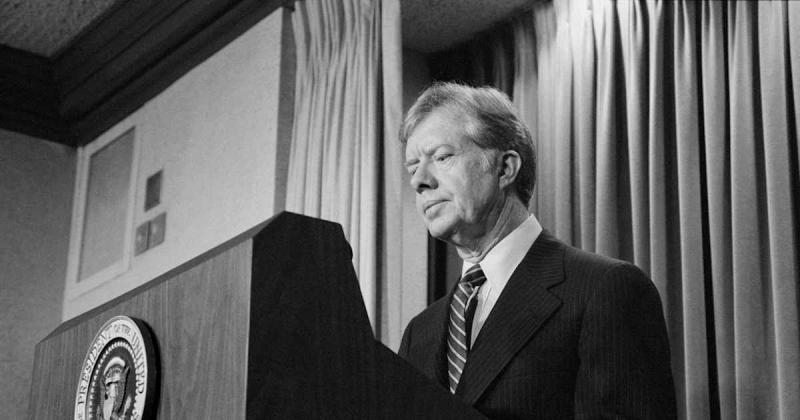
On January 2, 1980, in a strong reaction to the December 1979 Soviet invasion of Afghanistan, President Jimmy Carter asks the Senate to postpone action on the SALT II nuclear weapons treaty and recalls the U.S. ambassador to Moscow. These actions sent a message that the age of detente and the friendlier diplomatic and economic relations that were established between the United States and Soviet Union during President Richard Nixon's administration (1969-74) had ended.
Carter feared that the Soviet invasion of Afghanistan, in which an estimated 30,000 combat troops entered that nation and established a puppet government, would threaten the stability of strategic neighboring countries such as Iran and Pakistan and could lead to the USSR gaining control over much of the world's oil supplies. The Soviet actions were labeled "a serious threat to peace" by the White House. Carter asked the Senate to shelve ratification talks on SALT II, the nuclear arms treaty that he and Soviet Premier Leonid Brezhnev had already signed, and the president called U.S. ambassador to Moscow Thomas J. Watson back to Washington for "consultation," in an effort to let the Kremlin know that military intervention in Afghanistan was unacceptable.
Jimmy Carter
Find out more about Jimmy Carter's life after leaving the Oval Office, including his Nobel Peace Prize win.
2:27m watch
When the Soviets refused to withdraw from Afghanistan, America halted certain key exports to the USSR, including grain and high technology, and boycotted the 1980 summer Olympics, which were held in Moscow. The United States also began to covertly subsidize anti-Soviet fighters in Afghanistan. During Ronald Reagan's presidency in the 1980s, the CIA secretly sent billions of dollars to Afghanistan to arm and train the mujahedeen rebel forces that were battling the Soviets. This tactic was successful in helping to drive out the Soviets, but it also gave rise to the oppressive Taliban regime and Osama bin Laden's al-Qaida terrorist organization.
In 1980, Jimmy Carter lost the presidency to Ronald Reagan, who favored a more aggressive anti-Communist foreign policy. Reagan dubbed the USSR the "evil empire" and believed it was America's responsibility to save the world from Soviet repression. He dramatically increased U.S. defense spending and ramped up the nuclear arms race with the Soviets, whose faltering economy ultimately prevented them from keeping pace. The Soviet Union collapsed in 1991.
Also on This Day in History
Discover more of the major events, famous births, notable deaths and everything else history-making that happened on January 2nd
1492 -- Reconquest of Spain
The kingdom of Granada falls to the Christian forces of King Ferdinand V and Queen Isabella I, and the Moors lose their last foothold in Spain. Located at the confluence of the Darro and Genil rivers in southern Spain, the city of Granada was a Moorish fortress that rose to prominence during the reign of […]
1776 -- Continental Congress publishes the Tory Act
The Continental Congress publishes the "Tory Act" resolution on January 2, 1776, which describes how colonies should handle those Americans who remain loyal to the British and King George. The act called on colonial committees to indoctrinate those "honest and well-meaning, but uninformed people" by enlightening them as to the "origin, nature and extent of […]
1788 -- Georgia enters the Union
Georgia votes to ratify the U.S. Constitution, becoming the fourth state in the modern United States. Named after King George II, Georgia was first settled by Europeans in 1733, when a group of British debtors led by English philanthropist James E. Oglethorpe traveled up the Savannah River and established Georgia's first permanent settlement—the town of […]
1811 -- First censuring of a U.S. senator
Senator Timothy Pickering, a Federalist from Massachusetts, becomes the first senator to be censured when the Senate approves a censure motion against him by a vote of 20 to seven. Pickering was accused of violating congressional law by publicly revealing secret documents communicated by the president to the Senate. During the Revolutionary War, Pickering served […]
1897 -- Author Stephen Crane's boat sinks
On January 2, 1897, American writer Stephen Crane survives the sinking of The Commodore off the coast of Florida. He will turn the harrowing adventure into his classic short story "The Open Boat" (1897). The 25-year-old writer had gained international fame with the publication of his novel The Red Badge of Courage in 1896. A […]
1905 -- Russian fleet surrenders at Port Arthur
During the Russo-Japanese War, Port Arthur, the Russian naval base in China, falls to Japanese naval forces under Admiral Heihachiro Togo. It was the first in a series of defeats that by June turned the tide of the imperial conflict irrevocably against Russia. In February 1904, following a Russian rejection of a Japanese plan to […]
1923 -- Secretary Fall announces resignation in Teapot Dome scandal
Albert Fall, the secretary of the U.S. Department of Interior, announces he is resigning in response to public outrage over the Teapot Dome scandal. Fall's resignation, which took effect two months later, illuminated a deeply corrupt relationship between western developers and the federal government. Born in Kentucky in 1861, Albert Fall moved to New Mexico […]
1946 -- Several Japanese soldiers surrender after learning Pacific War has ended
On January 2, 1946, four months after Japan officially surrendered in World War II, an American soldier accepts the surrender of about 20 Japanese soldiers who had been hiding underground for almost a year—and only discovered that the war was over by reading it in the newspaper. On the island of Corregidor, located at the […]
1958 -- Opera star Maria Callas walks out of performance
On January 2, 1958, celebrated soprano Maria Callas walks off after the first act of a gala performance of Bellini's Norma in Rome, claiming illness. The president of Italy and most of Rome's high society were in the audience, and Callas, known for her volatile temperament, was sharply criticized. It was a characteristic move for […]
1962 -- Folk group The Weavers are banned by NBC after refusing to sign a loyalty oath
The Weavers, one of the most significant popular-music groups of the postwar era, saw their career nearly destroyed during the Red Scare of the early 1950s. Even with anti-communist fervor in decline by the early 1960s, the Weavers' leftist politics were used against them as late as January 2, 1962, when the group's appearance on […]
1965 -- Joe Namath spurns NFL to sign record deal with AFL's New York Jets
On January 2, 1965, quarterback Joe Namath spurns the NFL's St. Louis Cardinals to sign with the American Football League's New York Jets. The contract, reportedly for $427,000, is the most lucrative signed by a rookie in any sport. The deal with Namath, a star at the University of Alabama for head coach Bear Bryant, is […]
1971 -- Football fans crushed in stadium stampede
On January 2, 1971, 66 football (soccer) fans are killed in a stampede at a stadium in Glasgow, Scotland, as they attempt to leave a game after a late goal by the home team. Initial reports suggested that the disaster was caused by fans returning to their seats after hearing of the last goal, but […]
1973 -- The real-life murder behind "Looking For Mr. Goodbar"
In the early hours of January 2, 1973, Roseann Quinn, a 28-year-old New Yorker, is murdered by a man she met a earlier that night at Tweed's Bar on the Upper West Side. The incident inspires the cautionary novel and subsequent movie Looking For Mr. Goodbar. For many, Quinn's murder represented the dark side of […]
1974 -- President Nixon signs national speed limit into law
On January 2, 1974, President Richard M. Nixon signs the Emergency Highway Energy Conservation Act, setting a new national maximum speed limit. Prior to 1974, individual states set speed limits within their boundaries and highway speed limits across the country ranged from 40 mph to 80 mph. The U.S. and other industrialized nations enjoyed easy […]
1981 -- The Yorkshire Ripper is apprehended
The so-called Yorkshire Ripper is finally caught by British police, ending one of the largest manhunts in history. For five years, investigators had pursued every lead in an effort to stop the serial killer who terrorized Northern England, but the end came out of pure happenstance. Peter Sutcliffe was spotted in a car with false […]
2006 -- 13 coal miners are trapped in Sago Mine disaster; 12 die
An explosion rocks the Sago Mine in Sago, West Virginia on January 2, 2006. 13 coal miners were trapped, and all but one eventually died. The tragedy, exacerbated by false reports that 12 of the miners had been rescued, brought scrutiny upon the media, the company that owned the mine and the administration of then-president […]
2009 -- News breaks of rare Bugatti "garage find"
On January 2, 2009, media outlets report that a rare unrestored 1937 Bugatti Type 57S Atalante Coupe has been found in the garage of a British doctor. A month later, in early February, the car sold at a Paris auction for some $4.4 million. The black two-seater, one of just 17 57S Atalante Coupes ever […]
Be a good human. Grossly derogatory comments, blatantly inflammatory comments, excessive trolling, mean-spirited taunting and insults, scamming, spamming, and off topic comments may be removed in compliance with the site's Terms of Service and the Code of Conduct. The moderators have the final word.

Tags
Who is online
128 visitors
The United States became involved in the Soviet (Russian) invasion of Afghanistan. And how did Afghanistan repay the US? History seems to be repeating itself.