
Fewer pennies, more problems: Why retailers are pleading for exact change

By: Alex Bitter (Business Insider via MSN)

It's another TEA Party victory! What are they gonna do with their free chump change?
 S E E D E D C O N T E N T

- Retailers are putting up signs at cash registers warning customers that they're out of pennies.
- Some are rounding cash transactions, while others are simply asking for exact change.
- The US struck its last pennies for public use in 2025 but lacks a law about how to make change.
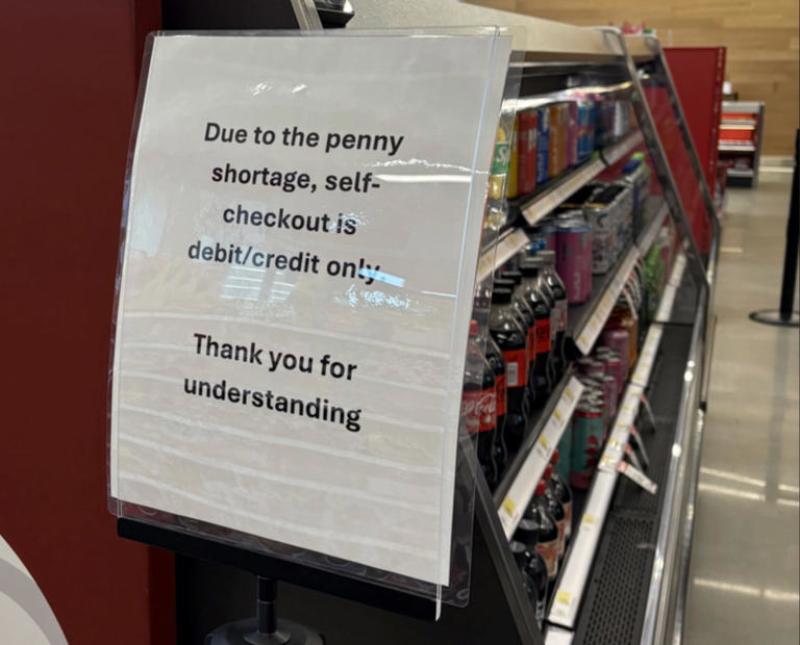
As the US one-cent coin disappears from circulation, stores are putting up signs asking for exact change or advising customers that their change will be rounded.
Retailers from AutoZone to Whole Foods are putting up the signs at checkouts pointing to the penny shortage and outlining their response to it.
Though the US Mint struck the last pennies in November, Congress hasn't approved any laws around the denomination's phase-out, including how retailers should handle cash transactions that don't end in five or 10 cents. That's forced many retailers to implement their own policies, including rounding transactions up or down to a nickel or dime.
"When they don't have pennies, rounding comes into place," Dylan Jeon, the National Retail Federation's senior director of government relations, told Business Insider.
At a Whole Foods location in Brooklyn this week, Business Insider saw a sign saying that the store "is unable to receive new pennies to make change with."
"If you pay in cash, your change will be rounded up to the nearest nickel and may not match the amount you see on the receipt," the sign read.
The policy isn't companywide, a Whole Foods spokesperson said. Rather, the grocer is implementing the policy at locations where local banks no longer have pennies to deliver.
"Customers always receive equal or greater change than owed," the spokesperson said. The chain still accepts pennies if customers have them, the spokesperson said.
Other retailers are using different strategies as pennies disappear.
In late December, a sign at a Panera location in Oklahoma seen by Business Insider said: "Due to a penny shortage, we would appreciate exact change or card payments."
On Reddit, users posted pictures of signs from retailers, including Kroger and AutoZone, that didn't mention a rounding rule but requested that customers using cash pay with exact change.
Besides rounding, some retailers are rationing their remaining pennies by keeping fewer of them in registers, the NRF's Jeon said.
Without a national rounding law, policies can vary between retailers — and potentially confuse customers, he said.
"If they go down the street to their hardware store, and they're rounding a certain way, and then they go to the clothing store and they're rounding differently, that could create some friction," Jeon said.
The Common Cents Act, introduced in Congress last year, would codify rounding to the nearest nickel as the federal standard — something the NRF supports, Jeon said.
Under the proposal, cash transactions ending in 1, 2, 6, or 7 cents would be rounded down to the nearest nickel. Purchases ending in 3, 4, 8, or 9 cents would be rounded up, meanwhile. "You're going to be rounding up as much as you're rounding down," Jeon said.
Canada, which started phasing out its one-cent coin in 2012, implemented a similar rounding law as it ended penny production and provided a model for the US, Jeon said. "Ideally, we want as much standardization as possible," he added.
The bill faced hurdles to passage in 2025, including the longest-ever US government shutdown and debate about a provision aimed at changing the composition of the five-cent coin. But the NRF is lobbying Congress to adopt the rounding language in 2026.
Retailers also risk running afoul of other statutes, Jeon told Business Insider.
Some states and cities, such as New York and Colorado, have passed laws requiring businesses to accept cash so shoppers without credit or debit cards can make purchases. Rounding without a federal law could also conflict with a federal rule requiring retailers to treat shoppers using SNAP benefits, many of whom use cash, the same as other customers, Jeon said.
As it stands, rounding transaction totals to the nearest nickel is at odds with those laws, the NRF and other retail trade groups wrote to the heads of congressional committees in charge of banking and financial services in September.
Be a good human. Grossly derogatory comments, blatantly inflammatory comments, excessive trolling, mean-spirited taunting and insults, scamming, spamming, and off topic comments may be removed in compliance with the site's Terms of Service and the Code of Conduct. The moderators have the final word.

Tags
Who is online
128 visitors
Penny wise and grifter extravagance is why businessmen running government is a bad idea.
Inflation is a bitch!
Getting rid of the Penny isn't such a bad thing but it takes a bit of planning. It's easy enough for retailers to change their prices or round up or down, Gas Stations have been selling gas at prices that always end in .9 cents for as long as I can remember (maybe some of the older members might know when this started) and they always seem to be able to calculate a final total that I can pay with a charge card or Cash. The way I see it is the biggest problem is Taxes and other government fees which the Retailer cannot change or round off (it would be Illegal) and these taxes are often set at % rates that makes pennies necessary and would need to be set at five cent increments. It's kind of crazy that this year there are new laws forcing retailers to accept Cash but at the same time the Government is taking away their ability to make proper change.