
Malcolm X assassinated | February 21, 1965

By: HISTORY


Today over the decades.
 S E E D E D C O N T E N T
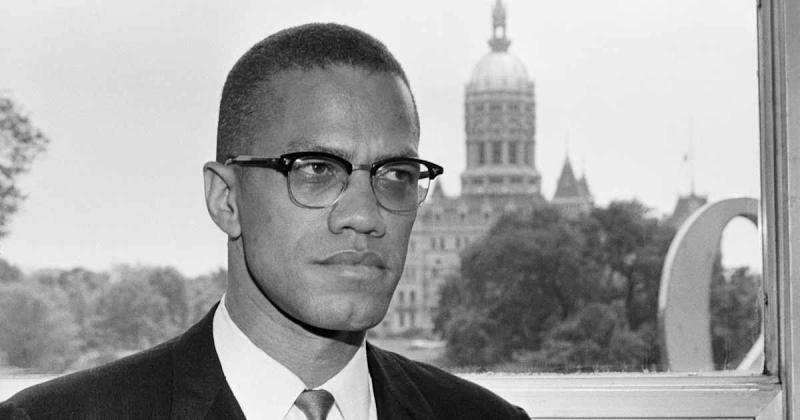
February 21, 1965: In New York City, Malcolm X, a Black nationalist and religious leader, is assassinated while addressing his Organization of Afro-American Unity at the Audubon Ballroom in Washington Heights. He was 39.
Born Malcolm Little in Omaha, Nebraska, in 1925, Malcolm was the son of James Earl Little, a Baptist preacher who advocated the Black nationalist ideals of Marcus Garvey. Threats from the Ku Klux Klan forced the family to move to Lansing, Michigan, where his father continued to preach his controversial sermons despite continuing threats. In 1931, Malcolm's father was murdered by the white supremacist Black Legion, and Michigan authorities refused to prosecute those responsible. In 1937, Malcolm was taken from his family by welfare caseworkers. By the time he reached high school age, he had dropped out of school and moved to Boston, where he became increasingly involved in criminal activities.
Malcolm X
Malcolm X speaks to reporters about the Black Nationalist Movement and the need to establish Black Rifle Clubs.
1:35m watch
In 1946, at the age of 21, Malcolm was sent to prison on a burglary conviction. It was there he encountered the teachings of Elijah Muhammad, the leader of the Nation of Islam, whose members are popularly known as Black Muslims. The Nation of Islam advocated Black nationalism and racial separatism. Muhammad's teachings had a strong effect on Malcolm, who entered into an intense program of self-education and took the last name "X" to symbolize his stolen African identity.
After six years, Malcolm was released from prison and became a loyal and effective minister of the Nation of Islam in Harlem, New York. In contrast with civil rights leaders such as Martin Luther King, Jr., Malcolm X advocated self-defense and the liberation of African Americans "by any means necessary." A fiery orator, Malcolm was admired by the African American community in New York and around the country.
In the early 1960s, he began to develop a more outspoken philosophy than that of Elijah Muhammad, whom he felt did not sufficiently support the civil rights movement. In late 1963, Malcolm's suggestion that President John F. Kennedy's assassination was a matter of the "chickens coming home to roost" provided Elijah Muhammad, who believed that Malcolm had become too powerful, with a convenient opportunity to suspend him from the Nation of Islam.
A few months later, Malcolm formally left the organization and made a Muslim pilgrimage to Mecca, where he was profoundly affected by the lack of racial discord among orthodox Muslims. He returned to America as El-Hajj Malik El-Shabazz and in June 1964 founded the Organization of Afro-American Unity, which advocated Black identity and held that racism, not the white race, was the greatest foe of the African American. Malcolm's new movement steadily gained followers, and his more moderate philosophy became increasingly influential in the Civil Rights Movement, especially among the leaders of the Student Non-Violent Coordinating Committee.
On stage at the Audubon Ballroom on February 21, 1965, Malcolm X was gunned down as his pregnant wife and four daughters took cover in the front row. Three members of the Nation of Islam—Mujahid Abdul Halim, Muhammad A. Aziz and Khalil Islam—were soon after charged with first-degree murder. Islam and Aziz maintained their innocence, and during the 1966 trial, Halim confessed to the crime and testified that Islam and Aziz were innocent. All three men were found guilty, however, and sentenced to 20 years to life in prison.
In 2021, Aziz and Islam were exonerated after an investigation that included the discovery of key FBI documents withheld from the defense and prosecution during the trial. Aziz was 83 at the time of the exoneration; Islam had died in 2009.
Timeline
Also on This Day in History
Discover more of the major events, famous births, notable deaths and everything else history-making that happened on February 21st
1848 -- Karl Marx publishes Communist Manifesto
On February 21, 1848, The Communist Manifesto, written by Karl Marx with the assistance of Friedrich Engels, is published in London by the Communist League.
1862 -- Battle of Valverde
On February 21, 1862, at the Battle of Valverde, Confederate troops under General Henry Hopkins Sibley attack Union troops commanded by Colonel Edward R. S. Canby near Fort Craig in New Mexico Territory. The first major engagement of the Civil War in the far West, the battle produced heavy casualties but no decisive result. This […]
1885 -- Washington Monument dedicated
The Washington Monument, built in honor of America's revolutionary hero and first president, is dedicated in Washington, D.C. The 555-foot-high marble obelisk was first proposed in 1783, and Pierre L'Enfant left room for it in his designs for the new U.S. capital. After George Washington's death in 1799, plans for a memorial for the "father […]
1916 -- Battle of Verdun begins
At 7:12 a.m. on the morning of February 21, 1916, a shot from a German Krupp 38-centimeter long-barreled gun—one of over 1,200 such weapons set to bombard French forces along a 20-kilometer front stretching across the Meuse River—strikes a cathedral in Verdun, France, beginning the Battle of Verdun, which would stretch on for 10 months […]
1918 -- Allied troops capture Jericho
On the morning of February 21, 1918, combined Allied forces of British troops and the Australian mounted cavalry capture the city of Jericho in Palestine after a three-day battle with Turkish troops. Commanded by British General Edmund Allenby, the Allied troops began the offensive on Tuesday, February 19, on the outskirts of Jerusalem. Despite battling […]
1944 -- Japanese prime minister Hideki Tojo makes himself "military czar"
On February 21, 1944, Hideki Tojo, prime minister of Japan, grabs even more power as he takes over as army chief of staff, a position that gives him direct control of the Japanese military. After graduating from the Imperial Military Academy and the Military Staff College, Tojo was sent to Berlin as Japan's military attache […]
1948 -- NASCAR founded
On February 21, 1948, the National Association for Stock Car Racing—or NASCAR, as it will come to be widely known—is officially incorporated. NASCAR racing will go on to become one of America's most popular spectator sports, as well as a multi-billion-dollar industry. The driving force behind the establishment of NASCAR was William "Bill" France Sr. […]
1952 -- Dick Button wins second Olympic figure skating gold
On February 21, 1952, men's figure skater Dick Button wins his second Olympic gold medal. Button captured his first gold prize at the 1948 Olympics, becoming the first American to ever take home the men's title. After dominating men's figure skating at the 1948 and 1952 Olympics, Button retired from amateur competition and later became […]
1961 -- Rockefeller imposter and convicted felon born
On February 21, 1961, Christian Karl Gerhartsreiter, a con man who went by the alias Clark Rockefeller and passed himself off as an American blueblood, is born in Germany. Gerhartsreiter gained the public spotlight in 2008, when he kidnapped his young daughter and became the target of an international manhunt. The attention the case sparked […]
1970 -- Henry Kissinger begins secret negotiations with North Vietnamese
National Security Advisor Henry Kissinger begins secret peace talks with North Vietnamese representative Le Duc Tho, the fifth-ranking member of the Hanoi Politburo, at a villa outside Paris. Le Duc Tho stated that the North Vietnamese position continued to require an unconditional U.S. withdrawal on a fixed date and the abandonment of the Thieu government […]
1972 -- President Nixon arrives in China for talks
In an amazing turn of events, President Richard Nixon takes a dramatic first step toward normalizing relations with the communist People's Republic of China (PRC) by traveling to Beijing for a week of talks. Nixon's historic visit began the slow process of the re-establishing diplomatic relations between the United States and communist China. Still mired […]
1981 -- Dolly Parton cements her crossover success as "9 to 5" hits #1
On February 21, 1981, Dolly Parton notches the biggest hit of her career, when the song "9 to 5" reaches #1 on the Billboard Hot 100 chart. The song, a soundtrack to the movie of the same name, would cement her crossover from country music to mainstream superstardom. Parton brought the full range of her […]
Be a good human. Grossly derogatory comments, blatantly inflammatory comments, excessive trolling, mean-spirited taunting and insults, scamming, spamming, and off topic comments may be removed in compliance with the site's Terms of Service and the Code of Conduct. The moderators have the final word.

Tags
Who is online
117 visitors
If the present is too much then try revisiting the past.