
U.S. hockey team beats the Soviets in the "Miracle on Ice" | February 22, 1980

By: HISTORY


Read about yesterday today.
 S E E D E D C O N T E N T
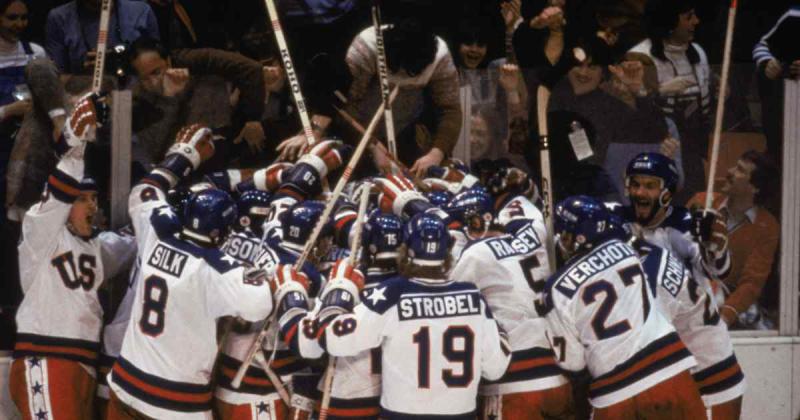
In one of the most dramatic upsets in Olympic history, on February 22, 1980, the underdog U.S. hockey team, made up of college players, defeats the four-time defending gold-medal winning Soviet team at the XIII Olympic Winter Games in Lake Placid, New York. The Soviet squad, previously regarded as the finest in the world, fell to the youthful American team 4-3 before a frenzied crowd of 10,000 spectators. Two days later, the Americans defeated Finland 4-2 to clinch the hockey gold.
The Soviet team had captured the previous four Olympic hockey golds, going back to 1964, and had not lost an Olympic hockey game since 1968. Three days before the Lake Placid Games began, the Soviets routed the U.S. team 10-3 in an exhibition game at Madison Square Garden in New York City. The Americans looked scrappy, but few blamed them for it—their average age, after all, was only 22, and their team captain, Mike Eruzione, was recruited from the obscurity of the Toledo Blades of the International League.
The Olympic Games: Fast Facts
Historian Yohuru Williams dives into the history of the Olympic Games.
1:16m watch
Few had high hopes for the seventh-seeded U.S. team entering the Olympic tournament, but the team soon silenced its detractors, making it through the opening round of play undefeated, with four victories and one tie, thus advancing to the four-team medal round. The Soviets, however, were seeded No. 1 and as expected went undefeated, with five victories in the first round.
On Friday afternoon, February 22, the American amateurs and the Soviet dream team met before a sold-out crowd at Lake Placid. The Soviets broke through first, with their new young star, Valery Krotov, deflecting a slap shot beyond American goalie Jim Craig's reach in the first period. Midway through the period, Buzz Schneider, the only American who had previously been an Olympian, answered the Soviet goal with a high shot over the shoulder of Vladislav Tretiak, the Soviet goalie.
The relentless Soviet attack continued as the period progressed, with Sergei Makarov giving his team a 2-1 lead. With just a few seconds left in the first period, American Dave Christian shot the puck down the ice in desperation. Mark Johnson picked it up and sent it into the Soviet goal with one second remaining. After a brief Soviet protest, the goal was deemed good, and the game was tied.
In the second period, the irritated Soviets came out with a new goalie, Vladimir Myshkin, and turned up the attack. The Soviets dominated play in the second period, outshooting the United States 12-2, and taking a 3-2 lead with a goal by Alesandr Maltsev just over two minutes into the period. If not for several remarkable saves by Jim Craig, the Soviet lead would surely have been higher than 3-2 as the third and final 20-minute period began.
'Miracle on Ice': When the US Olympic Hockey Team Stunned the World
The American hockey squad beat the odds and defeated the Soviet team at the 1980 Winter Olympics in what was called the 'miracle on ice.'
The American hockey squad beat the odds and defeated the Soviet team at the 1980 Winter Olympics in what was called the 'miracle on ice.'
By: Dave Roos
Nearly nine minutes into the period, Johnson took advantage of a Soviet penalty and knocked home a wild shot by David Silk to tie the contest again at 3-3. About a minute and a half later, Mike Eruzione, whose last name means "eruption" in Italian, picked up a loose puck in the Soviet zone and slammed it past Myshkin with a 25-foot wrist shot. For the first time in the game, the Americans had the lead, and the crowd erupted in celebration.
There were still 10 minutes of play to go, but the Americans held on, with Craig making a few more fabulous saves. With five seconds remaining, the Americans finally managed to get the puck out of their zone, and the crowd began counting down the final seconds. When the final horn sounded, the players, coaches, and team officials poured onto the ice in raucous celebration. The Soviet players, as awestruck as everyone else, waited patiently to shake their opponents' hands.
The so-called Miracle on Ice was more than just an Olympic upset; to many Americans, it was an ideological victory in the Cold War as meaningful as the Berlin Airlift or the Apollo moon landing. The upset came at an auspicious time: President Jimmy Carter had just announced that the United States was going to boycott the 1980 Summer Games in Moscow because of the Soviet invasion of Afghanistan, and Americans, faced with a major recession and the Iran hostage crisis, were in dire need of something to celebrate. After the game, President Carter called the players to congratulate them, and millions of Americans spent that Friday night in revelry over the triumph of "our boys" over the Russian pros.
As the U.S. team demonstrated in their victory over Finland two days later, they weren't your run-of-the-mill amateur squad. Three-quarters of the squad were top college players who were on their way to the National Hockey League (NHL), and coach Herb Brooks had trained the team long and hard in a manner that would have made the most authoritative Soviet coach proud. The 1980 U.S. hockey team was probably the best-conditioned American Olympic hockey team of all time—the result of countless hours running skating exercises in preparation for Lake Placid. In their play, the U.S. players adopted passing techniques developed by the Soviets for the larger international hockey rinks, while preserving the rough checking style that was known to throw the Soviets off-guard. It was these factors, combined with an exceptional afternoon of play by Craig, Johnson, Eruzione, and others, that resulted in the miracle at Lake Placid.
This improbable victory was later memorialized in a 2004 film, Miracle, starring Kurt Russell.
Timeline
Also on This Day in History
Discover more of the major events, famous births, notable deaths and everything else history-making that happened on February 22nd
1732 -- George Washington is born
On February 22, 1732, George Washington is born in Westmoreland County, Virginia, the first of six children of Augustine and Mary Ball Washington. (Augustine had three additional children from his first marriage.) An initially loyal British subject, Washington eventually led the Continental Army in the American Revolution and became the new nation's first president. He […]
1777 -- Archibald Bulloch dies under mysterious circumstances
On February 22, 1777, Revolutionary War leader and Georgia's first Provisional Governor Archibald Bulloch dies under mysterious circumstances just hours after Georgia's Council of Safety grants him the powers of a dictator in expectation of a British invasion. Bulloch was born in Charleston, South Carolina, in 1730 to a Scottish father, James, and his Puritan […]
1819 -- The U.S. acquires Spanish Florida
Spanish minister Do Luis de Onis and U.S. Secretary of State John Quincy Adams sign the Florida Purchase Treaty, in which Spain agrees to cede the remainder of its province of Florida to the United States. Spanish colonization of the Florida peninsula began at St. Augustine in 1565. By the 17th century, the Spanish began […]
1847 -- Battle of Buena Vista begins
During the Mexican-American War, Mexican General Santa Anna surrounds the outnumbered forces of U.S. General Zachary Taylor at the Angostura Pass in Mexico and demands an immediate surrender. Taylor refuses, allegedly replying, "Tell him to go to hell." Early the next morning, Santa Anna dispatches some 15,000 troops to move against the 5,000 Americans. Thus […]
1851 -- San Francisco vigilantes take the law into their own hands
An angry mob in San Francisco's business district "tries" two Australian suspects in the robbery and assault of C. J. Jansen. When the makeshift jury deadlocked, the suspects were returned to law enforcement officials. It was one of the most prominent vigilante moments of the California Gold Rush period. Jansen was working at his store at […]
1917 -- Mussolini wounded by mortar bomb
On February 22, 1917, Sergeant Benito Mussolini is wounded by the accidental explosion of a mortar bomb on the Isonzo section of the Italian Front in World War I. Born in Predappio, Italy, in 1883, the son of a blacksmith and a teacher, Mussolini was well-read, largely self-educated and had worked as a schoolteacher and […]
1942 -- President Roosevelt to MacArthur: Get out of the Philippines
President Franklin D. Roosevelt orders Gen. Douglas MacArthur out of the Philippines, as the American defense of the islands collapses. The Philippines had been part of the American commonwealth since it was ceded by Spain at the close of the Spanish-American War. When the Japanese invaded China in 1937 and signed the Tripartite Pact with […]
1946 -- George Kennan sends "long telegram" to State Department
George Kennan, the American charge d'affaires in Moscow, sends an 8,000-word telegram to the Department of State detailing his views on the Soviet Union, and U.S. policy toward the communist state. Kennan's analysis provided one of the most influential underpinnings for America's Cold War policy of containment and became a foundational document of 20th-century U.S. […]
1959 -- Lee Petty wins first Daytona 500
On February 22, 1959, Lee Petty defeats Johnny Beauchamp in a photo finish at the just-opened Daytona International Speedway in Florida to win the first-ever Daytona 500. The race was so close that Beauchamp was initially named the winner by William France, the owner of the track and head of the National Association for Stock […]
1967 -- Suharto takes full power in Indonesia
On February 22, 1967, Indonesian President Sukarno surrenders all executive authority to military dictator General Haji Mohammad Suharto, remaining president in title only. In 1965, Suharto, a senior army officer, narrowly saved Sukarno from a communist coup. In the aftermath, he moved to replace Sukarno and launched a purge of Indonesian communists that resulted in […]
1969 -- Barbara Jo Rubin becomes first female jockey to win a U.S. thoroughbred race
On February 22, 1969, 19-year-old Barbara Jo Rubin becomes the first female jockey to win a race at an American thoroughbred track when she rides Cohesion to a victory by a neck over Reely Beeg in the ninth race at Charles Town, West Virginia. That she raced at all was a testament to Rubin's ability […]
1978 -- Navstar 1, the world's first operational GPS satellite, launches
The U.S. Air Force launches Navstar 1, the world's first operational GPS satellite, from Vandenberg Air Force Base in California. GPS begins as a military technology, but expands to transform industries from aviation to communications. Global Positioning System (GPS) technology is an indispensible part of 21st century life, powering everything from rideshare apps to fitness […]
1983 -- "Moose Murders" opens—and closes—on Broadway
The notorious play "Moose Murders" bombs on Broadway, opening and closing at New York's Eugene O'Neill Theater on the same night. In doing so, its name becomes synonymous for an abysmal theatrical flop. An aging movie star, Texas oil money and a man-eating moose failed to save the show, which tied the Broadway record for […]
2006 -- Gang commits largest robbery in British history
In the early morning hours of February 22, 2006, a gang of at least six men, some of them armed, steal £53 million from the Securitas bank depot in Kent, Great Britain. It was the largest such theft in British history. The plot was well planned. On the evening before, two men, dressed as police […]
2014 -- 'El Chapo,' the world's most-wanted drug kingpin, is captured in Mexico
On February 22, 2014, one of the world's most-wanted criminals, Joaquin "El Chapo" ("Shorty") Guzman Loera, head of the Sinaloa cartel, the world's biggest drug trafficking organization, is captured and arrested in a joint U.S.-Mexican operation in Mazatlan, Mexico, after outrunning law enforcement for more than a decade. Guzman had been the target of an international […]
Be a good human. Grossly derogatory comments, blatantly inflammatory comments, excessive trolling, mean-spirited taunting and insults, scamming, spamming, and off topic comments may be removed in compliance with the site's Terms of Service and the Code of Conduct. The moderators have the final word.

Tags
Who is online
117 visitors
Trivial Pursuit, anyone?