
'We are concerned': Scott Bessent says Treasury is keeping a close eye on the private credit market

By: David Hollerith (Yahoo Finance)


This is one of the feedback Doom Loops that has emerged in the economy. The Federal Reserve has already been required to institute a bastardized form of Quantitative Easing called Reserve Management Purchases (RMP) to inject equity into the banking system. Consumer credit depends upon cash flow rather than consumer collateral. For the consumer credit market, the lending is backed by reserves held in Federal treasuries. That means reducing deficits undermines and weakens consumer credit banking.
What has created a potential crisis has been the move by the Treasury Dept. to convert ~ 30% of the Federal debt to short term T-bills that have the lowest yields and takes some pressure off the Federal budget. Almost a third of the Federal debt now matures over a 12 month cycle. There is much less wiggle room for emergency measures to forestall a default. The failure of fiscal austerity measures in the budget has moved the next debt limit crisis up to 2027. The country is edging closer to the brink at a faster rate.
 S E E D E D C O N T E N T
February 23, 2026 --
Pressure on Blue Owl Capital (OWL) isn't letting up after an asset sale meant to calm investor worries last week sparked new concern from top government officials about the $1.8 trillion private credit industry.
"We are concerned," Treasury Secretary Scott Bessent said Friday when asked about the growth of Blue Owl and other private lenders over recent years. "If there is something rotten, it is not going to be handed to the individual investors," Bessent said.
Last Wednesday, Blue Owl said it sold $1.4 billion in loans and lending commitments from three of its funds, with some proceeds used to repay investors 30% of their capital from the oldest of those private credit funds, known as Blue Owl Development Corporation II (OBDC II), which is winding down after scrapping a planned merger late last year.
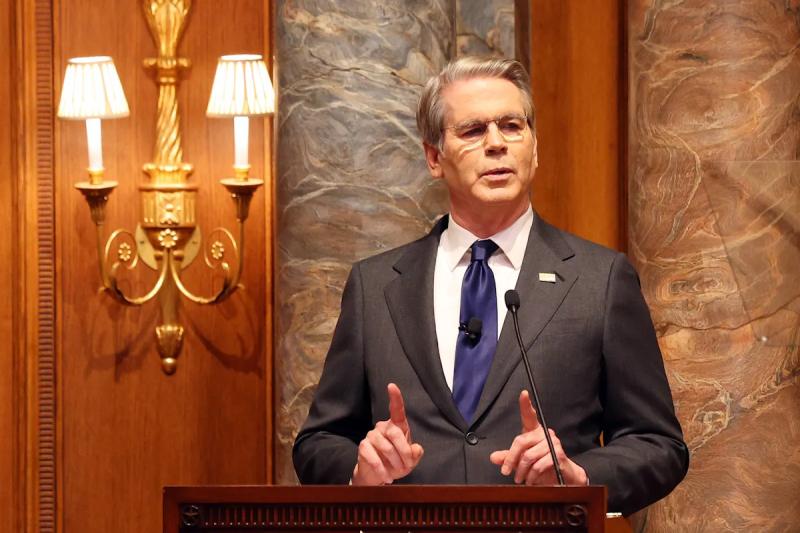
Treasury Secretary Scott Bessent speaks at the Economic Club of Dallas on Feb. 20. (Richard Rodriguez/Getty Images) ·Richard Rodriguez via Getty Images
But what drew outsized attention was Blue Owl's decision to eliminate the optionality for investors to cash out of OBDC II on a quarterly basis and instead institute a program of quarterly capital distributions based on the fund's future earnings and asset sales.
The move drew fresh scrutiny to the opaque world of private debt, which has boomed in recent years but has never truly faced a crisis — and is now garnering mounting scrutiny as it is gradually making its way into millions of US brokerage and retirement accounts following an executive order President Trump signed last summer.
Blue Owl's stock fell 5% Monday morning.
Wall Street analysts, who generally approved of Blue Owl's loan sale, still aren't worried about the firm or the wider private credit industry having significant credit problems.
"We don't believe there is a serious concern about a deterioration in private credit quality," Oppenheimer analyst Chris Kotowski wrote in a note to clients on Monday. Kotowski said last week Blue Owl's sale "should have been greeted favorably," adding that the marginal haircut of 99.7% on the dollar for the sold loans served as proof that private loan valuations "reflect market realities."
Blue Owl co-CEO Marc Lipschultz said earlier this month the company sees no "red flags" in the credit quality of its software-tied loans. "We don't have yellow flags. We actually have largely green flags," he told analysts.
One aspect of Blue Owl's sale did raise some eyebrows, as Bloomberg reported one of the buyers for its assets included Kuvare, a insurance focused asset manager Blue Owl acquired in 2024. Like Blue Owl, Apollo (APO), Ares (ARES), Blackstone (BX), KKR & Co. (KKR), and other major private credit lenders own insurance companies. (Disclosure: Yahoo is a portfolio company of funds managed by affiliates of Apollo Global Management.)
Barclays analyst Ben Troisi called Blue Owl's sale "appreciably more positive than it is negative," while raising the wider issue of the significance of a private lender selling assets to an insurance subsidiary.
The deal "could establish a template that other private credit managers could follow given how interconnected the insurance and private capital industries have become," Troisi wrote. "If similar transactions are repeated frequently, it would deepen the ties between these two parts of the non-bank sector," potentially making it more difficult to track risk.
"We want to gauge, 'Could [private credit] have any effects on the overall economy?' Thus far, it's been very additive," Bessent said during his Friday talk.
"But again, how does it affect the regulated system, and we want to prevent contagion."
An earlier version of this story misstated Kuvare's business focus. We regret the error.
Additional reporting from Jennifer Schonberger.
David Hollerith covers the financial sector, ranging from the country's biggest banks to regional lenders, private equity firms, and the cryptocurrency space.
Be a good human. Grossly derogatory comments, blatantly inflammatory comments, excessive trolling, mean-spirited taunting and insults, scamming, spamming, and off topic comments may be removed in compliance with the site's Terms of Service and the Code of Conduct. The moderators have the final word.

Trump's economic policies may be theoretically sound. A valid argument can be made that Trump knows what to do. But Trump obviously does not know how to do it. The implementation of Trump's policies sucks donkey dong.