
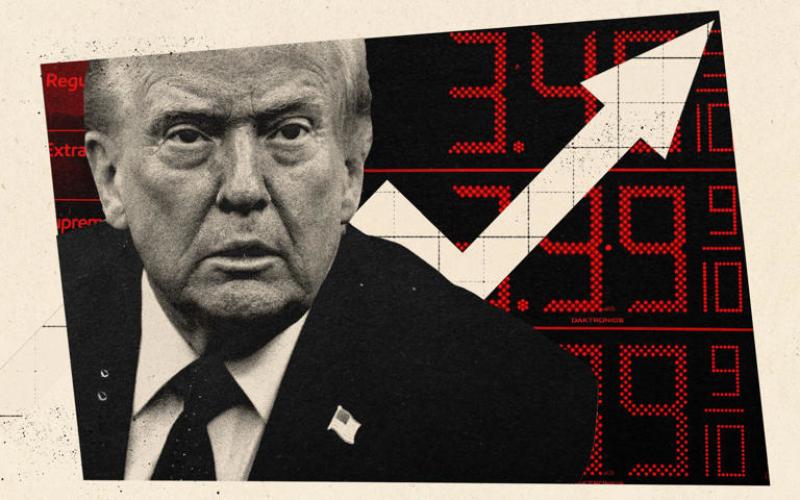
At home, Trump’s $100bn war backfires

By: Natasha Leake (The Telegraph via MSN)


STABLE GENIUS!
Trump hasn't rallied people around the flag with his odious fight club rhetoric. The 'nuclear bomb' fearmongering lost its luster after the US bunker busting strikes on Iran's uranium processing facilities. Now Trump has raised global oil prices which undermines other diplomatic efforts and support from allies. Trump increases uncertainty about the future with every new demand and false assurance.
Why was this good for America?
 S E E D E D C O N T E N T
At the Liberty Gas Station on the outskirts of Arlington, Virginia, petrol prices have been climbing for almost a week.
“Ten cents today, ten cents yesterday,” Yam Sitoula, a 56-year-old pump attendant sitting behind the counter, said.
Mr Sitoula’s boss has been calling him almost every day since American missiles began raining down on Iran, instructing him to update the cost of fuel on the giant sign outside the station, which is located a few miles west of the White House.
“A lot of customers are asking me why the price is going up,” Mr Sitoula says. “My boss thinks it will rise by another $1.50 in the next week.”
The so-called “jump at the pumps” is a direct effect of Donald Trump’s war on Iran.
Some 20 per cent of the world’s oil is transported through the Strait of Hormuz, which on Monday was declared “closed” by Iran’s Revolutionary Guards, who warned that any ship attempting to pass through would be “set ablaze”.
Meanwhile, the US is thought to be spending millions of dollars a day, with the total cost estimated to climb to some $100bn as it sends the largest military deployment to the Middle East since the Gulf War.
The eye-watering sums are starting to attract the ire of some of the Maga constituency who are already alarmed by Mr Trump’s turn away from traditional America First and isolationism.
Public polling suggests Mr Trump’s war is deeply unpopular with the general electorate, too, in a year that the president faces losing control of Congress in midterm elections.
Markets are also pressuring the White House as the world awaits stock exchanges reopening after a weekend in which energy facilities in Iran have been struck for the first time, sending dark palls of smoke over the capital.
Inside the Capitol Hill Exxon station, behind the counter, the manager robotically reads out a prepared speech explaining the price hikes.
“The conflict in the Middle East is causing an increase in oil prices due to feared disruption in production, which is in turn impacting the price of gasoline on the street.”
He sounded as if he’s been reading the same script all week.
US presidents have watched the petrol prices for decades, and often view them as a key indicator of their re-election chances.
“Barack Obama famously said that the only indicator that really told him what poll numbers were going to look like was gas prices,” says Richard Stern, the vice president of the Plymouth Institute for Free Enterprise.
“There’s a reality to that. Polling day to day does then track gas prices; it’s been like that for a very long time. So I think [White House Officials are] concerned.”
With the midterm elections looming, there are whispers among Republicans that Mr Trump is distracted by foreign affairs. Losing Congress would mean watching his second term as president collapse into months of investigations, a possible impeachment and legislative deadlock.
“I have no problem blowing up the Iranians,” one Republican source close to the White House told Politico, but being at war “is 75 per cent of your time”, they added, which is “a problem”.
On Thursday, Susie Wiles, Donald Trump’s chief of staff, instructed her team to look “under every rock” for ways to improve “energy prices, especially gasoline prices”. Officials are now “getting screamed at to find some good news”, Politico reported.
The administration is now so concerned that it is considering a temporary holiday on the federal gasoline tax, which stands at 18.3 cents per gallon (£0.03 per litre). However, that would require action from Congress and may not result in savings being passed on to the consumer.
“Price controls are going to cause even more harm that’ll just be felt in some other kind of way, further down the road from a timeline perspective,” Mr Stern said.
Petrol prices are particularly important in the context of the midterm elections, given that polls show that American voters’ primary concern is the cost of living.
Of more than 2,500 people surveyed in a poll for the Washington Post last month, fewer than three in 10 voters said that they felt they were “getting ahead financially”, while 45 per cent said that food now felt unaffordable. The findings show why affordability is a top concern in the next election.
Even younger voters are feeling the pinch. “Today’s prices here are 3.2, and last week’s prices were 2.8 here. It’s a decent increase,” 22-year-old paralegal Ayden Mullins says. “It p----s me off because I don’t like spending money on gas. I don’t have the gas mileage to justify it.”
Tony Zeliya, a 25-year-old stock manager from Virginia, says: “You notice that [fuel] goes up from high $2 to $3, $3.10. It’s not that great. Because this is another thing that you have to worry about. You’ve got to worry about groceries. You’ve got to worry about bills. It’s another thing that you don’t want on your plate.”
On Friday, the Bureau of Labour Statistics reported that the American economy had shed 92,000 jobs in February, far worse than the 60,000 which economists had expected.
It is this figure which is on the mind of Doug Lindholm, 65, who has just finished filling his car at a petrol station in Virginia. “I am concerned about the affordability question for Americans,” he says. “Have you seen the latest jobs report that just came out?”
“It was 92,000. The question is, what’s causing that? Is it the uncertainty about Trump’s failed policies, or is it the uncertainty about the war?” It is, he concludes, probably “attributable to both”, before he adds woefully: “I’m ashamed to say that I’m American at times.”
Diana Furchtgott-Roth, a fellow at the Energy Policy Research Foundation, was deputy executive director of the White House domestic policy council from 1991 to 1993, and associate director of the State Department’s office of policy planning under president George HW Bush.
“No one likes high prices,” she told The Telegraph. “Neither side of the Maga movement likes high prices. Democrats don’t like high prices. When I was in the George W Bush White House, there were extreme discussions about how to lower petrol prices. Presidents particularly don’t like high petrol prices.
“Because it’s the price that’s displayed as you drive to work. You see it a dozen times, because it’s the one price that has to be displayed. So it’s very obvious when it goes up, so no one likes it.”
However, Ms Furchtgott-Roth said that the high prices are “temporary”.
“They’re going to go down again after there’s a new democratic regime in Iran. And let me tell you, prices would have gone even higher if Iran had fulfilled some of its threats and set off nuclear weapons or attacked Europe.
“We’re breaking the eggs now and prices are going up, but I think that after that, prices will be lower without the threat of Iranian terrorism.”
Not all share such an optimistic view.
War price tag cause for alarm
On Friday, in an interview with the Financial Times, Saad Sherida al-Kaabi, Qatar’s energy minister, warned that the continuing conflict would trigger a halt in oil production throughout Persian Gulf states “within days” and “bring down the economies of the world”.
Oil barrels could cost $150 each, he said, more than double the price before Trump launched strikes on Iran last weekend, which in turn sent prices spiralling.
“If the Trump administration does not do something to restore confidence in ships travelling through the Strait of Hormuz, these prices are going to keep heading up,” Patrick De Haan, head of petroleum analysis for the pricing app Gas Buddy, told The Washington Post.
The price tag of the war is also a cause for alarm. On Tuesday, four days into the war, Forbes reported that early estimates suggest US military strikes had already cost American taxpayers more than $1bn. The conflict has a price tag which could stretch to $100bn depending on how long it continues, the outlet suggested.
The Centre for Strategic and International Studies estimated that the first 100 hours of Operation Epic Fury cost roughly $3.7bn, or $891m each day. Though some of the costs are budgeted, most ($3.5bn) are not.
Operational costs are now reaching nearly $200m, munitions replacements are costing over $3bn and replacing combat losses and repairing infrastructure damage is costing over $350m. Of this, only $178m was budgeted for operational costs. The rest would require additional defence department budgeting, through either a supplementary or appropriation bill.
Senior White House officials now expect Mr Trump’s administration to request tens of billions of dollars for the war.
Three F-15E jets, American all-weather strike fighters, estimated to cost up to $100m, were shot down by friendly fire in Kuwait on March 1.
Asked how much the whole operation would cost, Tom Cole, chairman of the House appropriations committee, simply replied: “A lot”.
The personal cost of war is also already being felt. Mr Trump received the bodies of six service members with their families in Delaware on Saturday night. The soldiers were remembered as “loving parents” and “dedicated students”, who were “days away” from returning to their own families.
Speaking at a summit of Latin American leaders in Miami before his trip to Delaware, Mr Trump said the fallen service members were heroes “coming home in a different manner than they thought they’d be coming home”. He pledged to keep American war deaths “to a minimum”.
The deaths have ignited fury in Mr Trump’s Maga base.
“No one should have to die for a foreign country,” Megyn Kelly, a podcaster and former Fox News host, said on Monday.
“I don’t think those forces members died for the United States. I think they died for Iran and Israel.”
Tucker Carlson, the podcaster, described the attack on Iran as “absolutely disgusting and evil” and said that “this is Israel’s war”.
At least a portion of Mr Trump’s base is “questioning his decision to launch this massive military operation against Iran,” Matthew Dallek, a professor at George Washington University’s graduate school of political management, told The Telegraph.
According to OnMessage, a conservative pollster, 49 per cent of Americans were found to be in favour of the war, while 48 per cent opposed it. Mr Trump’s own favourability in the same poll, seen by The Telegraph, was considerably less split, with 54 per cent of the 1,800 people polled viewing him negatively, and 45 per cent positively.
Such polls show no evidence of the “rally around the flag effect”, a common phenomenon often seen at the start of a war in which the country comes together in an overwhelming majority of support, according to Prof Dallek.
Back in Maryland, a queue of cars waits to enter a petrol station while impatient drivers sound their horns. Residents scramble to stock up on fuel before the prices jump higher.
Lynn Rothberg, 84, has not driven her car “for years”, but after hearing the neighbourhood “talking, talking, talking” about the rising fuel prices, she decided to take her red Honda to fill up.
“The thing that terrifies me is the war and all the people that are being killed,” she said.
“It’s not that I have a lot of money. I don’t have very much money, but I just paid $18 for filling it up, and I decided to do that before [prices] go sky high. I just figured I’d get it filled up.”
With no end to the conflict in sight, it is likely that prices will continue to rise.
“It’ll obviously be a huge concern as we enter into the midterm election season,” concludes Andrew Hale, a fellow at advancing American freedom. “It’s not as bad as it was when Russia invaded Ukraine, but it could potentially, in the longer term, be a problem.”
Be a good human. Grossly derogatory comments, blatantly inflammatory comments, excessive trolling, mean-spirited taunting and insults, scamming, spamming, and off topic comments may be removed in compliance with the site's Terms of Service and the Code of Conduct. The moderators have the final word.

Tags
Who is online
97 visitors
Whacking a hornet's nest as a show of fearless masculinity won't win friends or earn respect. That only gets an ass whuppin' from those who have been stung.
- Donald Trump
So let’s start a war of choice in the ME! And his genius supporters cheer.
At the Liberty Gas Station on the outskirts of Arlington, Virginia, petrol prices have been climbing for almost a week.
Wow!
But remember:
Nobody's ever seen anything like it before!
But in any event . . .Thank you for your attention to this matter!!!
Morning..Krishy....petrol here was $1.80 a litre...within hours of the bombings starting it shot up to $2.20 a litre..
The government threatens the petrol companies with fines for petrol price gouging but nothing ever happens..
Any excuse from China, COVID, Ukraine war, squabbles in the Middle East, bushfires, floods and anything else they can think of to charge extra at the pump...
That question makes no sense. How can eliminating a radical theocratic regime that sponsors world wide terrorism and hates us to our core not be good for America?
We haven't eliminated the regime.
We've cut a few heads off the hydra.
And we have no exit strategy.
Not yet, that's why I said eliminating.... Do you doubt it will happen?
Yep, as fast they show themselves.
Exit strategy? From what? The middle east...
Which country's navy do you think will open the Straits of Hormuz?
Where there is a will there is a way to blame it on Biden.
I don't think Sandy did that. What do you mean?
Yes.
You know the hydra just keeps growing new heads, right?
They still have a provisional government in place. We haven't banished the regime. We've killed a few members. Many more remain. And if we keep radicalizing Iranians by killing their daughters while they're in school, that hydra is going to keep on growing heads.
You think that's all it will take to get out of the mess we've been led into?
That's the second time in this short thread that you've attempted to get me to defend things I haven't said. That seems dishonest, don't you think?
Nice try, Greg.
That was your actual response to my question about exit strategy.
I know you'd like to equate this to what one of your pals is doing elsewhere, but in that "elsewhere", the dishonest question asked somebody to defend something they literally and demonstrably did not say. You said what you said, in conversation, in black and white. You're attempting, ineptly, to engage in a false equivalence, which is dishonest and trollish.
Not really, SSDD..... whatever
My question. Actually, I will be honest enough to admit that it was a statement:
In 4.1.1, you quoted that statement, and responded with:
So, this is how conversations work, ok? When you respond to my statement with such a question, that is how you indicate that this is your view of what is necessary for an exit strategy.
If it is not, it is on you to communicate that you just randomly mentioned opening the Strait of Hormuz, but did not intend for it to be our exit strategy. Which begs the question, "Why mention it?"
Now, do you think we have an exit strategy beyond "eliminating the regime", which we have not done, and may not ever be able to do?
Say we do manage it. What then? Who leads Iran? Somebody friendly to the US? How do we achieve that? How do we keep them in office, rather than seeing them deposed and exiled or killed outright? If they're deposed and exiled or killed outright, will their deposers/assassins be friendly to the US? How well did that work out for us in Afghanistan? Would you call the Taliban a friendly regime?
If we don't manage to keep in office a leader friendly to us, are we right back where we started, but with international opinion against us because we've engaged in a war of aggression, and done a piss-poor job of planning it?
Will Trump even have an attention span long enough to bother? He got tired of playing with Venezuela pretty quickly.
Bless your heart. Perhaps it's a formatting thing, not sure. On my screen those were two different questions. One slightly sarcastic and the other not.
Cause I felt like it...
I think we will and I'm still not sure by what you mean when you say exit strategy. We have no troops in Iran.
I have no idea. Do you think they could be less friendly?
Not at all...
I don't think so, he's gotten CA and SA attention lately.
Apropos of nothing, then?
Ok.
Hell of a way to have a discussion, and not especially believable, but sure.
Do you think "exit strategy" refers only to the physical removal of troops in Iran?
Bless your heart.
Most people don't think it wise to just eliminate a regime (or make a half-assed attempt at doing so), then leave a power vacuum in its place in a country known for violence and now pissed off at us for killing their innocent children.
You don't think we should address that? Just drop some bombs (hopefully not on a school again) and run?
Not at all, that's why I don't get what you're asking.
Thanks sister.
I thought that was pretty clear.
What can I help you understand?
Already addressed. We haven't, and likely won't.
FYI: As Sandy mentioned, we have not eliminated the regime!
But this war has claimed American lives:
the Pentagon identified four U.S. Army Reserve soldiers who were killed in a drone strike Sunday at a command center in Kuwait.
The strike also killed two other service members.
And sadly, as this war continues, it will probably claim more American lives.
The NYT just posted to Facebook that a seventh US service member has been killed in an attack on a US base in Saudi Arabia.
All of this dwarfed by the 165+ children and educators who we turned into pink mist with some of the world’s most lethal and advanced weaponry. At first opportunity Trump says his instincts tell him that it was Iran and their inaccurate weapons that killed them. And the Trump supporters cheer.
The Iran regime states something anti American ....and the left's base cheers
Where? What are they supposedly cheering?