
Beta Electric Aircraft Will Fly First Customers in Hawaii

By: Jack Daleo (Flying Magazine)
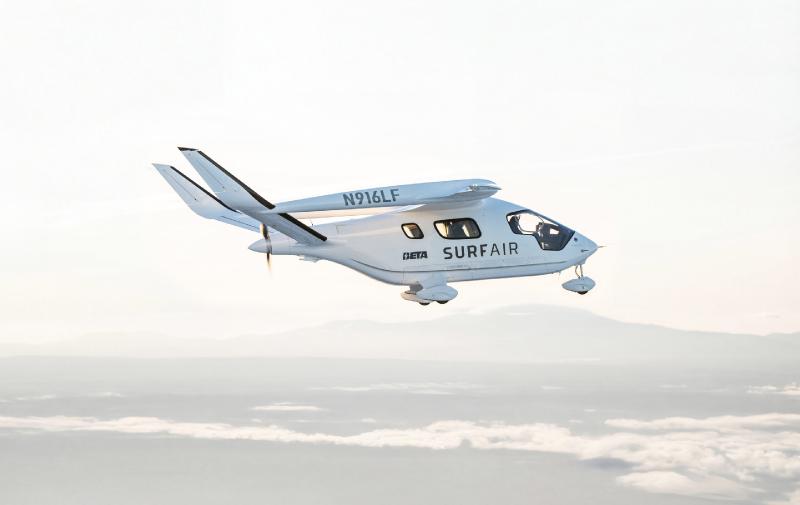


Development of the Alia electric aircraft has not received Federal subsidies. Too bad automakers cannot pick themselves up by their bootstraps.
 S E E D E D C O N T E N T
March 13, 2026 -- The first ticket-holding customers to fly on Beta Technologies’ Alia electric aircraft will be in Hawaii, the manufacturer revealed this week.
Beta on Thursday announced a partnership with Los Angeles-based Surf Air Mobility, which it said will be the first FAA Part 135-certified operator to fly Alia for regional scheduled passenger and on-demand charter service.
Surf signed an aircraft purchase agreement for 25 conventional takeoff and landing (CTOL) Alia variants, with options for 75 more, and secured priority delivery positions. The aircraft can be configured for passenger or cargo service, and Surf plans to initially offer the latter through Mokulele Airlines, a regional subsidiary.
Deanna White, CEO of Surf, said the company later plans to introduce Beta’s vertical takeoff and landing (VTOL) Alia.
“Our goal is to lead the commercial rollout of electric aviation, including flying the first paying passenger on a next-generation electric aircraft,” White said in a statement.
The partners plan to leverage Surf’s established passenger demand and airport infrastructure, as well as Beta’s electric aircraft charging systems, to create a network of commercial passenger routes in Hawaii. They will deploy chargers and other ground equipment at “mutually agreed locations.” Both companies view Hawaii—where Surf has a growing footprint—as an ideal launch market for Alia.
“Launching in Hawaii, with its short-haul routes, inter-island demand, and high fuel costs, enables us to continue to build on our extensive flight experience and transition that demonstrated performance into a scaled airline operation that is reliable and cost-efficient,” said Kyle Clark, CEO of Beta.
The partners in 2026 plan to conduct a series of Alia demonstration flights, jointly market the planned service, and “cultivate regulatory and political support” ahead of the launch.
Alia aircraft in 2025 surpassed 100,000 nm across flight testing and are closing in on 127,000 nm as of Friday, per Beta’s website. Beta pilots have flown the aircraft under VFR, IFR, day, and night conditions. That includes flights into John F. Kennedy International Airport (KJFK), Hartsfield-Jackson Atlanta International Airport (KATL), and other busy airfields.
Earlier this week, Beta was revealed to be part of seven of eight winning bids for the FAA’s eVTOL Integration Pilot Program (eIPP)—more than any manufacturer selected for the three-year initiative. Under the eIPP, the agency will permit operations with precertified aircraft at real airports, with real air traffic controllers, and—potentially—for revenue.
More Than an Electric Aircraft Order
Beta said that Surf is also working toward certification of a new maintenance, repair, and overhaul (MRO) center, which will become the exclusive, factory-authorized service center for Alia in Hawaii. Surf will fund preparations for the electric aircraft.
The operator plans to offer Beta customers operational support for passenger service, regional cargo operations, and on-demand charter flights. The partners aim to extend the MRO agreement to other Alia launch markets, providing local coverage. Other Alia operators would have the option to use the centers.
Surf will further designate Beta as its “preferred supplier” of electric ground infrastructure for its own fleet. It operates the Cirrus Vision Jet, Embraer Phenom 300, HA-420 Hondajet, Piper Meridian, and multiple airframes from Beechcraft, Bombardier, Cessna, Dassault, Gulfstream, and Pilatus.
Surf’s fleet comprises mainly small turboprops optimized for 50-to-500-mile trips because they are easier to electrify, which is the company’s long-term objective. It has an exclusive relationship with Textron Aviation to electrify the Grand Caravan EX using electric and hybrid-electric powertrains it is developing. In 2021, it ordered up to 150 Caravan EXs.
The company’s inaugural powertrain is targeted to reduce operational emissions by 50 percent without sacrificing performance. Future full-electric versions could eliminate emissions entirely and cut costs in half, Surf claims. Beyond Alia, it plans to operate and lease up to 90 EL9 ultra short takeoff and landing (STOL) aircraft from Electra.
Other Alia customers include Bristow Group, UPS, United Therapeutics, Metro Aviation, and e-Smart Group, as well as aircraft lessors LCI and Space Leasing International.
Jack Daleo is a staff writer covering advanced air mobility, including everything from drones to unmanned aircraft systems to space travel—and a whole lot more. He spent close to two years reporting on drone delivery for FreightWaves, covering the biggest news and developments in the space and connecting with industry executives and experts. Jack is also a basketball aficionado, a frequent traveler and a lover of all things logistics.
Be a good human. Grossly derogatory comments, blatantly inflammatory comments, excessive trolling, mean-spirited taunting and insults, scamming, spamming, and off topic comments may be removed in compliance with the site's Terms of Service and the Code of Conduct. The moderators have the final word.

Tags
Who is online
91 visitors
The announcement by Beta Technologies is actually a bigger deal than it seems. Hawaii is dependent upon shuttle aircraft to connect the islands. Petrol power is exorbitantly expensive since all fuel must be imported. The introduction of electric aircraft should dramatically lower the cost of inter-island travel. It could become cheaper to travel between islands than to travel on the islands.
If the deployment of electric aircraft proves successful then that would incentivize a more intense effort by air carriers to construct captive renewable generation capacity. There are already green shoots of cooperation by large commercial carriers.
This does seem like a perfect application for it.