
War in Iraq begins | March 19, 2003

By: HISTORY
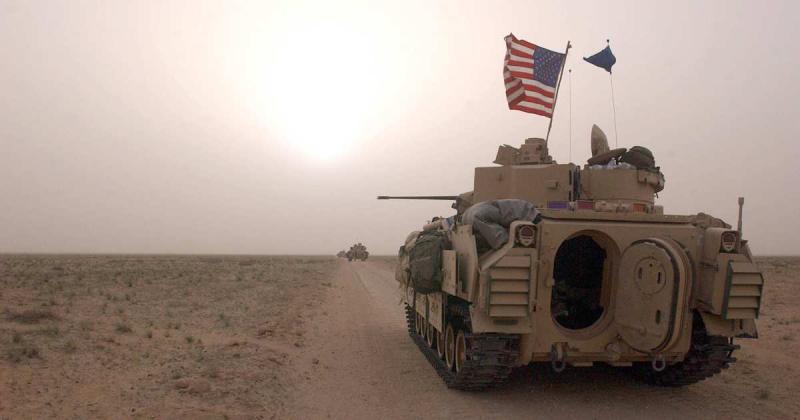


Timely reminder.
 S E E D E D C O N T E N T
On March 19, 2003, the United States, along with coalition forces primarily from the United Kingdom, initiates war on Iraq. Just after explosions began to rock Baghdad, Iraq's capital, U.S. President George W. Bush announced in a televised address, "At this hour, American and coalition forces are in the early stages of military operations to disarm Iraq, to free its people and to defend the world from grave danger." President Bush and his advisors built much of their case for war on the specious claim that Iraq, under dictator Saddam Hussein, possessed or was in the process of building weapons of mass destruction.
Hostilities began about 90 minutes after the U.S.-imposed deadline for Saddam Hussein to leave Iraq or face war passed. The first targets, which Bush said were "of military importance," were hit with Tomahawk cruise missiles from U.S. fighter-bombers and warships stationed in the Persian Gulf. In response to the attacks, Republic of Iraq radio in Baghdad announced, "the evil ones, the enemies of God, the homeland and humanity, have committed the stupidity of aggression against our homeland and people."
History Uncut: Saddam Hussein Captured
This video clip from "History Uncut" provides a glimpse into the capture of famed dictator Saddam Hussein. Former Iraq President Saddam Hussein had been in hiding for almost a year until U.S. forces captured him outside the city of Tikrit in a military operation known as Operation Red Dawn.
1:06m watch
Though Saddam Hussein had declared in early March 2003 that, "it is without doubt that the faithful will be victorious against aggression," he went into hiding soon after the American invasion, speaking to his people only through an occasional audiotape. Coalition forces were able to topple his regime and capture Iraq's major cities in just three weeks, sustaining few casualties. President Bush declared the end of major combat operations on May 1, 2003. Despite the defeat of conventional military forces in Iraq, an insurgency has continued an intense guerrilla war in the nation in the years since military victory was announced, resulting in thousands of coalition military, insurgent and civilian deaths.
After an intense manhunt, U.S. soldiers found Saddam Hussein hiding in a six-to-eight-foot deep hole, nine miles outside his hometown of Tikrit. He did not resist and was uninjured during the arrest. A soldier at the scene described him as "a man resigned to his fate." Hussein was arrested and began trial for crimes against his people, including mass killings, in October 2005.
In June 2004, the provisional government in place since soon after Saddam's ouster transferred power to the Iraqi Interim Government. In January 2005, the Iraqi people elected a 275-member Iraqi National Assembly. A new constitution for the country was ratified that October. On November 6, 2006, Saddam Hussein was found guilty of crimes against humanity and sentenced to death by hanging. After an unsuccessful appeal, he was executed on December 30, 2006.
No weapons of mass destruction were found in Iraq. The U.S. declared an end to the war in Iraq on December 15, 2011, nearly ten years after the fighting began.
Also on This Day in History
Discover more of the major events, famous births, notable deaths and everything else history-making that happened on March 19th
1865 -- Battle of Bentonville begins in North Carolina
On March 19, 1865, at the Battle of Bentonville, North Carolina, Confederate General Joseph Johnston makes a desperate attempt to stop Union General William T. Sherman's drive through the Carolinas in the Civil War's last days; however, Johnston's motley force cannot stop the advance of Sherman's mighty army. Following his famous March to the Sea […]
1916 -- First U.S. air combat mission begins
Eight Curtiss "Jenny" planes of the First Aero Squadron take off from Columbus, New Mexico, in the first combat air mission in U.S. history. The First Aero Squadron, organized in 1914 after the outbreak of World War I, was on a support mission for the 7,000 U.S. troops who invaded Mexico to capture Mexican revolutionary […]
1931 -- Nevada legalizes gambling
In an attempt to lift the state out of the hard times of the Great Depression, the Nevada state legislature votes to legalize gambling. Located in the Great Basin desert, few settlers chose to live in Nevada after the United States acquired the territory at the end of the Mexican War in 1848. In 1859, […]
1935 -- Harlem riot of 1935
A riot breaks out in Harlem when local residents suspect that a Black boy has been beaten, and possibly killed, by a white business owner. Although the rumors turn out to be false, the riot highlights the struggles of Harlem's historically Black community against discrimination during the Great Depression. On March 19, 1935, Lino Rivera, […]
1949 -- East Germany approves new constitution
In a precursor to the establishment of a separate, Soviet-dominated East Germany, the People's Council of the Soviet Zone of Occupation approves a new constitution. This action, together with the U.S. policy of pursuing an independent pathway in regards to West Germany, contributed to the permanent division of Germany. The postwar status of Germany had […]
1953 -- First Academy Awards telecast on NBC
On March 19, 1953, for the first time, audiences are able to sit in their living rooms and watch as the movie world's most prestigious honors, the Academy Awards, are given out at the RKO Pantages Theatre in Hollywood, California. Organized in May 1927, the Academy of Motion Picture Arts and Sciences was envisioned as […]
1957 -- Elvis Presley puts a down payment on Graceland
With a $1,000 cash deposit against a sale price of $102,500, Elvis Presley agrees to purchase the home called Graceland on March 19, 1957. In the spring of 1957, Elvis Presley was completing his second Hollywood movie, Loving You, and his first movie soundtrack album. He had two studio albums and 48 singles already under […]
1966 -- Texas Western defeats Kentucky in barrier-breaking NCAA final
In College Park, Maryland on March 19, 1966, underdog Texas Western College defeats Kentucky, 72-65, in the NCAA men's college basketball final—the first NCAA title for an all-Black starting five. "I wasn't out to be a pioneer when we played Kentucky," Texas Western coach Don Haskins told the Los Angeles Times years later. "I was simply playing the […]
1970 -- National emergency declared in Cambodia
The National Assembly grants "full power" to Premier Lon Nol, declares a state of emergency, and suspends four articles of the constitution, permitting arbitrary arrest and banning public assembly. Lon Nol and First Deputy Premier Prince Sisowath Sirik Matak had conducted a bloodless coup against Prince Norodom Sihanouk the day before and proclaimed the establishment […]
1999 -- Bodies found in Yosemite serial killer case
On March 19, 1999, law enforcement officials discover the charred bodies of forty-two-year-old Carol Sund and sixteen-year-old Silvina Pelosso in the trunk of their burned-out rental car, a day after the vehicle was located in a remote area several hours from Yosemite National Park. Cary Stayner, a handyman at the lodge where the women were […]
Be a good human. Grossly derogatory comments, blatantly inflammatory comments, excessive trolling, mean-spirited taunting and insults, scamming, spamming, and off topic comments may be removed in compliance with the site's Terms of Service and the Code of Conduct. The moderators have the final word.

Tags
Who is online
72 visitors
Were those the good old days?
I don't think anybody with a clear mind thinks that. Only those that have a nostalgia for women waiting at the door in their pearls and high heels with a drink in their hand for the head of the household
Thanks for compiling this. Good history lesson