
U.S. troops withdraw from Vietnam | March 29, 1973

By: HISTORY


LESSON OF HISTORY
Have we learned nothing?
 S E E D E D C O N T E N T
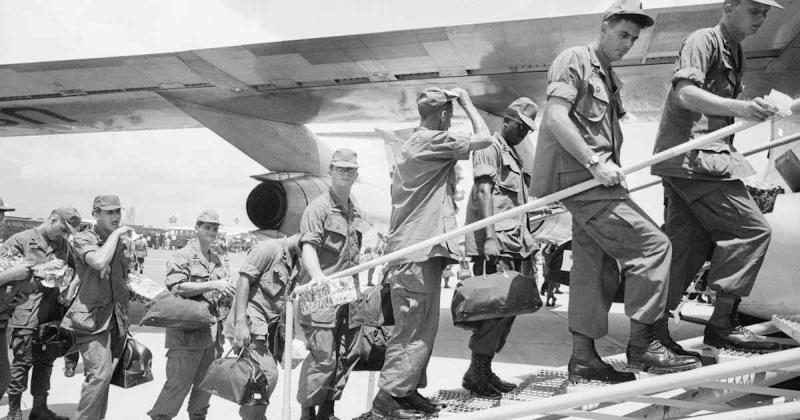
March 29, 1973 -- Two months after the signing of the Vietnam peace agreement, the last U.S. combat troops leave South Vietnam as Hanoi frees many of the remaining American prisoners of war held in North Vietnam. America's direct eight-year intervention in the Vietnam War was at an end.
In Saigon, some 7,000 U.S. Department of Defense civilian employees remained behind to aid South Vietnam in conducting what looked to be a fierce and ongoing war with communist North Vietnam.
Vietnamization
Search and Destroy missions were a crucial part of the American war strategy in Vietnam.
3:01m watch
In 1961, after two decades of indirect military aid, U.S. President John F. Kennedy sent the first large force of U.S. military personnel to support the ineffectual autocratic regime of South Vietnam against the communist North. Three years later, with the South Vietnamese government crumbling, President Lyndon B. Johnson ordered limited bombing raids on North Vietnam, and Congress authorized the use of U.S. troops. By 1965, North Vietnamese offensives left President Johnson with two choices: escalate U.S. involvement or withdraw. Johnson ordered the former, and troop levels soon jumped to more than 300,000 as U.S. air forces commenced the largest bombing campaign in history.
During the next few years, the extended length of the war, the high number of U.S. casualties, and the exposure of U.S. involvement in war crimes, such as the massacre at My Lai, helped turn many in the United States against the Vietnam War. The communists' Tet Offensive of 1968 crushed U.S. hopes of an imminent end to the conflict and galvanized U.S. opposition to the war. In response, Johnson announced in March 1968 that he would not seek reelection, citing what he perceived to be his responsibility in creating a perilous national division over Vietnam. He also authorized the beginning of peace talks.
In the spring of 1969, as protests against the war escalated in the United States, U.S. troop strength in the war-torn country reached its peak at nearly 550,000 men. Richard Nixon, the new U.S. president, began U.S. troop withdrawal and "Vietnamization" of the war effort that year, but he intensified bombing. Large U.S. troop withdrawals continued in the early 1970s as President Nixon expanded air and ground operations into Cambodia and Laos in attempts to block enemy supply routes along Vietnam's borders. This expansion of the war, which accomplished few positive results, led to new waves of protests in the United States and elsewhere.
Finally, in January 1973, representatives of the United States, North and South Vietnam, and the Vietcong signed a peace agreement in Paris, ending the direct U.S. military involvement in the Vietnam War. Its key provisions included a cease-fire throughout Vietnam, the withdrawal of U.S. forces, the release of prisoners of war, and the reunification of North and South Vietnam through peaceful means. The South Vietnamese government was to remain in place until new elections were held, and North Vietnamese forces in the South were not to advance further nor be reinforced.
In reality, however, the agreement was little more than a face-saving gesture by the U.S. government. Even before the last American troops departed on March 29, the communists violated the cease-fire, and by early 1974 full-scale war had resumed. At the end of 1974, South Vietnamese authorities reported that 80,000 of their soldiers and civilians had been killed in fighting during the year, making it the most costly of the Vietnam War.
On April 30, 1975, the last few Americans still in South Vietnam were airlifted out of the country as Saigon fell to communist forces. North Vietnamese Colonel Bui Tin, accepting the surrender of South Vietnam later in the day, remarked, "You have nothing to fear; between Vietnamese there are no victors and no vanquished. Only the Americans have been defeated." The Vietnam War was the longest and most unpopular foreign war in U.S. history and cost 58,000 American lives. As many as two million Vietnamese soldiers and civilians were killed.
Also on This Day in History
Discover more of the major events, famous births, notable deaths and everything else history-making that happened on March 29th
1865 -- Appomattox, the final campaign in the Civil War, begins
On March 29, 1865, the final campaign of the Civil War begins in Virginia when Union troops under General Ulysses S. Grant move against the Confederate trenches around Petersburg. General Robert E. Lee's outnumbered Rebels were soon forced to evacuate the city and begin a desperate race west. Eleven months earlier, Grant moved his army […]
1945 -- Gen. George Patton takes Frankfurt
Gen. George S. Patton's 3rd Army captures Frankfurt, as "Old Blood and Guts" continues his march east. Frankfurt am Main, literally "On the Main" River, in western Germany, was the mid-19th century capital of Germany (it was annexed by Prussia in 1866, ending its status as a free city). Once integrated into a united German […]
1951 -- The "Mad Bomber" strikes in New York
On March 29, 1951, a homemade device explodes at Grand Central Terminal in New York City, startling commuters but injuring no one. In the next few months, five more bombs were found at landmark sites around New York, including the public library. Authorities realized that this new wave of terrorist acts was the work of […]
1951 -- Rosenbergs convicted of espionage
In one of the most sensational trials in American history, Julius and Ethel Rosenberg are convicted of espionage for their role in passing atomic secrets to the Soviets during and after World War II. The husband and wife were later sentenced to death and were executed in 1953. The conviction of the Rosenbergs was the […]
1958 -- First reading of the Keeling Curve, which shows carbon dioxide levels in Earth's atmosphere
In March of 1958, Dr. Charles David Keeling begins regularly measuring the amount of carbon dioxide in the atmosphere from the Mauna Loa Observatory in Hawai'i. Over the ensuing years, his research will reveal what is now known as the Keeling Curve: a graph of continuously-taken measurements showing the rapid accumulation of carbon dioxide. Previously, […]
1971 -- Lt. William Calley found guilty of My Lai murders
Lt. William L. Calley is found guilty of premeditated murder at My Lai by a U.S. Army court-martial at Fort Benning, Georgia. Calley, a platoon leader, had led his men in a massacre of Vietnamese civilians, including women and children, at My Lai 4, a cluster of hamlets in Quang Ngai Province on March 16, […]
1974 -- U.S. space probe, Mariner, visits Mercury
The unmanned U.S. space probe Mariner 10, launched by NASA in November 1973, becomes the first spacecraft to visit the planet Mercury, sending back close-up images of a celestial body usually obscured because of its proximity to the sun. Mariner 10 had visited the planet Venus eight weeks before but only for the purpose of […]
1974 -- Exiled writer Aleksandr Solzhenitsyn reunited with family
On March 29, 1974, prominent Soviet author, historian and political dissident Aleksandr Solzhenitsyn is reunited with his family after being exiled from his home country. Publication of The Gulag Archipelago, his detailed history of the Soviet Union's vast system of prisons and labor camps, helped raise global awareness of the communist nation's rampant political repression. Its […]
1982 -- Freshman Michael Jordan hits winning shot to give North Carolina NCAA title
On March 29, 1982, 19-year-old North Carolina freshman Michael Jordan makes a 16-foot jump shot with 15 seconds left to give the Tar Heels a 63-62 win over Georgetown for the NCAA Tournament championship. "To tell the truth," Jordan tells reporters in New Orleans afterward, "I didn't see it go in. I didn't want to […]
Be a good human. Grossly derogatory comments, blatantly inflammatory comments, excessive trolling, mean-spirited taunting and insults, scamming, spamming, and off topic comments may be removed in compliance with the site's Terms of Service and the Code of Conduct. The moderators have the final word.

Tags
Who is online
122 visitors
Yeah, come on all of you, big strong men
Uncle Sam needs your help again
He's got himself in a terrible jam
Way down yonder in Vietnam
So put down your books, pick up a gun
Gonna have a whole lot of fun