
President Reagan shot | March 30, 1981

By: (HISTORY)
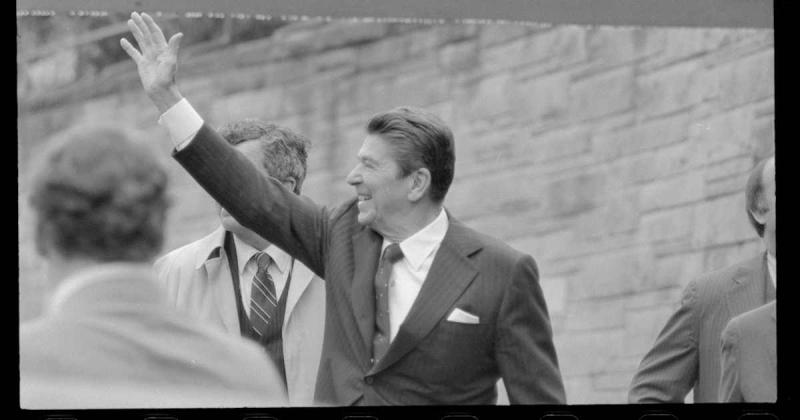


Where were you when the shots rang out? But few remember Alexander Haig.
 S E E D E D C O N T E N T
On March 30, 1981, President Ronald Reagan is shot in the chest outside a Washington, D.C. hotel by a drifter named John Hinckley Jr.
The president had just finished addressing a labor meeting at the Washington Hilton Hotel and was walking with his entourage to his limousine when Hinckley, standing among a group of reporters, fired six shots at the president, hitting Reagan and three of his attendants. White House Press Secretary James Brady was shot in the head and critically wounded, Secret Service agent Timothy McCarthy was shot in the side, and District of Columbia policeman Thomas Delahanty was shot in the neck. After firing the shots, Hinckley was overpowered and pinned against a wall, and President Reagan, apparently unaware that he'd been shot, was shoved into his limousine by a Secret Service agent and rushed to the hospital.
The president was shot in the left lung, and the .22 caliber bullet just missed his heart. In an impressive feat for a 70-year-old man with a collapsed lung, he walked into George Washington University Hospital under his own power. As he was treated and prepared for surgery, he was in good spirits and quipped to his wife, Nancy, "Honey, I forgot to duck," and to his surgeons, "Please tell me you're Republicans." Reagan's surgery lasted two hours, and he was listed in stable and good condition afterward.
Ronald Reagan
Ronald Reagan galvanized the American public through his famous speeches that helped redefine American politics in the 1980s.
4:18m watch
The next day, the president resumed some of his executive duties and signed a piece of legislation from his hospital bed. On April 11, he returned to the White House. Reagan's popularity soared after the assassination attempt, and at the end of April he was given a hero's welcome by Congress. In August, this same Congress passed his controversial economic program, with several Democrats breaking ranks to back Reagan's plan. By this time, Reagan claimed to be fully recovered from the assassination attempt. In private, however, he would continue to feel the effects of the nearly fatal gunshot wound for years.
Of the victims of the assassination attempt, Secret Service agent Timothy McCarthy and D.C. policeman Thomas Delahanty eventually recovered. James Brady, who nearly died after being shot in the eye, suffered permanent brain damage. He later became an advocate of gun control, and in 1993 Congress passed the "Brady Bill," which established a five-day waiting period and background checks for prospective gun buyers. President Bill Clinton signed the bill into law.
After being arrested on March 30, 1981, 25-year-old John Hinckley was booked on federal charges of attempting to assassinate the president. He had previously been arrested in Tennessee on weapons charges. In June 1982, he was found not guilty by reason of insanity. In the trial, Hinckley's defense attorneys argued that their client was ill with narcissistic personality disorder, citing medical evidence, and had a pathological obsession with the 1976 film Taxi Driver, in which the main character attempts to assassinate a fictional senator.
His lawyers claimed that Hinckley saw the movie more than a dozen times, was obsessed with the lead actress, Jodie Foster, and had attempted to reenact the events of the film in his own life. Thus the movie, not Hinckley, they argued, was the actual planning force behind the events that occurred on March 30, 1981.
The verdict of "not guilty by reason of insanity" aroused widespread public criticism, and many were shocked that a would-be presidential assassin could avoid being held accountable for his crime. However, because of his obvious threat to society, he was placed in St. Elizabeth's Hospital, a mental institution. In the late 1990s, Hinckley's attorney began arguing that his mental illness was in remission and thus had a right to return to a normal life.
Beginning in August 1999, he was allowed supervised day trips off the hospital grounds and later was allowed to visit his parents once a week unsupervised. The Secret Service voluntarily monitored him during these outings. In 2016, he was given a conditional release to move in with his mother in Williamsburg, Virginia. In 2018, a judge ruled he can now live within 75 miles of Williamsburg, provided he meets regularly with his psychiatrist and social worker, among other conditions.
Also on This Day in History
Discover more of the major events, famous births, notable deaths and everything else history-making that happened on March 30th
1775 -- King George endorses New England Restraining Act
Hoping to keep the New England colonies dependent on the British, King George III formally endorses the New England Restraining Act on March 30, 1775. The New England Restraining Act required New England colonies to trade exclusively with Great Britain as of July 1. An additional rule would come into effect on July 20, banning […]
1814 -- Napoleon's forces defeated in Paris
European forces allied against Napoleonic France march triumphantly into Paris, formally ending a decade of French domination on the Continent. Napoleon, one of the greatest military strategists in history, seized control of the French state in 1800, and in 1804 was crowned emperor. By 1807, he controlled an empire that stretched across Europe. In 1812, […]
1855 -- Violence disrupts first Kansas election
In territorial Kansas' first election, some 5,000 so-called "Border Ruffians" invade the territory from western Missouri and force the election of a pro-slavery legislature. Although the number of votes cast exceeded the number of eligible voters in the territory, Kansas Governor Andrew Reeder reluctantly approved the election to prevent further bloodshed. Trouble in territorial Kansas […]
1867 -- U.S. purchase of Alaska ridiculed as "Seward's Folly"
U.S. Secretary of State William H. Seward signs a treaty with Russia for the purchase of Alaska for $7 million. Despite the bargain price of roughly two cents an acre, the Alaskan purchase was ridiculed in Congress and in the press as "Seward's Folly," "Seward's icebox," and President Andrew Johnson's "polar bear garden." Inuit and […]
1870 -- 15th Amendment adopted
Following its ratification by the requisite three-fourths of the states, the 15th Amendment, granting African American men the right to vote, is formally adopted into the U.S. Constitution. Passed by Congress the year before, the amendment reads, "the right of citizens of the United States to vote shall not be denied or abridged by the […]
1939 -- Batman debuts in comics
On March 30, 1939, Detective Comics No. 27 appears on the nation's newsstands, introducing the world to a new superhero, the Batman. Dated May 1939, the comic book featured the caped crusader on its cover, swooping through the air on a rope, while holding a bad guy in a headlock. "Starting this issue," the cover […]
1948 -- Henry Wallace criticizes Truman's Cold War policies
Henry Wallace, former vice president and Progressive Party presidential candidate, lashes out at the Cold War policies of President Harry S. Truman. Wallace and his supporters were among the few Americans who actively voiced criticisms of America's Cold War mindset during the late-1940s and 1950s. Widely admired for his intelligence and integrity, Henry Wallace had […]
1949 -- Actor Robert Mitchum is released after serving time for marijuana possession
Actor Robert Mitchum is released from a Los Angeles County prison farm after spending the final week of his two-month sentence for marijuana possession there. In the fall of 1948, Mitchum, the star of classics such as Cape Fear and Night of the Hunter, was smoking a joint at a small party in the Laurel […]
1965 -- Bomb explodes outside U.S. Embassy in Saigon
A bomb explodes in a car parked in front of the U.S. Embassy in Saigon, virtually destroying the building and killing 19 Vietnamese, two Americans, and one Filipino; 183 others were injured. Congress quickly appropriated $1 million to reconstruct the embassy. Although some U.S. military leaders advocated special retaliatory raids on North Vietnam, President Lyndon […]
1971 -- Starbucks opens its first store in Seattle's Pike Place Market
On March 30, 1971, Starbucks opens its first store in Seattle's iconic Pike Place market with a single employee. The store sells high-quality roasted coffee beans, freshly brewed hot coffee and not much else. Founders Gerald Baldwin, Zev Siegl and Gordon Bowker, 20-something coffee lovers who met at the University of San Francisco, named their […]
1974 -- The Ramones play their first public gig in Manhattan
On March 30, 1974, the Ramones play their first New York City gig, launching a punk-rock revolution. Five months later, on August 16, the four young men from Forest Hills, Queens, would make their more famous "debut" on the New York music scene, at the CBGB bar—often (incorrectly) identified as their first performance. That gig […]
1974 -- John Denver has his first #1 hit with "Sunshine On My Shoulders"
John Denver scores his first #1 song, "Sunshine On My Shoulders," on March 30, 1974. He would go on to become one of the most popular singer-songwriters of the 1970s. "Sunshine On My Shoulders" was John Denver's attempt to write a sad song, a big part of Denver's broad appeal. "I was so down I […]
2009 -- President Obama announces auto industry shakeup
On March 30, 2009, President Barack Obama issues an ultimatum to struggling American automakers General Motors (GM) and Chrysler: In order to receive additional bailout loans from the government, he says, the companies need to make dramatic changes in the way they run their businesses. The president also announced a set of initiatives intended to […]
Be a good human. Grossly derogatory comments, blatantly inflammatory comments, excessive trolling, mean-spirited taunting and insults, scamming, spamming, and off topic comments may be removed in compliance with the site's Terms of Service and the Code of Conduct. The moderators have the final word.

Tags
Who is online
156 visitors
Can't be a bad day with Batman's birthday and the debut of the Ramones.