
What the US economy stands to lose if Chinese EVs aren't let in

By: Sabri Ben-Achour and Ashley Rodriguez (Marketplace)


Noah Smith is a neoliberal trying to disguise himself as an industrialist. Smith's short-sighted advice is why the United States is no longer competitive. A financialized economy simply cannot compete with an industrial economy. Stockholder interests rarely align with national interests.
Noah Smith's diagnosis of the US auto industry misses the mark. US automakers have adopted a business model of capital efficiency, conservative risk management, and profit stability that is favored by stockholders. As a result, US auto production requires a vulnerable JIT supply chain and numerous additional steps in the production cycle that are controlled by middlemen. As we have learned over the past decade, the financialized 'efficiency trap' is fragile and lacks resilience. Every disruption has now become an existential threat to US auto production that is cause for a national emergency.
BYD is a truly industrial enterprise that operates under a business model that prioritizes market share over profit margin and resilience over efficiency. BYD has created a vertically integrated, captive supply chain that allows for nimble adjustment to market forces and a buffer against supply chain shocks. BYD has improved its profitability by removing middlemen and lowering per unit profit expectations. BYD operates as a manufacturing ecosystem under its own control.
Noah Smith's blue-sky wishful thinking won't change BYD's business model. BYD won't be buying US made batteries because BYD produces its own batteries without the need for middlemen. BYD is its own supply chain. Noah Smith has only painted more lipstick on the pig of financialized profiteering. But it's the same neoliberal pig that has been feeding at the public trough for decades. The financial model of efficiency, productivity, and stockholder value is systemically flawed and can't be fixed with blue-sky wishful thinking or more lipstick on the neoliberal pig.
 S E E D E D C O N T E N T
Economist Noah Smith said demand for electric vehicles could accelerate battery production and other key technologies.
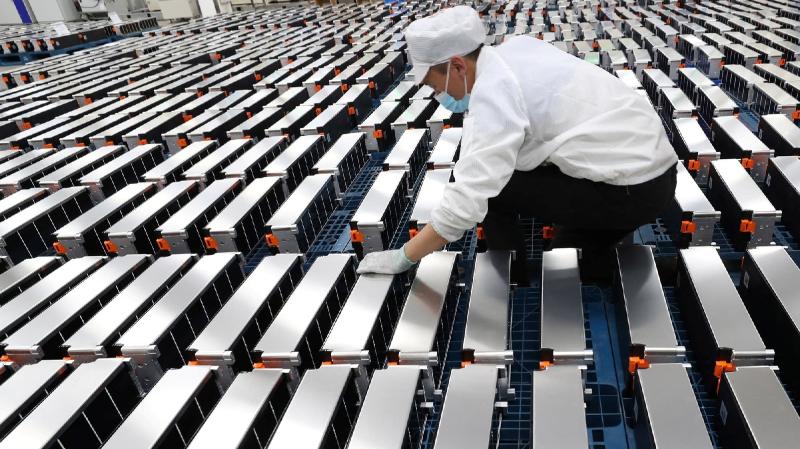
World/Internationalby Sabri Ben-Achour and Ashley RodriguezPlayListen NowSaveShareDownloadMore EV demand could help scale the battery supply chains needed for the next generation of industrial technology.CN-STR/AFP via Getty Images
After facing a punishing 100% tariff, Canada slashed import taxes on Chinese EVs to just over 6% earlier this year. Under the agreement, Canada will allow up to 49,000 Chinese EVs into the Canadian market.
That would comprise less than 3% of Canada's annual car sales, but the move has raised concerns in the United States, from the White House to Detroit, where automakers rely heavily on Canadian buyers.
So what does this mean for the North American auto industry? And could Chinese EVs eventually make their way onto American roads?
"Marketplace Morning Report" host Sabri Ben-Achour spoke with Noah Smith, an economics writer and founder of the Noahpinion blog. The following is an edited transcript of their conversation.
Sabri Ben-Achour: Chinese manufacturing has gutted one U.S. industry after another, starting with the low-tech. And over the years, the competition is becoming more and more high-tech. There was apparel, then magnets, rare earths, solar panels. Why expose U.S. automakers to that competition when it has gone so badly for so many other industries?
Noah Smith: The reason is basically that our own automakers have decided that electric cars are not the future, and they're not going to make them. The rest of the world is shifting to electric cars. Therefore, this is killing battery demand. Now, batteries are increasingly important to manufacturing everything. Batteries are taking over in you know, robots, of course, all kinds of appliances, all kinds of installed machinery, storage data centers have huge batteries to smooth out electricity use. So basically, we need more demand for batteries.
I want American industry to be able to make cutting-edge stuff with good technology that really works. And the only way we're going to do that is if we make batteries, batteries, batteries. And Chinese electric cars use batteries, and therefore battery factories will go up and up and up all over America if you have the demand locally from the Chinese electric car companies.
Ben-Achour: So, it's not necessarily about protecting the U.S. auto industry. It's about creating a bunch of other industries, like batteries, that would benefit?
Smith: That's exactly right. The idea is that, you know, physical technologies are converging toward a basic package of things. You have energy from a battery. You have control from chips. You have also some other kinds of chips called power electronics that help you, like, move the power around the thing. And then you have motion from a motor. Everything is converging on this one unified tech stack. Basically, we need that tech stack. Trying to preserve this sort of antiquated combustion car tech stack as this tiny, little orphaned thing cut off from the rest of manufacturing is not going to help us in manufacturing. It's going to hurt it.
Ben-Achour: What does the U.S. economy as a whole stand to lose if we do not let the Chinese cars in?
Smith: The answer is manufacturing industries of the future. We're purposefully sticking ourselves in the past with these combustion cars that are an obsolete technology. And if we cut ourselves off from the technology of the future, which are EVs, we will be behind in physical technologies. We will be behind in manufacturing. Protecting an obsolete technology and keeping out an advanced technology is bad for your manufacturing ecosystem.
Be a good human. Grossly derogatory comments, blatantly inflammatory comments, excessive trolling, mean-spirited taunting and insults, scamming, spamming, and off topic comments may be removed in compliance with the site's Terms of Service and the Code of Conduct. The moderators have the final word.

Tags
Who is online
156 visitors
Noah Smith is really just trying to sell the same old soap in a new box. The idea that vertically integrated manufacturers would buy US made batteries sounds like just another scam. Why would BYD give up it's greatest strength to satisfy US passive investors?