
The United States officially enters World War I | April 6, 1917

By: (HISTORY)


A last war that wasn't.
 S E E D E D C O N T E N T
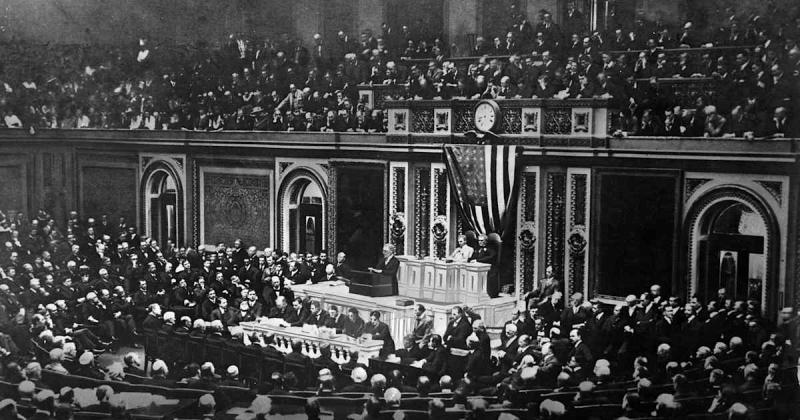
April 6, 1917 --Two days after the U.S. Senate voted 82 to 6 to declare war against Germany, the U.S. House of Representatives endorses the declaration by a vote of 373 to 50. As a result, America formally enters World War I.
When World War I erupted in 1914, President Woodrow Wilson pledged neutrality for the United States, a position that the vast majority of Americans favored. Britain, however, was one of America's closest trading partners, and tension soon arose between the United States and Germany over the latter's attempted quarantine of the British Isles.
Several U.S. ships traveling to Britain were damaged or sunk by German mines, and in February 1915 Germany announced unrestricted warfare against all ships, neutral or otherwise, that entered the war zone around Britain. One month later, Germany announced that a German cruiser had sunk the William P. Frye, a private American vessel. President Wilson was outraged, but the German government apologized and called the attack an unfortunate mistake.
How a Wrong Turn Started World War I
Archduke Ferdinand's assassination caused the outbreak of World War I, but what caused the assassination itself? It may have been something as simple as a wrong turn.
3:14m watch
On May 7, the British-owned Lusitania ocean liner was torpedoed without warning just off the coast of Ireland. Of the 1,959 passengers, 1,198 were killed, including 128 Americans. The German government maintained that the Lusitania was carrying munitions, but the U.S. demanded reparations and an end to German attacks on unarmed passenger and merchant ships. In August, Germany pledged to see to the safety of passengers before sinking unarmed vessels, but in November sunk an Italian liner without warning, killing 272 people, including 27 Americans. With these attacks, public opinion in the United States began to turn irrevocably against Germany.
In 1917, Germany, determined to win its war of attrition against the Allies, announced the resumption of unrestricted warfare in war-zone waters. Three days later, the United States broke diplomatic relations with Germany, and just hours after that the American liner Housatonic was sunk by a German U-boat. On February 22, Congress passed a $250 million arms appropriations bill intended to make the United States ready for war. In late March, Germany sunk four more U.S. merchant ships, and on April 2 President Wilson appeared before Congress and called for a declaration of war against Germany. Four days later, his request was granted.
On June 26, the first 14,000 U.S. infantry troops landed in France to begin training for combat. After four years of bloody stalemate along the western front, the entrance of America's well-supplied forces into the conflict marked a major turning point in the war and helped the Allies to victory. When the war finally ended, on November 11, 1918, more than two million American soldiers had served on the battlefields of Western Europe, and some 50,000 of them had lost their lives.
Also on This Day in History
Discover more of the major events, famous births, notable deaths and everything else history-making that happened on April 6th
1830 -- The Church of Jesus Christ of Latter-day Saints established
In Fayette, New York, Joseph Smith, founder of The Church of Jesus Christ of Latter-day Saints (also known as the Mormon Church), organizes the Church of Christ during a meeting with a small group of believers. Born in Vermont in 1805, Smith claimed in 1823 that he had been visited by a Christian angel named […]
1841 -- John Tyler is inaugurated as 10th president
On April 6, 1841, John Tyler is sworn in as president. Tyler was elected as William Harrison's vice president earlier in 1841 and was suddenly thrust into the role of president when Harrison died one month into office. He was the first vice president to immediately assume the role of president after a sitting president's […]
1862 -- Battle of Shiloh begins
The Civil War explodes in the west as the armies of Union General Ulysses S. Grant and Confederate General Albert Sidney Johnston collide at Shiloh, near Pittsburgh Landing in Tennessee. The Battle of Shiloh became one of the bloodiest engagements of the war, and the level of violence shocked North and South alike. For six […]
1896 -- First modern Olympic Games
On April 6, 1896, the Olympic Games, a long-lost tradition of ancient Greece, are reborn in Athens 1,500 years after being banned by Roman Emperor Theodosius I. At the opening of the Athens Games, King Georgios I of Greece and a crowd of 60,000 spectators welcomed athletes from 13 nations to the international competition. The […]
1909 -- Robert Peary almost reaches the North Pole
On April 6, 1909, American explorer Robert Peary accomplishes a long elusive dream, when he, assistant Matthew Henson and four Inuits reach what they determine to be the North Pole. Decades after Peary's death, however, navigational errors in his travel log surfaced, placing the expedition in all probability a few miles short of its goal. […]
1924 -- First successful around-the-world flight begins
On April 6, 1924, eight American pilots depart Seattle's Sand Point Naval Air Station in four modified Navy torpedo bombers, in hopes of becoming the first people to travel around the entire globe by air—something attempted unsuccessfully by several European flyers in previous years. After 175 days (flying time: 371 hours 11 minutes), and a […]
1941 -- Germany invades Yugoslavia and Greece
The German air force launches Operation Castigo, the bombing of Belgrade, on April 6, 1941, as 24 divisions and 1,200 tanks drive into Greece. The attack on Yugoslavia was swift and brutal, an act of terror resulting in the death of 17,000 civilians—the largest number of civilian casualties in a single day since the start […]
1970 -- Sam Sheppard, the inspiration for "The Fugitive," dies
On April 6, 1970, Sam Sheppard, a doctor convicted of murdering his pregnant wife in a trial that caused a media frenzy in the 1950s, dies of liver failure. After a decade in prison, Sheppard was released following a re-trial. His story is rumored to have loosely inspired the television series and movie The Fugitive. […]
Be a good human. Grossly derogatory comments, blatantly inflammatory comments, excessive trolling, mean-spirited taunting and insults, scamming, spamming, and off topic comments may be removed in compliance with the site's Terms of Service and the Code of Conduct. The moderators have the final word.

Tags
Who is online
162 visitors
You will hear of wars and rumors of wars ...
(For those who might be interested: )
Wrong turns started and finished WWI, no Treaty of Versailles Redux please.