
John Wilkes Booth shoots Abraham Lincoln | April 14, 1865

By: (HISTORY)


Coincidence? Abraham Lincoln died on April 15 which is now a day mourning for many.
 S E E D E D C O N T E N T
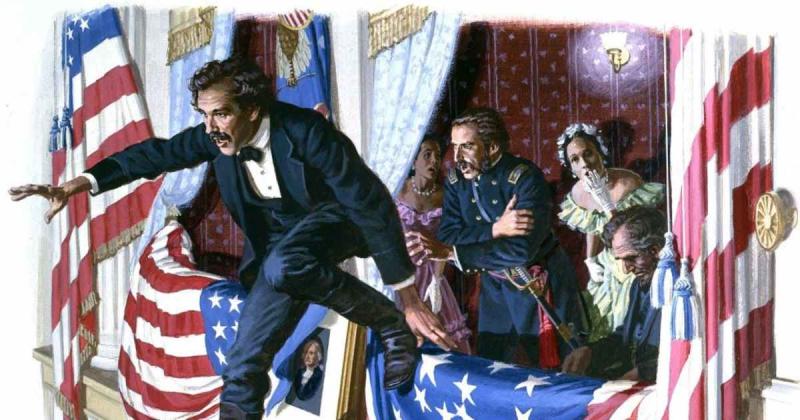
President Abraham Lincoln is shot in the head at Ford's Theatre in Washington, D.C. on April 14, 1865. The assassin, actor John Wilkes Booth, shouted, "Sic semper tyrannis! (Ever thus to tyrants!) The South is avenged," as he jumped onto the stage and fled on horseback. Lincoln died the next morning.
Booth, who remained in the North during the war despite his Confederate sympathies, initially plotted to capture President Lincoln and take him to Richmond, the Confederate capital. However, on March 20, 1865, the day of the planned kidnapping, the president failed to appear at the spot where Booth and his six fellow conspirators lay in wait. Two weeks later, Richmond fell to Union forces. In April, with Confederate armies near collapse across the South, Booth hatched a desperate plan to save the Confederacy.
The Lincoln Assassination Plot
The assassination of President Lincoln was just one part of a larger plot to decapitate the federal government of the U.S. after the Civil War.
4:04m watch
Learning that Lincoln was to attend Laura Keene's acclaimed performance in Our American Cousin at Ford's Theater on April 14, Booth plotted the simultaneous assassination of Lincoln, Vice President Andrew Johnson, and Secretary of State William H. Seward. By murdering the president and two of his possible successors, Booth and his conspirators hoped to throw the U.S. government into a paralyzing disarray.
On the evening of April 14, conspirator Lewis T. Powell burst into Secretary of State Seward's home, seriously wounding him and three others, while George A. Atzerodt, assigned to Vice President Johnson, lost his nerve and fled.
Meanwhile, just after 10 p.m., Booth entered Lincoln's private theater box unnoticed, and shot the president with a single bullet in the back of his head. Although Booth had broken his left leg jumping from Lincoln's box, he succeeded in escaping Washington.
The president, mortally wounded, was carried to a cheap lodging house opposite Ford's Theater. At about 7:22 the next morning, he died—the first U.S. president to be assassinated.
Booth was a well-regarded actor who was particularly loved in the South before the Civil War. During the war, he stayed in the North and became increasingly bitter when audiences weren't as enamored of him as they were in Dixie. Along with friends Samuel Arnold, Michael O'Laughlin and John Surratt, Booth conspired to kidnap Lincoln and deliver him to the South.
On March 17, along with George Atzerodt, David Herold and Lewis Powell, the group met in a Washington bar to plot the abduction of the president three days later. However, when the president changed his plans, the scheme was scuttled. Shortly afterward, the South surrendered to the Union and the conspirators altered their plan. They decided to kill Lincoln, Vice President Andrew Johnson and Secretary of State William Seward on the same evening.
When April 14 came around, Atzerodt backed out of his part to kill Johnson. Upset, Booth went to drink at a saloon near Ford's Theatre. At about 10 p.m. he walked into the theater and up to the president's box. Lincoln's guard, John Parker, was not there because he had gotten bored with the play and left his post to get a beer. Booth easily slipped in and shot the president in the back of the head. The president's friend, Major Rathbone, attempted to grab Booth but was slashed by Booth's knife. Booth injured his leg badly when he jumped to the stage to escape, but he managed to hobble outside to his horse.
Meanwhile, Lewis Powell forced his way into William Seward's house and stabbed the secretary of state several times before fleeing. Booth rode to Maryland with David Herold and stopped at the home of Dr. Samuel Mudd, who placed splints on Booth's leg. They hid in a barn on Richard Garrett's farm as thousands of Union troops combed the area looking for them. The other conspirators were captured, except for John Surratt, who fled to Canada.
When the troops finally caught up with Booth and Herold on April 26, they gave them the option of surrendering before the barn was burned down. Herold decided to surrender, but Booth remained in the barn as it went up in flames. Booth was then shot and killed in the burning barn by Corporal Boston Corbett. On July 7, George Atzerodt, Lewis Powell, David Herold, and John Surratt's mother, Mary, were hanged in Washington. The execution of Mary Surratt is believed by some to have been a miscarriage of justice. Although there was proof of Surratt's involvement in the original abduction conspiracy, it is clear that her deeds were minor compared to those of the others who were executed.
Her son John was eventually tracked down in Egypt and brought back to trial, but he managed, with the help of clever lawyers, to win an acquittal.
Also on This Day in History
Discover more of the major events, famous births, notable deaths and everything else history-making that happened on April 14th
1775 -- First American abolition society founded in Philadelphia
The Society for the Relief of Free Negroes Unlawfully Held in Bondage, the first American society dedicated to the cause of abolition, is founded in Philadelphia on April 14, 1775. The society changes its name to the Pennsylvania Society for Promoting the Abolition of Slavery and the Relief of Free Negroes Unlawfully Held in Bondage […]
1828 -- "Webster's American Dictionary of the English Language" is printed
Noah Webster, a Yale-educated lawyer with an avid interest in language and education, publishes his American Dictionary of the English Language on April 14, 1828. Webster's dictionary was one of the first lexicons to include distinctly American words. The dictionary, which took him more than two decades to complete, introduced more than 10,000 "Americanisms." The […]
1910 -- Taft becomes first U.S. president to throw out first pitch at MLB game
On April 14, 1910, President William Howard Taft becomes the first president to throw out the ceremonial first pitch at a Major League Baseball game. The historic toss on opening day is to star Walter Johnson, the Washington Senators' starting pitcher against the Philadelphia Athletics at National Park in the nation's capital. Senators owner Clark […]
1918 -- American pilots engage in first dogfight over the western front
Six days after being assigned for the first time to the western front, two American pilots from the U.S. First Aero Squadron engage in America's first aerial dogfight with enemy aircraft. In a battle fought almost directly over the Allied Squadron Aerodome at Toul, France, U.S. fliers Douglas Campbell and Alan Winslow succeeded in shooting […]
1932 -- Loretta Lynn is born
Loretta Lynn, a singer who greatly expanded the opportunities for women in the male-dominated world of country-western music, is born in Butcher Hollow, Kentucky on April 14, 1932. Unlike some country-western stars that sang about a rural working class life but lived an urban middle class existence, Loretta Lynn's country roots were unquestionably authentic. Born Loretta […]
1935 -- "Black Sunday" Dust Bowl storm strikes
In what came to be known as "Black Sunday," one of the most devastating storms of the 1930s Dust Bowl era sweeps across the region on April 14, 1935. High winds kicked up clouds of millions of tons of dirt and dust so dense and dark that some eyewitnesses believed the world was coming to […]
1944 -- Explosion on cargo ship rocks Bombay, India
The cargo ship Fort Stikine explodes in a berth in the docks of Bombay, India (now known as Mumbai), killing 1,300 people and injuring another 3,000 on April 14, 1944. As it occurred during World War II, some initially claimed that the massive explosion was caused by Japanese sabotage; in fact, it was a tragic […]
1960 -- Montreal Canadiens win fifth consecutive Stanley Cup
On April 14, 1960, the Montreal Canadiens defeat the Toronto Maple Leafs to win the Stanley Cup for a record fifth year in a row. The Canadiens reached the Stanley Cup Finals after sweeping the Chicago Blackhawks in four games, while the Maple Leafs defeated the Detroit Red Wings, four games to two. The championship […]
1969 -- Katharine Hepburn and Barbra Streisand tie for Best Actress Oscar
On April 14, 1969, during the first internationally televised Oscars ceremony, Ingrid Bergman exclaims "It's a tie!" upon opening the Best Actress envelope—the first tie in a major acting category in three decades. The award went to both Katharine Hepburn, for her turn as Eleanor of Aquitaine in The Lion in Winter, and Barbra Streisand, […]
1986 -- U.S. bombs terrorist and military targets in Libya
On April 14, 1986, the United States launches air strikes against Libya in retaliation for the Libyan sponsorship of terrorism against American troops and citizens. The raid, which began shortly before 7 p.m. EST (2 a.m., April 15 in Libya), involved more than 100 U.S. Air Force and Navy aircraft, and was over within an […]
1988 -- Soviets agree to withdraw from Afghanistan
Representatives of the USSR, Afghanistan, the United States and Pakistan sign an agreement calling for the withdrawal of Soviet forces from Afghanistan. In exchange for an end to the disputed Soviet occupation, the United States agreed to end its arms support for the Afghan anti-Soviet factions, and Afghanistan and Pakistan agreed not to interfere in […]
1996 -- Greg Norman blows six-shot Masters lead in epic collapse
On April 14, 1996, third-round leader Greg Norman loses a six-shot lead in the final round of the Masters golf tournament and finishes second—one of the worst collapses in sports history. Nick Faldo wins the green jacket, finishing five strokes ahead of Norman. "I played like a bunch of [expletive]," the Australian tells reporters afterward. […]
Be a good human. Grossly derogatory comments, blatantly inflammatory comments, excessive trolling, mean-spirited taunting and insults, scamming, spamming, and off topic comments may be removed in compliance with the site's Terms of Service and the Code of Conduct. The moderators have the final word.

Tags
Who is online
162 visitors
"Now he belongs to the ages" -- Edwin Stanton