
Trump may claim he won the fight with Iran, but there’s a bigger war already underway

By: Robert Maginnis (FOX News via MSN)

Maginnis' FOX News analysis suffers from nostalgia for a world that no longer exists. Myopic analysis won't bring back the ideological rivalry of the Cold War. Today's rivalries in the geopolitical arena are now economic and becoming more transactional.
The China-Russia-Iran strategic alignment arose from the Ukrainian war as a response to President Biden's use of sanctions and financial isolation as weapons of war. And the Ukrainian war has revealed the limitations of the financialized world order. Sanctions can be circumvented and direct transactions bypass the financial gatekeepers (and toll collectors) on global trade.
The Iranian war has forced a quasi-strategic alignment between China-India-Pakistan-Saudi Arabia-Iran. Southeast Asia is toying with joining that strategic alignment. The Iranian war has disrupted the supply chains of the Asian industrial economies. And the Iranian war has revealed the limitations of advanced technical kinetic warfare to protect and secure supply chains. Coercive strength has become a threat to the global economy rather than a means of stability.
President Trump has inadvertently divided the world into two global orders. One is the financialized services portion of the global economy that relies on rules-based protections for a global monetary system (with the United States providing coercive security). The other is the industrialized producing portion of the global economy that depends upon trustworthy transactional agreements. President Trump is demonstrating that a financialized economy cannot compete with industrialized economies. Both Presidents Biden and Trump have shown the world that the rules-based financialized global order that worked well for a nuclear showdown during the Cold War is now obsolete and inadequate for today's transition to Trade Wars.
 S E E D E D C O N T E N T

April 20, 2026 -- The Iran conflict appears to be winding down. If the fragile ceasefire holds, President Donald Trump may stand before the American people in coming days and declare victory — shipping lanes reopened, deterrence restored, the ayatollahs humbled. On its face, that would be a genuine achievement.
The Iran campaign wasn’t wrong. Confronting a nuclear-threshold regime that funded terrorism across three continents and threatened international shipping lanes was a legitimate strategic necessity. Trump acted where others hesitated.
But every consequential action carries second- and third-order effects — and those now unfolding extend well beyond what any victory headline can contain.
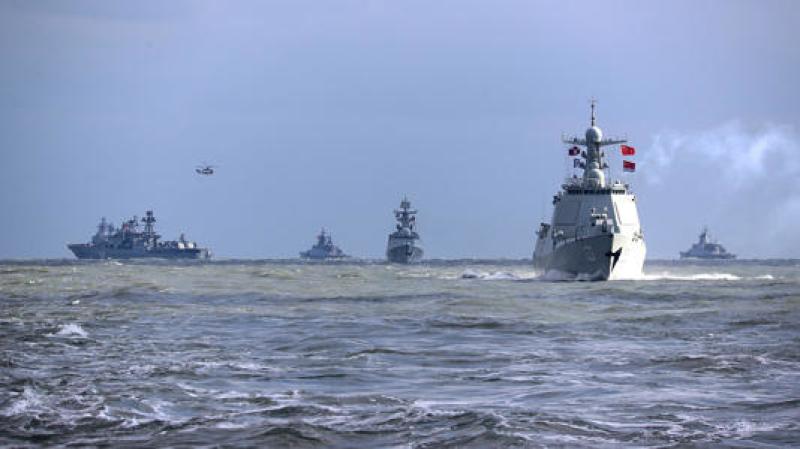
While Washington has been grinding down Iran’s military infrastructure, something far more consequential has been hardening in the background: a China-Russia-Iran strategic alignment accelerating the fracture of the post-Cold War world order — and that fracture now runs directly through the transatlantic alliance itself.
Xi’s signal cannot be dismissed
That is not diplomatic boilerplate. That is a geopolitical declaration.
Russian Foreign Minister Sergey Lavrov sharpened the message at that same Beijing meeting, declaring that Iran holds an "inalienable" right to enrich uranium — a direct, public rebuke of Trump’s core demand for zero enrichment, and proof that Moscow is not merely watching this conflict but actively shielding Tehran’s nuclear position.
Xi and Putin spent the Iran war watching from the sidelines — but not standing still. According to a Ukrainian intelligence assessment reviewed by Reuters, Russia provided Iran with satellite imagery and cyber support — unconfirmed, but consistent with Moscow’s pattern of proxy warfare.
Russia also publicly called on Washington to abandon "the language of ultimatums" on Tehran, proposed taking custody of Iran’s enriched uranium stockpile, and reaped a windfall as Brent crude surged toward $120 a barrel — a price surge that directly bankrolled Putin’s war of choice in Ukraine at the precise moment American forces were tied down in the Gulf.
China’s support stopped short of confirmed combat involvement, but its strategic weight was substantial. Beijing purchased over 80% of Iran’s exported oil at discounted prices, keeping Tehran financially viable through the bombardment. Chinese-linked tankers remained active in Iranian oil transit even amid blockade conditions.
Trump acknowledged the concern directly: he exchanged letters with Xi Jinping after hearing reports that Beijing was supplying shoulder-fired and anti-aircraft missiles to Tehran. Xi’s response, in Trump’s own words, said "essentially, he’s not doing that" — and Trump threatened a 50% additional tariff if proven otherwise.
In January 2026, Iran, China, and Russia formalized a comprehensive trilateral strategic pact — not a mutual defense treaty, but a framework for nuclear, economic and military alignment. The Center for Strategic and International Studies has tracked this emerging "CRINK" alignment — China, Russia, Iran, and North Korea — and the data shows it hardening, not softening, under American military pressure.
This is the strategic trap Washington has walked into. Pressure on Iran did not isolate Tehran — it drove the axis tighter.
NATO is fracturing on Washington’s watch
The Iran war has done more damage to the Western alliance than any Russian influence operation in decades.
Former NATO Secretary General Jens Stoltenberg reminded the world from the official NATO lectern that NATO "is a defensive Alliance … not threatening anyone" — an alliance built in 1949 to defend Western Europe against Soviet aggression, not to launch discretionary wars of choice in the Middle East.
When Trump demanded warships from NATO allies France, Germany, Italy, and Britain — and separately from non-NATO partners Australia and Japan — to reopen the Strait of Hormuz, France, Germany, Italy, Britain, Australia, and Japan all refused.
Trump called their refusal a stain on the alliance that will "never disappear" and announced he is strongly considering withdrawing the United States from NATO — calling it a "paper tiger." The administration has since discussed pulling American troops from European soil.
Jim Townsend, former deputy assistant secretary of Defense for Europe and NATO, put it plainly: "We are closer to a break than we have ever been." Seventy-seven years of collective deterrence — the architecture that kept Soviet tanks out of Western Europe — is teetering, not because Putin outmaneuvered us, but because we fractured it ourselves in the middle of a Middle Eastern war.
Both understand that a United States estranged from its democratic allies is a United States strategically weakened — regardless of how many Iranian bunkers lie in rubble.
The real battlefield is bigger than Iran
Across three books — "Alliance of Evil" (2018), "Preparing for World War III" (2024), and "The New AI Cold War" (2026) — I have tracked the civilizational contest now underway. The Iran war is a chapter in it.
China and Russia have used this conflict as a live training exercise — studying American carrier operations, missile intercept patterns and logistics flows in real time. Every signature revealed in the Gulf feeds directly into Beijing’s Taiwan invasion planning.
Meanwhile, the December 2025 U.S. National Security Strategy still treats China and Russia as separate problems — a strategic blind spot that would have alarmed President Richard Nixon and his Secretary of State Henry Kissinger, who spent careers preventing exactly that coalition.
Proverbs 11:14 states it plainly: "Where there is no guidance, a people falls, but in an abundance of counselors there is safety." A strategy that isolates its allies and misreads its adversaries is not strength. It is the architecture of eventual defeat.
The real question is not whether Trump can declare victory over Iran. He likely can. The question is what that victory costs: a NATO alliance pushed to its breaking point and a Sino-Russian partnership hardened by American overextension.
Great-power competition is decided in the accumulation of alignments, relationships and credibility built or squandered over years. Winning in Tehran while losing in Brussels and Beijing is not a net victory. It is a strategic setback dressed in tactical success.
President Trump has the instincts of a dealmaker. The moment to make the critical deals — with NATO, against the axis — is right now, before the victory speech becomes the last act rather than the opening of the next strategic chapter.
Because Xi Jinping is not congratulating us. He is calculating.
Be a good human. Grossly derogatory comments, blatantly inflammatory comments, excessive trolling, mean-spirited taunting and insults, scamming, spamming, and off topic comments may be removed in compliance with the site's Terms of Service and the Code of Conduct. The moderators have the final word.

Tags
Who is online

119 visitors
Is President Trump fighting the wrong war in the wrong century? At times is certainly seems so.
Small nations have done their homework and now know how to wage war asymetrically.
Remember, this is a guy that thinks that a fence will stop illegal immigration, bleach injections fight disease, and windmills kill whales.