
China's quiet role in Middle East peace talks gains attention

By: HUIZHONG WU and KANIS LEUNG (AP News)
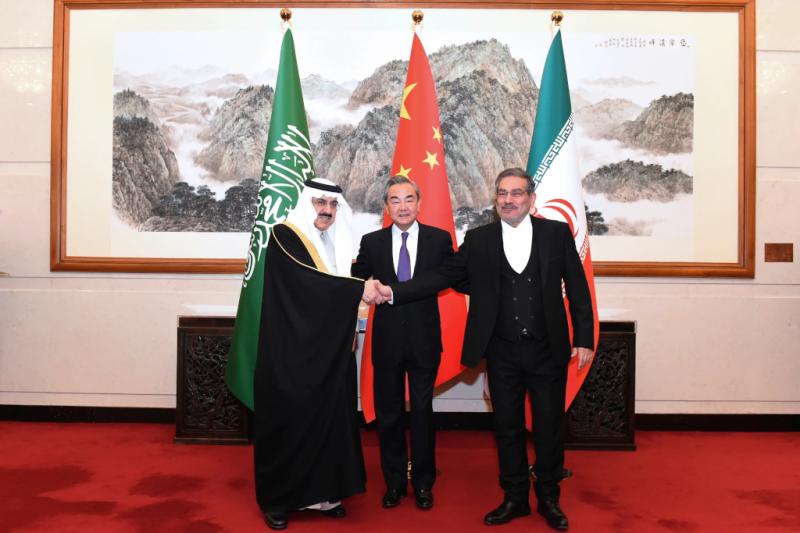


The myopic focus on Iran doesn't really capture the full extent of what is happening. China's influence is growing in the whole Persian Gulf. In many ways China is employing the same sort of soft diplomacy and buyer-influence that the United States used during the 1950s - 60s.
The article describes China's influence with Iran. As the photo shows, China is positioning itself between Iran and Saudi Arabia. China is leveraging that same influence throughout the Persian Gulf.
 S E E D E D C O N T E N T
April 23, 2026, BANGKOK (AP) — China's role as an unofficial mediator in the latest war in the Middle East is drawing attention across the world as it seeks to project the image of being a responsible global power while U.S. actions are straining its long-standing alliances.
China's profile in international diplomacy has risen in recent years, thanks to active efforts from its diplomats. Long reluctant to get involved in conflicts far from its borders, it has nevertheless emerged as a major player with attempts to mediate conflicts from Southeast Asia to Europe.
With the Iran war, Beijing is not an official mediator, but all parties — including Washington and Tehran — say it has played an important role in trying to de-escalate the conflict.
Experts say Beijing's strategies for diplomacy in multiple conflicts have looked similar and have had mixed success in influencing negotiations, but the efforts come at an opportune time, as U.S. actions under President Donald Trump have increased tensions with traditional diplomatic allies.
In the Iran war, experts say, China's close economic and political ties to Tehran put it in a unique position of influence as the conflict hurts the global energy supply, especially in Asia.
Trump says China encouraged Iran to negotiate ceasefire
Trump has said he believes China helped encourage Iran to negotiate the fragile ceasefire that he has now extended.
Diplomats told The Associated Press that Beijing, the biggest purchaser of sanctioned Iranian oil, used its leverage to urge the Iranians back to the negotiating table for historic face-to-face talks in Pakistan earlier this month.
Beijing has not confirmed that account, likely because it does not want to be seen as part of a U.S.-led security framework, said Yaqi Li, a researcher at the S. Rajaratnam School of International Studies at Nanyang Technological University in Singapore.
Related Stories US still delivering weapons to Ukraine, Zelenskyy says, as Prince Harry visits Kyiv3 MIN READTrump orders US military to 'shoot and kill' Iranian small boats choking Strait of Hormuz4 MIN READ19Lebanon and Israel to resume rare direct talks in Washington to extend Israel-Hezbollah ceasefire3 MIN READ
Still, some saw it as a major moment for Beijing, which has criticized the U.S.' and Israel's war against Iran.
After the war began with U.S.-Israeli strikes on Feb. 28, Chinese Foreign Minister Wang Yi spoke with counterparts including Israel, Saudi Arabia, Bahrain and the United Arab Emirates. As of mid-April, he had 30 phone calls with various parties about the war, according to a tally of his calls from the Ministry of Foreign Affairs.
Wang also hosted his counterpart from close ally Pakistan, which has been acting as the main mediator in the latest talks, to present a five-point proposal calling for an end to hostilities and the reopening of the Strait of Hormuz.
Chinese President Xi Jinping in recent days has been uncharacteristically outspoken, warning last week against "the world's retrogression to the law of the jungle." This week, he called for the Strait of Hormuz to reopen.
China leans on its role as an economic power
George Chen, a partner at The Asia Group consultancy, said China's role in the Iran situation is irreplaceable. As Tehran's biggest oil buyer, its advice carries weight. China is also one of the few countries that has showed sympathy for Iran's situation at the United Nations, he said.
Further, Iran's ballistic missile program was built with Chinese technology, and China sells dual-use industrial components that can be used for missile production, according to the U.S. government.
Although China isn't as immediately influential as Pakistan or key Arab Gulf states in active mediation, it occupies a unique position as the key economic partner for many of those countries.
Tuvia Gering, a nonresident fellow at the Atlantic Council's Global China Hub, said China is uniquely positioned to offer economic incentives that matter to Tehran, especially after the war ends, as Beijing can promise investment in reconstruction and commercial relief in ways few others can.
"It could be one of the few actors capable of giving Tehran both political cover and material incentives to accept constraints and stick to them," he said.
China's role as a global mediator is growing
One of China's biggest diplomatic wins in recent years came in 2023, when it was among the parties bringing Saudi Arabia and Iran together to restart official engagement.
It was widely seen as a major geopolitical breakthrough that reduced the risk of direct and proxy conflict, said Muhammad Zulfikar Rakhmat, a researcher at the Center of Economic and Law Studies in Indonesia.
But China is choosing when to play a role cautiously, he said, noting that Saudi Arabia and Iran had preexisting incentives to reengage diplomatically. "Its mediation tends to be opportunistic and low-risk, often occurring when conditions are already conducive to agreement," he said.
Beijing also was active during the recent conflict between Thailand and Cambodia, hosting multiple meetings between them and attending initial ceasefire talks alongside the U.S. in Malaysia. When fighting started again in December, China and the U.S. helped broker another ceasefire.
Beijing also has issued peace proposals for the war in Ukraine, hosting the Ukrainian foreign minister at one point, even though it maintains what it calls a "no-limits" friendship with Russia.
Beijing's role remains carefully worded
China's diplomatic efforts tend to follow a pattern, experts say, with Beijing reiterating calls to respect the U.N. charter and national sovereignty.
With the Iran war, Xi last week called for "upholding the principles of peaceful coexistence, upholding national sovereignty, upholding the rule of international law, and coordinating development and security."
"A lot of the points are remarkably consistent," said Hoo Tiang Boon, a professor of Chinese foreign policy at Nanyang Technological University.
In conflicts further afield, the stakes for Beijing can be low but benefits can be high as the world tries to come to terms with the Trump administration's approach to negotiating, Thitinan Pongsudhirak, a professor of international relations at Thailand's Chulalongkorn University, said.
"What the U.S. is doing is deeply damaging, and everyone suffers from it ... and China is displaying global leadership and exerting its global role by speaking to the rules-based international system," he said. "It's an inescapable contrast."
HUIZHONG WU Wu covers Chinese culture, society, and politics for The Associated Press, as well as the country's growing overseas influence from Bangkok. She was previously based in Taiwan and China.
KANIS LEUNG Leung covers Hong Kong, Macao and mainland China for The Associated Press. She is based in Hong Kong.
Be a good human. Grossly derogatory comments, blatantly inflammatory comments, excessive trolling, mean-spirited taunting and insults, scamming, spamming, and off topic comments may be removed in compliance with the site's Terms of Service and the Code of Conduct. The moderators have the final word.

Tags
Who is online

119 visitors
During the 1950s-60s the United States leveraged the 'Seven Sisters' oil majors to become integrated into the infrastructure for producing Persian oil. China's belt-and-road initiative leverages commercial logistics to integrate into the commercial infrastructure of the Persian Gulf.
China's influence is growing in the whole Persian Gulf. In many ways China is employing the same sort of soft diplomacy and buyer-influence that the United States used during the 1950s - 60s.
Soft diplomacy= Trying to help the world's number one exporter of terror remain viable by helping it evade sanctions and arming it.
I thought Trump was going to fix the # 1 exporter of terror with a policy of Gazafication. Pete Hegseth has told us the Iranian regime has been destroyed by US and God's righteous wrath.
So who is going to get the Iranian oil? Who is going to invest in rebuilding Iran? What's the plan for the Persian Gulf after the # 1 exporter of terror is gone?
Do you think the Middle eastern countries who Iran has terrorized believe China's "soft power" in assisting the Iranian regime has been helpful ? do you think Ukraine enjoys China keeping Russian armies in the field with its support?
OR maybe it's China turning to the IMF to collect on the predatory loans that China and seize infrastructure in Africa and South America that make it so well regarded? I'm sure China pressuring the rest of the world to cover these defaults is just being a good neighbor. Who is more well liked than a payday loan company?
China is also a lifeline for Iraq, UAE, Qatar, and Saudi Arabia. Almost 80% of the Persian Gulf oil China imports is supplied by the Arab states in the region.
We'll find out now that President Trump has opened the door for the Repsol Sinopec Brasil joint venture to begin operating in Venezuela. China may end up influencing US access to Venezuelan sour crude.