
Test triggers nuclear disaster at Chernobyl | April 26, 1986

By: HISTORY


Seems like only yesterday.
 S E E D E D C O N T E N T

On April 26, 1986, the world's worst nuclear power plant accident occurs at the Chernobyl nuclear power station in the Soviet Union. Thirty-two people died and dozens more suffered radiation burns in the opening days of the crisis, but only after Swedish authorities reported the fallout did Soviet authorities reluctantly admit that an accident had occurred.
The Chernobyl station was situated at the settlement of Pripyat, about 65 miles north of Kiev in the Ukraine. Built in the late 1970s on the banks of the Pripyat River, Chernobyl had four reactors, each capable of producing 1,000 megawatts of electric power. On the evening of April 25, 1986, a group of engineers began an electrical-engineering experiment on the Number 4 reactor. The engineers, who had little knowledge of reactor physics, wanted to see if the reactor's turbine could run emergency water pumps on inertial power.
Children Testing Gas Masks for the US Government
As the Cold War wore on, the American government became increasingly concerned about a potential Soviet strike on the U.S. mainland. In this footage from the early 1960's, children are used to test the effectiveness of gas masks.
2:18m watch
As part of their poorly designed experiment, the engineers disconnected the reactor's emergency safety systems and its power-regulating system. Next, they compounded this recklessness with a series of mistakes: They ran the reactor at a power level so low that the reaction became unstable, and then removed too many of the reactor's control rods in an attempt to power it up again. The reactor's output rose to more than 200 megawatts but was proving increasingly difficult to control. Nevertheless, at 1:23 a.m. on April 26, the engineers continued with their experiment and shut down the turbine generator to see if its inertial spinning would power the reactor's water pumps. In fact, it did not adequately power the water pumps, and without cooling water the power level in the reactor surged.
To prevent meltdown, the operators reinserted all the 200-some control rods into the reactor at once. The control rods were meant to reduce the reaction but had a design flaw: graphite tips. So, before the control rod's five meters of absorbent material could penetrate the core, 200 graphite tips simultaneously entered, thus facilitating the reaction and causing an explosion that blew off the heavy steel and concrete lid of the reactor. It was not a nuclear explosion, as nuclear power plants are incapable of producing such a reaction, but was chemical, driven by the ignition of gases and steam that were generated by the runaway reaction. In the explosion and ensuing fire, more than 50 tons of radioactive material were released into the atmosphere, where it was carried by air currents.
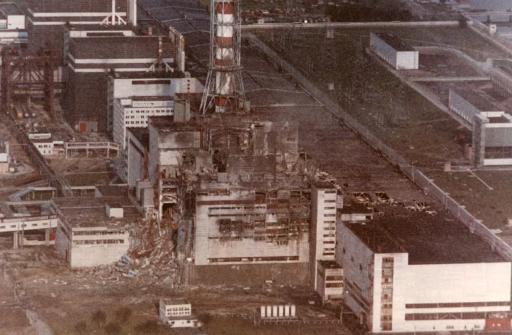
A view of the Chernobyl Nuclear power plant three days after the explosion. Considered history's worst nuclear accident, the Chernobyl disaster on April 26, 1986 killed 31 people directly, many due to radiation poisoning during the cleanup. The area around the plant remains so contaminated that it's officially closed off to human habitation. (Hone/Gamma-Rapho/Getty Images)
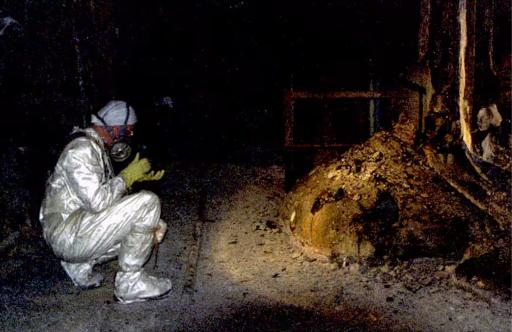
The Elephants Foot of the Chernobyl disaster is shown in the immediate aftermath of the meltdown. The Elephants Foot, named for its appearance, is a solid mass made of melted nuclear fuel mixed with lots of concrete, sand and core sealing material that the fuel had melted through. It lies in a basement area under the original location of the core. (Universal History Archive/UIG/Getty Images)
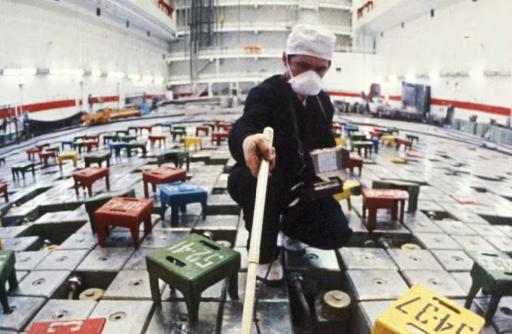
A technician in one of the reactors of the Chernobyl nuclear power plant tests for high levels of radiation in May 1986 after the accident. (Govfoto/UIG/Getty Images)
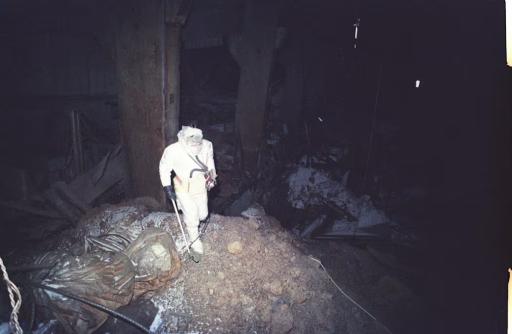
Under the sarcophagus, some 130 feet below ground, at the epicenter of the explosion, liquidator Georgi Reichtmann, a Chernobyl engineer, measures radiation levels in 1990. (Igor Kostin/Sygma/Getty Images)
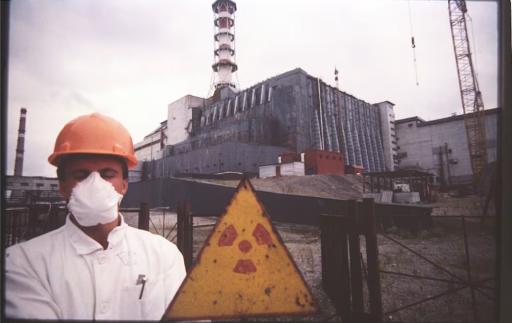
Over a hurried construction period of 206 days, crews erected a steel and cement sarcophagus to entomb the damaged reactor. Here, an employee stands in front of a radiation sign at the sarcophagus a few years after its construction. A 35,000-ton New Safe Confinement was built on tracks and then slid over the damaged reactor and existing sarcophagus in November 2016. (Igor Kostin/Sygma/Getty Images)
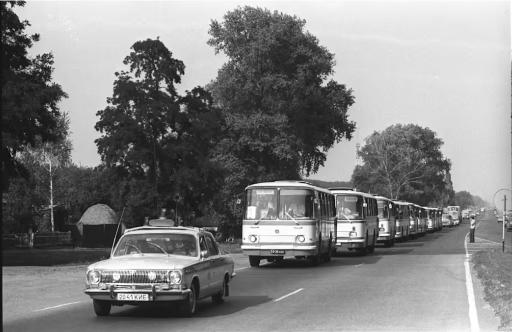
The evacuation of 47,000 inhabitants of Pripyat in over a thousand buses, only took a few hours as local people were told to take few personal belongings and identity papers, as it was thought they would be returning several days later. Most would never return to their homes. (Igor Kostin/Sygma/Getty Images)
A man scans his produce for radioactivity after the Chernobyl accident in May 1986 in Strasbourg, France. (Dominique Gutekunst/Gamma-Rapho/Getty Images)

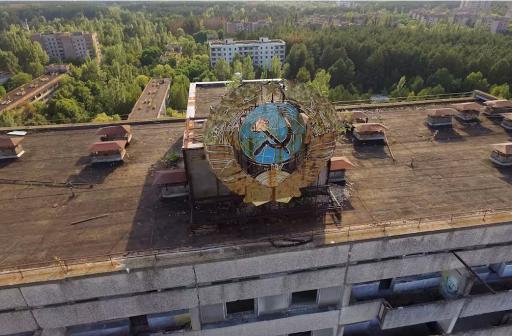
In this 2016 aerial view, a Soviet-era hammer and sickle stands on top of an abandoned apartment building in the ghost town of Pripyat not far from the Chernobyl nuclear power plant. (Sean Gallup/Getty Images)
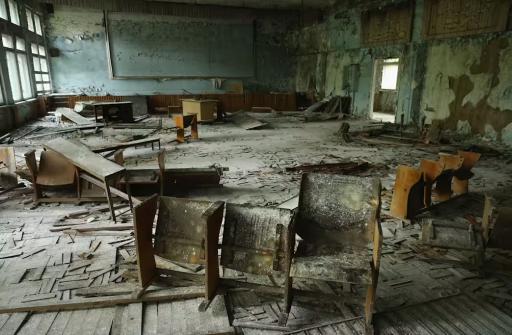
Pupils' chairs stand on rotting floorboards in an auditorium of abandoned School Number 3 on September 30, 2015 in Pripyat, Ukraine. Pripyat lies only a couple miles from the former Chernobyl nuclear power plant and was built in the 1970s to house the plant's workers and their families. (Getty Images / Sean Gallup)
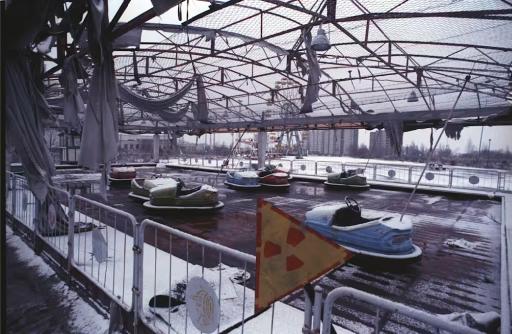
Bumper cars at a fair rust away in the ghost town of Pripyat, which was evacuated following the disaster. Today Pripyat remains a ghost-town, its apartment buildings, shops, restaurants, hospital, schools, cultural center and sports facilities derelict and its streets overgrown with trees. The city lies in the inner exclusion zone around Chernobyl where persistently high levels of radiation make the area uninhabitable for thousands of years to come. (Igor Kostin/Sygma/Getty Images)
On April 27, Soviet authorities began an evacuation of the 30,000 inhabitants of Pripyat. A cover-up was attempted, but on April 28 Swedish radiation monitoring stations, more than 800 miles to the northwest of Chernobyl, reported radiation levels 40 percent higher than normal. Later that day, the Soviet news agency acknowledged that a major nuclear accident had occurred at Chernobyl.
In the opening days of the crisis, 32 people died at Chernobyl and dozens more suffered radiation burns. The radiation that escaped into the atmosphere, which was several times that produced by the atomic bombs dropped on Hiroshima and Nagasaki, was spread by the wind over Northern and Eastern Europe, contaminating millions of acres of forest and farmland. An estimated 5,000 Soviet citizens eventually died from cancer and other radiation-induced illnesses caused by their exposure to the Chernobyl radiation, and millions more had their health adversely affected. In 2000, the last working reactors at Chernobyl were shut down and the plant was officially closed.
Also on This Day in History
Discover more of the major events, famous births, notable deaths and everything else history-making that happened on April 26th
1777 -- British rampage Danbury, Connecticut
On April 26, 1777, British troops under the command of General William Tryon attack the town of Danbury, Connecticut, and begin destroying everything in sight. Facing little, if any, opposition from Patriot forces, the British went on a rampage, setting fire to homes, farmhouses, storehouses and more than 1,500 tents. The British destruction continued for […]
1798 -- Mountain man James Beckwourth is born
James Beckwourth, one of only a handful of early mountain men to emerge from the system of slavery, is born in Fredericksburg, Virginia. The exact year of Beckwourth's birth is in dispute. Some historians suggest it may have been 1800 rather than 1798. The uncertainty arises both from Beckwourth's notorious reputation for exaggerating and rewriting […]
1865 -- Lincoln assassin John Wilkes Booth dies
John Wilkes Booth is killed when Union soldiers track him down to a Virginia farm 12 days after he assassinated President Abraham Lincoln. Twenty-six-year-old Booth was one of the most famous actors in the country when he shot Lincoln during a performance at Ford's Theater in Washington, D.C., on the night of April 14. Booth […]
1913 -- Murder in Atlanta pencil factory leads to lynching of Leo Frank
Thirteen-year-old Mary Phagan is found sexually molested and murdered in the basement of the Atlanta, Georgia, pencil factory where she worked. Her murder later led to one of the most disgraceful episodes of bigotry, injustice and mob violence in American history: the lynching of Leo Frank. Next to Phagan's body were two small notes that […]
1915 -- Allies sign Treaty of London
On April 26, 1915, after receiving the promise of significant territorial gains, Italy signs the Treaty of London, committing itself to enter World War I on the side of the Allies. With the threat of imminent war looming in July 1914, the Italian army under Chief of Staff Luigi Cadorna had begun preparing for war […]
1937 -- Nazis test new air force, Luftwaffe, on Basque town of Guernica
During the Spanish Civil War, the German military tests its powerful new air force—the Luftwaffe—on the Basque town of Guernica in northern Spain. Although the independence-minded Basque region opposed General Francisco Franco's Nationalist forces in the Spanish Civil War, Guernica itself was a small rural city of only 5,000 inhabitants that declared non-belligerence in the […]
1954 -- Geneva Conference to resolve problems in Asia begins
In an effort to resolve several problems in Asia, including the war between the French and Vietnamese nationalists in Indochina, representatives from the world's powers meet in Geneva. The conference marked a turning point in the United States' involvement in Vietnam. Representatives from the United States, the Soviet Union, the People's Republic of China, France, […]
1954 -- Polio vaccine trials begin
The Salk polio vaccine field trials, involving 1.8 million children, begin in McLean, Virginia. A year later, the vaccine was declared safe and effective and quickly became a standard part of childhood immunizations in America.
1977 -- Studio 54 opens in New York City
On April 26, 1977, the legendary discoteque Studio 54 opens its doors for the very first time. It would soon become the global epicenter of the disco craze and the most famous nightclub in the world. The impresarios behind Studio 54 were Steve Rubell and Ian Schrager, college roommates at Syracuse University who got into […]
1983 -- Soviet leader Yuri Andropov writes letter to U.S. fifth-grader Samantha Smith
The Soviet Union releases a letter that Russian leader Yuri Andropov wrote to Samantha Smith, an American fifth-grader from Manchester, Maine, inviting her to visit his country.
1984 -- President Reagan visits China
On April 26, 1984, President Ronald Reagan arrives in China for a diplomatic meeting with Chinese President Li Xiannian. The trip marked the third time a U.S. president had traveled to China since President Richard Nixon's historic trip in 1972 (Gerald Ford visited in 1975). First lady Nancy Reagan accompanied her husband to China, along […]
1986 -- Maria Shriver marries Arnold Schwarzenegger
Almost a decade after meeting at a celebrity tennis tournament, television news reporter Maria Shriver marries movie actor and former bodybuilder Arnold Schwarzenegger on April 26, 1986. Politically, it seemed an unlikely match: Shriver, then a co-anchor for the CBS Morning News in New York City, was a Democrat and a member of one of […]
2012 -- Former Liberian president Charles Taylor found guilty of war crimes
On April 26, 2012, former Liberian president Charles Taylor is found guilty of abetting horrific war crimes, including rape and mutilation in Sierra Leone. His conviction was the first for war crimes by a former head of state in an international court since the Nuremberg trials of Nazi leaders after World War II. Taylor was found […]
Be a good human. Grossly derogatory comments, blatantly inflammatory comments, excessive trolling, mean-spirited taunting and insults, scamming, spamming, and off topic comments may be removed in compliance with the site's Terms of Service and the Code of Conduct. The moderators have the final word.

Tags
Who is online
138 visitors
Remember the headlines?