
English Channel tunnel opens | May 6, 1994

By: HISTORY
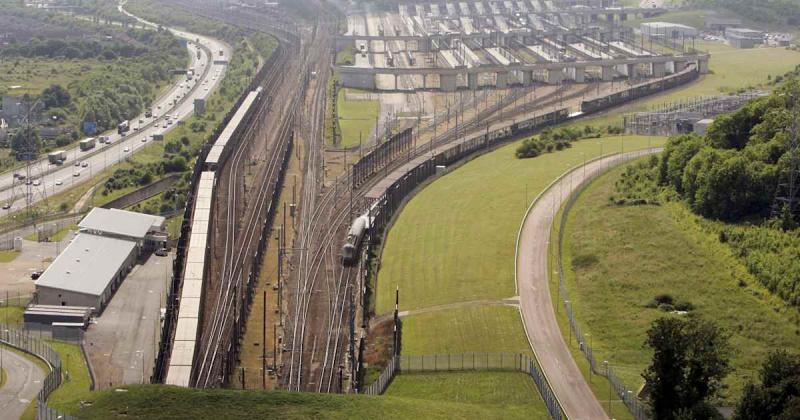


The Chunnel was an engineering milestone that felt like science fiction at the time. Today its just taken for granted as infrastructure.
 S E E D E D C O N T E N T
In a May 6, 1994 ceremony presided over by England's Queen Elizabeth II and French President Francois Mitterrand, a rail tunnel under the English Channel is officially opened, connecting Britain and the European mainland for the first time since the Ice Age.
The Channel Tunnel, or "Chunnel," connects Folkestone, England, with Coquelles, France, 31 miles away. The Chunnel cut travel time between England and France to a swift 35 minutes and eventually between London and Paris to two-and-a-half hours.
As the world's longest undersea tunnel, the Chunnel runs under water for 23 miles, with an average depth of 150 feet below the seabed. Each day, about 30,000 people, 6,000 cars and 3,500 trucks journey through the Chunnel on passenger, shuttle and freight trains.
Ever wonder how today's technology works? Modern Marvels goes behind the world's most fascinating innovations to see how they came to be.
Millions of tons of earth were moved to build the two rail tunnels—one for northbound and one for southbound traffic—and one service tunnel. Fifteen thousand people were employed at the peak of construction. Ten people were killed during construction.
Napoleon's engineer, Albert Mathieu, planned the first tunnel under the English Channel in 1802, envisioning an underground passage with ventilation chimneys that would stretch above the waves. In 1880, the first real attempt was made by Colonel Beaumont, who bore a tunnel more than a mile long before abandoning the project. Other efforts followed in the 20th century, but none on the scale of the tunnels begun in June 1988.
The Chunnel's $16 billion cost was roughly twice the original estimate, and completion was a year behind schedule. One year into service, Eurotunnel announced a huge loss, one of the biggest in United Kingdom corporate history at the time. A scheme in which banks agreed to swap billions of pounds worth of loans for shares saved the tunnel from going under and it showed its first net profit in 1999.
Freight traffic was suspended for six months after a fire broke out on a lorry in the tunnel in November 1996. Nobody was seriously hurt in the incident.
In 1996, the American Society of Civil Engineers identified the tunnel as one of the Seven Wonders of the Modern World.
Also on This Day in History
Discover more of the major events, famous births, notable deaths and everything else history-making that happened on May 6th
1876 -- "Duchess of Devonshire" painting stirs interest—and theft
On May 6, 1876, Thomas Gainsborough's painting, Duchess of Devonshire, causes a stir when it goes up for auction at Christie's in London. It sells to a London art dealer, William Agnew, for $51,540, the highest price ever paid for a painting at auction. Three weeks later, Agnew displays the painting at his gallery—and it […]
1935 -- FDR creates the Works Progress Administration (WPA)
On May 6, 1935, President Franklin D. Roosevelt signs an executive order creating the Works Progress Administration (WPA). The WPA was just one of many Great Depression relief programs created under the auspices of the Emergency Relief Appropriations Act, which Roosevelt had signed the month before. The WPA, the Public Works Administration (PWA) and other […]
1937 -- The Hindenburg disaster
The airship Hindenburg, the largest dirigible ever built and the pride of Nazi Germany, bursts into flames in Lakehurst, New Jersey, killing 36 people.
1940 -- John Steinbeck wins a Pulitzer for "The Grapes of Wrath"
On May 6, 1940, John Steinbeck is awarded the Pulitzer Prize for his novel The Grapes of Wrath. The book traces the fictional Joad family of Oklahoma as they lose their family farm and move to California in search of a better life. They encounter only more difficulties and a downward slide into poverty. The […]
1942 -- All American forces in the Philippines surrender unconditionally
On May 6, 1942, U.S. Lieutenant General Jonathan Wainwright surrenders all U.S. troops in the Philippines to the Japanese. The island of Corregidor remained the last Allied stronghold in the Battle of the Philippines after the Japanese victory at Bataan (from which General Wainwright had managed to flee, to Corregidor). Constant artillery shelling and aerial […]
1954 -- Roger Bannister runs first four-minute mile
In Oxford, England, 25-year-old medical student Roger Bannister cracks track and field's most notorious barrier: the four-minute mile. Bannister, who was running for the Amateur Athletic Association against his alma mater, Oxford University, won the mile race with a time of 3 minutes and 59.4 seconds. For years, so many athletes had tried and failed […]
1955 -- West Germany joins NATO
Ten years after the Nazis were defeated in World War II, West Germany formally joins the North Atlantic Treaty Organization (NATO), a mutual defense group aimed at containing Soviet expansion in Europe. This action marked the final step of West Germany's integration into the Western European defense system. Germany had been a divided nation since […]
1991 -- Harry Gant is oldest NASCAR winner—again
On May 6, 1991, 51-year-old race car driver Harry Gant racks up his 12th National Association of Stock Car Auto Racing (NASCAR) Winston Cup career victory in the Winston 500 in Talladega, Alabama. In doing so, Gant bettered his own record as the oldest man ever to win a NASCAR event. A native of Taylorsville, […]
1992 -- Former Soviet leader Mikhail Gorbachev reviews Cold War in speech at Westminster College
In an event steeped in symbolism, former Soviet leader Mikhail Gorbachev reviews the Cold War in a speech at Westminster College in Fulton, Missouri—the site of Winston Churchill's "Iron Curtain" speech 46 years before. Gorbachev mixed praise for the end of the Cold War with some pointed criticisms of U.S. policy. In 1946, Winston Churchill, […]
1994 -- Paula Jones accuses Bill Clinton of sexual harassment
Paula Jones, a former Arkansas state clerk, files suit against President Bill Clinton in the federal court in Little Rock, Arkansas, on May 6, 1994, asking for $700,000 in damages. Jones claimed that Clinton, while governor of Arkansas, sexually harassed her and then defamed her after she went public with her accusations. The following August, […]
2004 -- Final episode of "Friends" airs on NBC
At 9:00 p.m. Eastern and Pacific times on May 6, 2004, that familiar theme song ("I'll Be There For You" by the Rembrandts) announces the beginning of the end, as an estimated 51.1 million people tune in for the final original episode of NBC's long-running comedy series Friends. Created and executive-produced (with Kevin S. Bright) […]
2013 -- Ohio kidnap victims rescued after years in captivity
On May 6, 2013, three women are rescued from a Cleveland, Ohio, house where they had been imprisoned for many years by their abductor, 52-year-old Ariel Castro, an unemployed bus driver. The women—Michelle Knight, Amada Berry and Gina DeJesus—went missing separately between 2002 and 2004, when they were 21, 16 and 14 years old, respectively. […]
Be a good human. Grossly derogatory comments, blatantly inflammatory comments, excessive trolling, mean-spirited taunting and insults, scamming, spamming, and off topic comments may be removed in compliance with the site's Terms of Service and the Code of Conduct. The moderators have the final word.

Tags
Who is online

93 visitors
How quickly the thrill fades.