
Transcontinental railroad completed | May 10, 1869

By: HISTORY
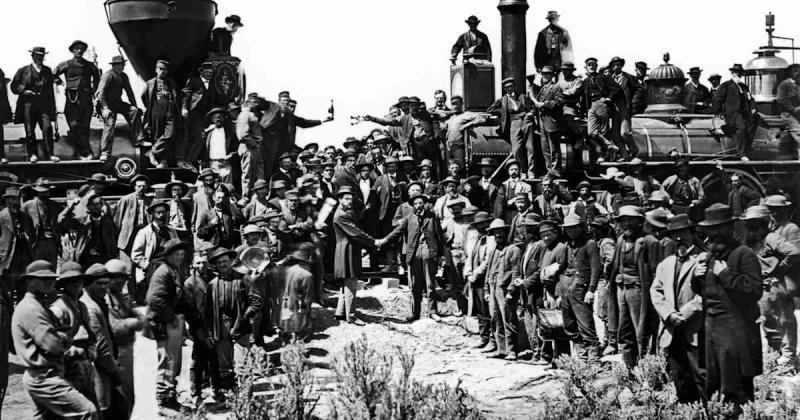

A 'moonshot' for a war weary nation.
 S E E D E D C O N T E N T

On May 10, 1869, the presidents of the Union Pacific and Central Pacific railroads meet in Promontory, Utah, and drive a ceremonial last spike into a rail line that connects their railroads. This made transcontinental railroad travel possible for the first time in U.S. history. No longer would western-bound travelers need to take the long and dangerous journey by wagon train.
Since at least 1832, both Eastern and frontier statesmen realized a need to connect the two coasts. It was not until 1853, though, that Congress appropriated funds to survey several routes for the transcontinental railroad. The actual building of the railroad would have to wait even longer, as North-South tensions prevented Congress from reaching an agreement on where the line would begin.
One year into the Civil War, a Republican-controlled Congress passed the Pacific Railroad Act (1862), guaranteeing public land grants and loans to the two railroads it chose to build the transcontinental line, the Union Pacific and the Central Pacific. With these in hand, the railroads began work in 1866 from Omaha and Sacramento, forging a northern route across the country. In their eagerness for land, the two lines built right past each other, and the final meeting place had to be renegotiated.
Transcontinental Railroad
Find out how the transcontinental railroad transformed America into one nation.
3:27m watch
Harsh winters, staggering summer heat and the lawless, rough-and-tumble conditions of newly settled western towns made conditions for the Union Pacific laborers—mainly Civil War veterans of Irish descent—miserable. The overwhelmingly immigrant Chinese work force of the Central Pacific also had its fair share of problems, including brutal 12-hour work days laying tracks over the Sierra Nevada Mountains (they also received lower wages than their white counterparts). On more than one occasion, whole crews would be lost to avalanches, or mishaps with explosives would leave several dead.
For all the adversity they suffered, the Union Pacific and Central Pacific workers were able to finish the railroad-laying nearly 2,000 miles of track-by 1869, ahead of schedule and under budget. Journeys that had taken months by wagon train or weeks by boat now took only days. Their work had an immediate impact: The years following the construction of the railway were years of rapid growth and expansion for the United States, due in large part to the speed and ease of travel that the railroad provided.
Also on This Day in History
Discover more of the major events, famous births, notable deaths and everything else history-making that happened on May 10th
1534 -- French navigator Jacques Cartier begins exploring the Canadian coast
On May 10, 1534, French navigator Jacques Cartier becomes the first European explorer to encounter the eastern coast of Canada, as he enters the Gulf of St. Lawrence in the present-day province of Quebec. In the first of his three expeditions to Canada, he would circumnavigate the Gulf and explore the coasts of Newfoundland and […]
1773 -- British parliament passes unpopular Tea Act
On May 10, 1773, the British Parliament passes the Tea Act, a bill designed to save the faltering East India Company from bankruptcy by greatly lowering the tea tax it paid to the British government and, thus, granting it a de facto monopoly on the American tea trade. Because all legal tea entered the colonies […]
1775 -- Second Continental Congress assembles as Americans capture Fort Ticonderoga
On May 10, 1775, Ethan Allen and Benedict Arnold lead a successful attack on Fort Ticonderoga in upstate New York, while the Second Continental Congress assembles in Philadelphia, Pennsylvania. The Congress faced the task of conducting a war already in progress. Fighting had begun with the Battle of Lexington and Concord on April 19, and […]
1785 -- Hot air balloon crash becomes world's first aviation disaster
Launched during a local fair, the unmanned balloon drifted off course and ignited a fire that tore through the town of Tullamore, Ireland.
1863 -- Confederate general Thomas J. "Stonewall" Jackson dies
The South loses one of its boldest generals on May 10, 1863, when 39-year-old Thomas J. "Stonewall" Jackson dies of pneumonia a week after his own troops accidentally fired on him during the Battle of Chancellorsville in Virginia. In the first two years of the war, Jackson terrorized Union commanders. A native Virginian, Jackson grew […]
1865 -- Confederate President Jefferson Davis captured by Union forces
Jefferson Davis, president of the fallen Confederate government, is captured with his wife and entourage near Irwinville, Georgia, by a detachment of Union General James H. Wilson's cavalry. On April 2, 1865, with the Confederate defeat at Petersburg, Virginia imminent, General Robert E. Lee informed President Davis that he could no longer protect Richmond and […]
1871 -- Treaty of Frankfurt ends Franco-Prussian War
The humiliating defeat of Louis Napoleon's Second Empire of France is made complete on May 10, 1871, when the Treaty of Frankfurt is signed, ending the Franco-Prussian War and marking the decisive entry of a newly unified German state on the stage of European power politics, so long dominated by the great empires of England […]
1924 -- J. Edgar Hoover begins his 48-year tenure as FBI director
J. Edgar Hoover is named acting director of the Bureau of Investigation (now the FBI) on May 10, 1924. By the end of the year he was officially promoted to director. This began his 48-year tenure in power, during which time he personally shaped American criminal justice in the 20th century. Hoover first became involved […]
1940 -- Winston Churchill becomes prime minister of Britain
Winston Churchill, First Lord of the Admiralty, is called to replace Neville Chamberlain as British prime minister following the latter's resignation after losing a confidence vote in the House of Commons. In 1938, Prime Minister Chamberlain signed the Munich Agreement with Nazi leader Adolf Hitler, giving the Sudetenland region of Czechoslovakia over to German conquest […]
1970 -- Photographer captures soaring Stanley Cup champion Bobby Orr in iconic image
On May 10, 1970, 40 seconds into overtime of Game 4 of the Stanley Cup final, Boston Bruins star Bobby Orr slips the winning goal past St. Louis Blues goaltender Glenn Hall. After scoring, Orr leaps into the air before landing flat and sliding into his teammates' embrace. The famous celebration is immortalized by Boston Record-American photographer Ray […]
1980 -- Government approves $1.5 billion loan for Chrysler
On May 10, 1980, United States Secretary of the Treasury G. William Miller announces the approval of nearly $1.5 billion dollars in federal loan guarantees for the nearly bankrupt Chrysler Corporation. At the time, it was the largest rescue package ever granted by the U.S. government to an American corporation. Founded as the Maxwell Motor […]
1990 -- China releases 211 prisoners arrested during Tiananmen Square protests
The government of the People's Republic of China announces that it is releasing 211 people arrested during the massive protests held in Tiananmen Square in Beijing in June 1989. Most observers viewed the prisoner release as an attempt by the communist government of China to dispel much of the terrible publicity it received for its […]
1994 -- Nelson Mandela, South Africa's first Black president, is inaugurated
In South Africa, Nelson Rolihlahla Mandela is sworn in as the first Black president of South Africa. In his inaugural address, Mandela, who spent 27 years of his life as a political prisoner of the South African government, declared that "the time for the healing of the wounds has come." Two weeks earlier, more than […]
1996 -- Eight climbers die on Mt. Everest
Eight climbers die on Mount Everest during a storm on May 10, 1996. It was the worst loss of life ever on the mountain on a single day. Author Jon Krakauer, who himself attempted to climb the peak that year, wrote a best-selling book about the incident, Into Thin Air, which was published in 1997. […]
2002 -- Robert Hanssen, FBI agent turned Russian spy, is sentenced to life in prison
On May 10, 2002, Robert Hanssen, a former FBI agent who intermittently sold state secrets to Russia over the course of two decades, receives his sentencing for espionage: life in prison without the possibility of parole. "I apologize for my behavior. I am shamed by it," said Hanssen. "I have opened the door for calumny […]
Be a good human. Grossly derogatory comments, blatantly inflammatory comments, excessive trolling, mean-spirited taunting and insults, scamming, spamming, and off topic comments may be removed in compliance with the site's Terms of Service and the Code of Conduct. The moderators have the final word.

Tags
Who is online
105 visitors
Go west, young man!