
This 380,000-Mile Tesla Model 3 Has Its Original Battery. Range Loss Is Huge

By: Andrei Nedelea (InsideEVs)
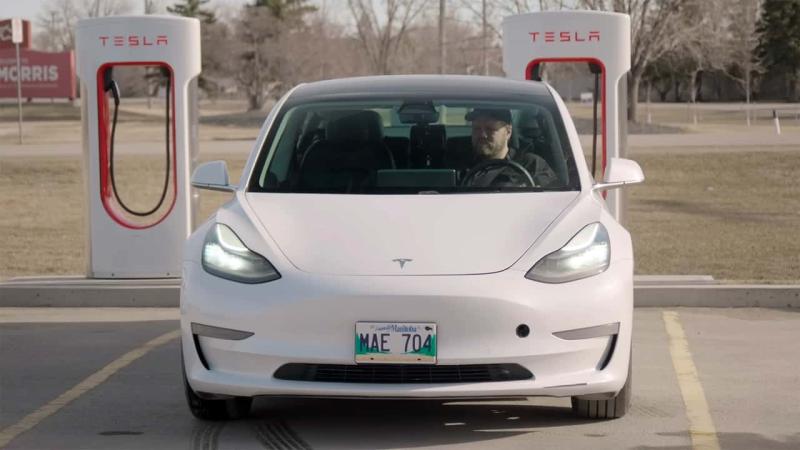


Do you want the good news or the bad news?
 S E E D E D C O N T E N T
- This 380,000-mile Tesla Model 3 is still running on its original battery pack.
- Its displayed range has dropped by 34.2%, from 240 miles to 158 miles.
- Despite major degradation, it still managed 138.3 highway miles at 68 mph.
May 3, 2026 -- Battery degradation is an inevitable reality of EV ownership, but how much capacity it loses over time can vary wildly depending on how it was used. You would think that a 2019 Tesla Model 3 Standard Range with 380,000 miles (610,000 km) and its original battery would be wheezing by now with hardly any usable range. But that's not the case.
Drive Protected from Canada bought this high-mileage Model 3, which is reportedly still sporting its original battery pack, to document its performance. They took the car in to charge up to 100%, and it showed a range of 158 miles (254 km). That's a lot less than it originally had with a full battery—240 miles (386 km) when new—meaning it's 82 miles (132 km) down, or 34.2% less.
That is certainly a big drop and expected given the mileage. This is a battery that has less than 70% of its original capacity, so it is a prime candidate to be swapped out for a fresh unit. However, over 150 miles is still a decent number for someone with a short commute, and since the car doesn't seem to have any other issues except the range loss, it should continue to run fine with its original battery.
They performed a highway range test in the video, setting off with a fully charged battery, driving at 110 km/h (68 mph), with ambient temperature rising from 51.8°F (11°C) to 73.4°F (23°C) by the end of the test. It returned to the charger showing 0% left in the battery after covering 138.3 miles (222.6 km), with an average consumption of 4.27 miles/kWh (14.55 kWh/100 km).
This means the car used 32.4 kilowatt-hours for the trip, which is considerably less than the 49 kWh it should have had originally. But the number is consistent with the initial range prediction, and it's still a good result given that it was almost all highway driving.
This is a useful reminder that the problem of battery degradation is not a simple one. This Model 3 has clearly lost significant capacity, and no one shopping for a used EV should ignore that. But after mileage that would send many gas cars into retirement, it still behaves like a usable car rather than a rolling advertisement about range loss.
Be a good human. Grossly derogatory comments, blatantly inflammatory comments, excessive trolling, mean-spirited taunting and insults, scamming, spamming, and off topic comments may be removed in compliance with the site's Terms of Service and the Code of Conduct. The moderators have the final word.

Tags
Who is online
105 visitors
I want to know how many sets of tires this car has needed. That seems to be one of the hidden costs for EVs.
Tires are a hidden cost? My 2005 Chevy plumbing van has 225,000 miles and is on it's sixth set of tires. They're pretty new right now.
According to reported averages, the Tesla in the article should be on its 12th or 13th set of tires. Even extrapolating your tire data means the Tesla should be on its 11th set of tires. At an average cost of $800 to $1600 for a set of tires, the cost for the Tesla model 3 in article should be somewhere between $9,600 and $20,800. It has been widely reported that tire wear on EVs is 20% to 30% faster than on ICE vehicles so my estimates may be low ball, too.
Of course, the big savings would be on fuel. For a comparable gas vehicle the cost would for fuel would be about $0.13 per mile. The cost for the Tesla model 3 would be about $0.09 per mile to charge at home. (Fast charging at a public charger would cost about the same as gasoline, so there would be little savings on fuel.) An ICE car would cost about $49,500 (based on 24.5 mpg at $3.20 per gallon) compared to $34,200 for the Tesla charged at home to drive 380,000 miles.