
An AI hate wave is here

By: Madison Mills (AXIOS)


Is the problem really Artificial Intelligence, or is the problem how AI is being deployed? So far, the headlines have focused on money to be made from AI hoping to exploit investors with 'magical thinking' and promises of 'miracles'. Investors want to exploit AI for financial gain but the public will have to actually live with AI. So, the public would naturally be interested in the nitty gritty questions glossed over to create an investor sugar high: Why is it needed? What exactly will it do? And how, precisely, will this make things better?
 S E E D E D C O N T E N T
If AI were a candidate for political office, it would be losing in a landslide.
Why it matters: The AI hype cycle would have you believe the technology is inevitable. But AI backlash is growing, as people worry it will steal their jobs, jack up electricity rates and further enrich the wealthy, all while hurting the environment.
State of play: A commencement address went viral this week after Florida real estate executive Gloria Caulfield said "artificial intelligence is the next Industrial Revolution," sparking a chorus of boos from the crowd.
- The speaker could have avoided the jeers had she checked the latest polls: Only 18% of young people ages 14 to 29 say they feel hopeful about AI, according to a recent Gallup survey.
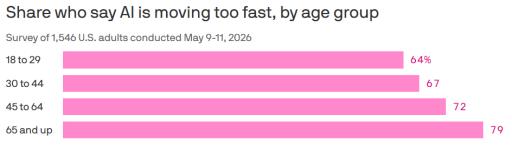
- The disdain spans generations and political parties. An Economist/YouGov poll released this week showed over 70% of Americans think AI is advancing too quickly, with 68% of Republicans and 77% of Democrats saying it's moving too fast.
- Other YouGov polling shows negative views of AI rising from 34% three years ago to just over 50% now.
Between the lines: AI executives aren't doing much to quell the backlash, which is already showing signs of slowing the industry. Some of them appear unfazed — or unaware.
- In previous conversations with Axios, AI executives at multiple frontier AI labs were surprised by the negative opinions. They see AI as just as inevitable as the rise of the internet.
- Asked about backlash to AI, Superhuman Mail CEO Rahul Vohra — whose company makes an AI-powered email assistant — seemed unfamiliar with the premise of the question. After hearing about poor polling around AI, he responded: "We don't really see that."
Data: Economist/YouGov ; Chart: Sara Wise/Axios
What they're saying: While the tech underlying AI is here to stay, "What is not inevitable is that these technologies will be embedded in every aspect of our lives, become indispensable, or replace humans," Dr. Avriel Epps, assistant professor at University of California, Riverside, said in an email to Axios.
"Nothing in the future is inevitable and no single person, company, or group gets to decide what will happen in the future."
Threat level: Negative AI sentiment could become a financial liability for AI labs if it continues to curb access to their most valuable resource: compute power.
- A record number of data centers, which provide the compute AI companies use to answer user queries, were canceled in the first quarter of 2026 amid resistance from communities, per Heatmap Pro data .
- "Public pushback is emerging as a binding constraint, particularly around data center buildout," Morgan Stanley analysts wrote in a note about market risks associated with the midterms.
- These data center setbacks are "sapping confidence" among investors, according to a note investment bank Jefferies sent to clients.
Reality check: AI has been around for years and is bound to be a central part of American life, whatever form it ultimately takes.
- "Some version of AI is inevitable ... but we have choice," said Arun Bahl, the CEO of Aloe, an AI company that builds models designed to be trustworthy. "Is it the dystopian plot? Or can we have tools that humans trust?"
- Globally, opinion is more positive, with the share of respondents expecting AI to do more good than harm rising to 59% in 2025 from 55% in 2024, according to Stanford data .
The bottom line: The AI industry has a serious PR problem that threatens to inhibit the rapid growth that its leaders have taken for granted.
Be a good human. Grossly derogatory comments, blatantly inflammatory comments, excessive trolling, mean-spirited taunting and insults, scamming, spamming, and off topic comments may be removed in compliance with the site's Terms of Service and the Code of Conduct. The moderators have the final word.

Tags
Who is online

229 visitors
What we have is another failure of strategic planning. This has become a recurring problem in our financialized economy.
The booing at the commencement ceremony is noteworthy. I think Gen z knows that AI will affect them. Isn't that interesting. No sympathy for those who lost their livelihoods in manufacturing etc, but now the students are worried.
Professors and teachers are creating disincentives to use AI. In some cases, students are being punished for using AI.
It's not surprising that institutional education tries to protect itself from competition by AI. That's particularly true for non-STEM areas of teaching. That is not an intrinsic flaw of AI but, rather, a failure of strategic planning for deployment of AI.
The resistance to AI is symptomatic of shortcomings with our modern economic theories. Everyone is so focused on how to exploit AI for financial gain that constructive utilization of AI receives too little and too haphazard attention. Ai is a new, shiny toy that fits a business model of extracting financial gain -- then a miracle occurs -- and AI becomes a constructive tool.
I don't mind that. If AI can scan an x-ray better than a technician, I'm all for it. If it can make precision bombing more precise, I'm all for it.
My problem is when it is used to teach and report the news. I learned the lessons of "1984" right here in America these past few decades.
Those are the 'small potato' applications that China has prioritized with 'embodied AI'. China is attempting to capture the market for smart machines and smart tasks that embody AI. The idea is to democratize specialized skills and abilities which would boost the productivity of a workforce. That is not what US investors are pursuing.
The US is prioritizing a central super-brain that can perform strategic/tactical planning, manage systems, and perform evaluation/recommendation functions. The US is attempting to apply AI for command level planning and execution of an 'Operation Epic Fury', to forecast defense needs for the next 10 years and prepare recommendations, to manage a global supply chain and accommodate interruptions, to evaluate a market (such as EV market) and recommend ways to capture that market. The goal of super-brain AI is to boost financial performance by eliminated tasks/workers and avoiding malinvestment (every dollar invested is supposed to provide a return). The US super-brain approach will require each enterprise to have its own data center (super-brain) or enterprises will need to share cookie-cutter business/management models.