
A Thousand Pioneers Head West on the Oregon Trail

By: (HISTORY)


A journey begins with the first step. The rest is history.
 S E E D E D C O N T E N T
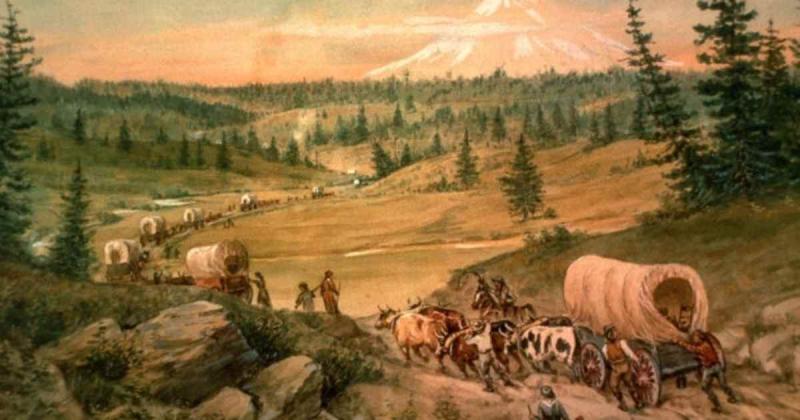
The first major wagon train to the Pacific Northwest departs from Elm Grove, Missouri, on the Oregon Trail. Some 1,000 people and 5,000 oxen and cattle set out on May 22, participating in what became known as the Great Emigration of 1843.
Although U.S. sovereignty over the Oregon Territory was not clearly established until 1846, American fur trappers and missionary groups had been living in the region for decades, to say nothing of the Native Americans who had settled the land centuries earlier. Dozens of books and lectures proclaimed Oregon's agricultural potential, piquing the interest of white American farmers. The first large party of overland migrants to Oregon came in 1841 when a small band of 70 pioneers, intending primarily to farm, left Independence, Missouri. They followed a route blazed by fur traders, which took them west along the Platte River through the Rocky Mountains via the easy South Pass in Wyoming and then northwest to the Columbia River. In the years to come, pioneers came to call the route the Oregon Trail.
Migrants Travel West on the Oregon Trail
Over 400,000 people travel West to start a new life and claim new land along the Oregon Trail, including Lucinda Brown. One-hundred seventy years later, one of her descendants sees a kettle from her journey for the first time.
2:41m watch
In 1842, a slightly larger group of 100 pioneers made the 2,000-mile journey to Oregon. The next year, however, the number of emigrants skyrocketed to 1,000. The sudden increase was a product of a severe depression in the Midwest combined with a flood of propaganda from fur traders, missionaries and government officials extolling the virtues of the land. Farmers dissatisfied with their prospects in Ohio, Illinois, Kentucky and Tennessee, hoped to find better lives in the supposed paradise of Oregon.
The 1843 train comprised more than 100 wagons with the herd of oxen and cattle trailing behind. Dr. Elijah White, a Presbyterian missionary who had made the trip the year before, served as a guide.
The first section of the Oregon Trail ran through the relatively flat country of the Great Plains. Obstacles were few, though the river crossings could be dangerous for wagons. As the men, women and children making the journey traversed Native American territories, the danger of attacks was a small but genuine risk. To be on the safe side, the pioneers drew their wagons into a circle at night to create a makeshift stockade. If they feared Native Americans might raid their livestock—the Plains tribes valued the horses, though generally ignored the oxen—they would drive the animals into the enclosure.
The pioneers quickly learned that they were more likely to be injured or killed by a host of other causes. Obstacles included accidental discharge of firearms, falling off mules or horses, drowning in river crossings and disease. After entering the mountains, the trail also became much more difficult, with steep ascents and descents over rocky terrain. The pioneers risked injury from overturned and runaway wagons.
Yet, as with the 1,000-person party that made the journey in 1843, the vast majority of pioneers on the trail survived to reach their destination in the fertile, well-watered land of western Oregon. The migration of 1844 was smaller than that of the previous season, but in 1845, it jumped to nearly 3,000. Thereafter, migration on the Oregon Trail was an annual event, though the practice of traveling in giant convoys of wagons gave way to many smaller bands of one or two-dozen wagons. The trail was heavily traveled until 1884, when the Union Pacific constructed a railway along the route.
Also on This Day in History
Discover more of the major events, famous births, notable deaths and everything else history-making that happened on May 22nd
1455 -- The War of the Roses begins
In the opening battle of England's War of the Roses, the Yorkists defeat King Henry VI's Lancastrian forces at St. Albans, 20 miles northwest of London. Many Lancastrian nobles perished, including Edmund Beaufort, the duke of Somerset, and the king was forced to submit to the rule of his cousin, Richard of York. The dynastic […]
1781 -- Patriot siege of Ninety Six, South Carolina begins
On May 22, 1781, Major General Nathanael Greene and 1,000 Patriots attempt an attack on the critical village of Ninety Six in the South Carolina backcountry. After failing to seize the fortified settlement, they began a siege of it, which lasted until their retreat on June 18, making it the longest of the Revolutionary War. […]
1783 -- Zong slave ship trial: insurance loss or mass murder?
Hearing arguments in the case of the Zong, a slave ship, the Chief Justice of the King's Bench in London states that a massacre of enslaved African "was the same as if Horses had been thrown over board" on May 22, 1783. The crew of the Zong had thrown at least 130 captive Africans into […]
1802 -- First Lady Martha Washington dies
President George Washington's devoted widow and the nation's first lady, Martha Dandridge Custis Washington, dies at her Mt. Vernon home on May 22, 1802. She was 70 years old. Like her husband, Martha Washington was born in the American colonies as a British subject (1731). The petite, dark-haired 19-year-old married her first husband, a prosperous […]
1856 -- Southern congressman beats Northern senator with a cane in the halls of Congress
Southern Congressman Preston Brooks savagely beats Northern Senator Charles Sumner in the halls of Congress as tensions rise over the expansion of slavery. When the controversial Kansas-Nebraska Act of 1854 was passed, popular sovereignty was applied within the two new territories and people were given the right to decide the slavery issue by vote. Because […]
1859 -- Sir Arthur Conan Doyle, creator of Sherlock Holmes, is born
It's the birthday of Sir Arthur Conan Doyle, the creator of master sleuth Sherlock Holmes. Doyle was born in Scotland and studied medicine at the University of Edinburgh, where he met Dr. Joseph Bell, a teacher with extraordinary deductive reasoning power. Bell partly inspired Doyle's character Sherlock Holmes years later. After medical school, Doyle moved […]
1939 -- The Pact of Steel is signed; the Axis is formed
On May 22, 1939, Italy and Germany agree to a military and political alliance, giving birth formally to the Axis powers, which will ultimately include Japan. Mussolini coined the nickname "Pact of Steel" (he had also come up with the metaphor of an "axis" binding Rome and Berlin) after reconsidering his first choice, "Pact of […]
1958 -- Jerry Lee Lewis drops a bombshell in London
The arrival in the United Kingdom of one of the biggest figures in rock and roll was looked forward to with great anticipation in May of 1958. Nowhere in the world were the teenage fans of the raucous music coming out of America more enthusiastic than they were in England, and the coming tour of […]
1972 -- President Nixon arrives in Moscow for historic summit
On May 22, 1972, President Richard Nixon arrives in Moscow for a summit with Soviet leaders. Although it was Nixon's first visit to the Soviet Union as president, he had visited Moscow once before-as U.S. vice president. As Eisenhower's vice president, Nixon made frequent official trips abroad, including a 1959 trip to Moscow to tour […]
1981 -- Wayne Williams is questioned by police for Atlanta child murders
On May 22, 1981, police staking out a bridge over the Chattahoochee River near Atlanta, Georgia, hear a loud splash, and begin chasing Wayne Williams as he attempts to drive away in a station wagon. After questioning him about his involvement in the unprecedented string of child murders in Atlanta over the two previous years, […]
1990 -- South Yemen and North Yemen are unified as the Republic of Yemen
After 150 years apart, Marxist South Yemen and conservative North Yemen are unified as the Republic of Yemen. Ali Abdullah, president of North Yemen, became the new country's president, and Ali Salem Al-Baidh, leader of the South Yemeni Socialist Party, vice president. The first free elections were held in 1993. Situated at the southern tip […]
2002 -- Chandra Levy's remains found
The remains of former Federal Bureau of Prisons intern Chandra Levy are found on May 22, 2002, over a year after the 24-year-old was last seen at a health club. The bone remains, discovered by a man walking through Washington, D.C.'s Rock Creek Park, were identified through dental records. A sweatshirt, sneakers and a Sony […]
2004 -- George W. Bush falls from his bicycle
On May 22, 2004, President George Bush is in a bicycle accident. Bush had taken up mountain biking for exercise at the suggestion of physicians. Washington Post reporter Dana Milbank recounted how Bush fell from his mountain bike while completing a 17-mile course on his ranch in Crawford, Texas. Despite scrapes and scratches on his […]
2004 -- Controversial documentary "Fahrenheit 9/11" wins Palme d'Or prize
On May 22, 2004, Michael Moore's documentary film Fahrenheit 9/11 beats out 18 other films to win the coveted Palme d'Or, the top prize at the Cannes Film Festival. It became the first documentary to triumph at Cannes since The Silent World, co-directed by Jacques Cousteau and Louis Malle, won the Palme d'Or in 1956. […]
2017 -- Manchester Arena bombed during Ariana Grande concert
Just moments after Ariana Grande finished the final song of her May 22, 2017 concert at Manchester Arena, a suicide bomber detonated an explosion on the premises, killing 22 concertgoers and injuring 116 more. ISIS claimed responsibility for what was the deadliest act of terrorism in Britain since the 2005 London metro bombings. A scene of youthful fun […]
Be a good human. Grossly derogatory comments, blatantly inflammatory comments, excessive trolling, mean-spirited taunting and insults, scamming, spamming, and off topic comments may be removed in compliance with the site's Terms of Service and the Code of Conduct. The moderators have the final word.

Tags
Who is online
124 visitors
Another momentous event in America's rich history.
My family came west in 1845 in what was called the Grigsby-Ides party. They diverted to the south onto the California Trail and ended up in the Napa Valley in what was then part of Mexico.