
The wind boom Trump couldn't stop

By: Josh Axelrod (dw. com)
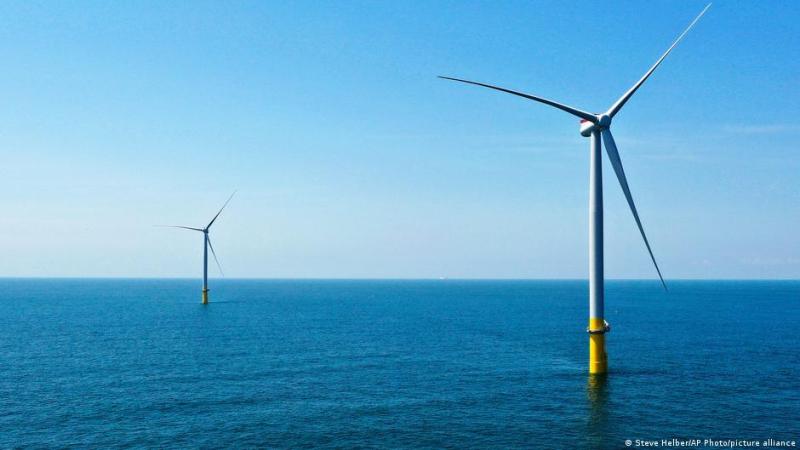


Offshore windfarms can and do interfere with underwater acoustic surveillance systems, such as the Navy's SOSUS and IUSS networks. So, these windfarms really can adversely impact national security. The wind turbines are being improved to reduce vibration noise; however, building offshore windfarms does include a hidden cost to modify the underwater surveillance systems.
 S E E D E D C O N T E N T
May 26, 2026 -- The US president makes no bones about his disdain for wind power, which over the years he's falsely blamed for cancer and whale deaths in the Atlantic Ocean.
But his anti-wind sentiment has assumed new proportions since he took office. During that time, he has thrown up roadblocks to stop wind expansion at every turn: from pulling permits, issuing stop-work orders and paying energy companies to halt offshore projects in favor of oil and gas drilling.
Nonetheless, Donald Trump will likely oversee the biggest expansion in wind in the nation's history. By 2027, the country is expected to have nearly 35 times the offshore wind capacity it had when he took office.
"It's a tale of two cities," Jeremy Firestone, a professor emeritus at the University of Delaware's School of Marine Science and Policy, told DW.
At a time when fuel prices are high, electricity demand is rising thanks in part to power-hungry AI data centers, and planetary heating is worsening, clean energy advocates say removing wind from that story will have consequences for consumers.
"With the real focus on data centers and the price of electricity and the price of oil and the price of fuel," says Ted Kelly, director of clean energy at the nonprofit Environmental Defense Fund (EDF), "it would be even more ridiculous to continue to block clean energy projects and drive electric prices even higher."
The war on wind — and the fightback
Yet blocking is exactly what Trump is set on doing. On the first day of his second term, he issued an executive memorandum freezing leasing on new wind projects — dubbed "the wind ban" by campaigners.
He then went on to issue stop-work orders on all five endorsed offshore initiatives under construction, citing classified national security concerns, and to pull permits from other approved projects.
The intervention has not stopped there. One of his most recent moves involves paying energy companies to walk away from wind. In March, the administration handed nearly $1 billion (€854 million) to French energy giant TotalEnergies, which had bought leases to develop offshore wind projects near North Carolina and New York.
Catching wind at sea is not something the current US administration cares to endorseImage: Getty Images via AFP
A month later, he offered payouts to two other companies totaling $885 million. A move that Secretary of the Interior Doug Burgum said would help "lower everyday energy costs" for Americans who will "no longer be footing the bill for expensive, unreliable, intermittent energy projects."
Despite the forces pushing back against wind power, it is having a moment in the legal spotlight. "When offshore wind goes to court, it has been winning," said Pasha Feinberg, an offshore wind strategist at the US nonprofit Natural Resources Defense Council.
Last December, a judge struck down Trump's wind ban, ruling it exceeded his authority. And while the administration is appealing, other courts have also ruled construction could restart on all five offshore projects issued with a stop-work order.
Meanwhile, the administration's tax cut legislation, the One Big Beautiful Act bill — which eliminated clean energy tax credits created under former president Joe Biden — has produced a sprint for developers to break ground on renewables projects before they expire in July.
New offshore wind farms are expected to add around six gigawatts to the grid by 2027 — enough to power some 2.5 million homes. One is Norwegian energy company Equinor's Empire Wind project, located south of Long Island. Previously hit by a now overturned stop-work order, it will use turbines so powerful that a single blade rotation is set to offer a day and half of energy for one home.
What wind does for Americans' electricity bills
In 2025, wind generated around 10% of US electricity, behind natural gas at 40% and nuclear at roughly 17%. Even without subsidies, utility-scale onshore wind and solar remain some of the cheapest new power sources in the US, according to financial advisory firm Lazard. Offshore is pricier, but still broadly competitive with new gas plants and far cheaper than nuclear.
Once a turbine is built, the wind costs nothing, so wind farms can sell wholesale electricity far more cheaply than gas or coal plants, tending to pull down prices for everyone. "Ratepayers are going to save a lot of money, because it's going to tamp down these hourly prices," Firestone said.
The effect is already visible: A cold snap in New England last December should have sent energy prices soaring, but Vineyard Wind — an almost complete offshore project off Massachusetts — was churning with strong winter ocean winds, displacing price-volatile natural gas. The EDF estimated it saved ratepayers $2 million a day across the region.
Wind projects also generate an estimated $2 billion annually in state and local tax and land-lease payments. The industry employs 133,000 people, compared to roughly 115,900 working in oil and gas exploration and extraction in 2024. Wind turbine service technicians are among the two fastest-growing occupations in the US this decade, according to the Bureau of Labor Statistics.
The wind story of the future
Still, the political volatility is damaging investor confidence even where Trump has lost in court, say analysts. Before the US president returned to power, BloombergNEF had projected 39 gigawatts of US offshore wind capacity by 2035. The firm expects six to be the ceiling for now.
"We don't see any new offshore wind projects coming online without significant policy changes," said Harrison Sholler, a wind analyst at BloombergNEF.
Amid ever-growing demand for electricity and anxiety about energy bills, advocates argue that wind's economic logic will eventually win out. The top three onshore producer states — Texas, Iowa and Oklahoma — are all largely red. And more than eight in 10 American voters support more renewable energy, including 77% of Republicans, according to polling from offshore wind advocacy group Turn Forward.
"We have no choice but to use it if we're going to meet our energy demands," Feinberg said. "It will carry the day."
Edited by: Jennifer Collins
Be a good human. Grossly derogatory comments, blatantly inflammatory comments, excessive trolling, mean-spirited taunting and insults, scamming, spamming, and off topic comments may be removed in compliance with the site's Terms of Service and the Code of Conduct. The moderators have the final word.

Tags
Who is online
84 visitors
IMO, offshore wind farms are a passing fad. There are better ways to utilize the amount of resources needed for windfarms that do not require resorting to oil.
and planetary heating is worsening, clean energy advocates say removing wind from that story
The warming isn't because of us, it's due to the rising sea levels which transfer more heat to the colder latitudes and this, with at least another 25' of sea level rise, will bring on the next ice age.
As for wind farms being a national security risk, either on or off shore, doesn't really matter, when we become more reliant on these wind farms while decreasing other sources of power, a well placed nuke at 30,000 to 35,000 feet above the east coast and/or west coast will pretty much cripple our ability to recover quickly. Once you decommission an easily EMP hardened power station with wind farms which can't be easily EMP hardened, you've sacrificed national security.
Besides that, we have solar farms now in the process of being installed in this area. As it was explained to us the reason wasn't to become carbon neutral by some target date, but that this area was lacking in power generation and the solar farms were to supplement current power generation and make a sizeable profit in the process. The representative for the company installing the solar farms actually stated that they weren't installing them to curb global warming and those that think so are "environmental morons".
...to rightwing conservatives who live in their own separate climate detached from reality in the MAGAverse which can only be found deep inside their dear Leaders impacted colon.
WTF? No, seriously, what the actual fuck are you talking about. That's as insane an argument as Trump suggesting we nuke hurricanes.
That's not even worth responding to it's so full of holes. To say it's moronic would be an understatement. To argue against wind energy because of nukes and EMP's is certifiably insane.
So, you're now admitting that clean energy can be profitable, but you just have something against wind farms? Sounds more like someone's been listening to rightwing radio that dances to Trumps stupid tune so when he says 'Bad windfarm' the dumbshits come out and do what they do, offer the dumbest fucking narratives they can muster. Just curious, how well would that solar farm do with " a well placed nuke at 30,000 to 35,000 feet above the east coast and/or west coast"?
So, which is it? Prior to every ice age of the last 800,000 years the sea levels were up to 25' higher than our current sea levels, the inconvenient truth about Al Gore's "Inconvenient Truth" is the coast lines will shift inland, but where Gore's movie assumes it is because of man therefore man can stop it, but in reality it isn't us and we can't stop it, it has happened seven times before and this time will be no different.
Over 99.9% of peer-reviewed climate science agrees that this anthropogenic activity is the unequivocal cause of modern global warming. Causes - NASA Science
This is where part of the problem lies, when scientists first found there were multiple ice ages, there was a rush to come up with a theory to figure out why the earth "cooled" to start an ice age. The problem with that was the assumption that the earth's climate had to get colder to push the planet into an ice age, but using the assumption, Milankovitch produced a theory, the scientists all agreed and accepted as fact to this day. Now comes the problem, the earth is in part of the Milankovitch Cycle where an ice age should already be here, the earth is at apogee during the northern hemisphere's summer. The planet is still warming and sea levels are still rising, so there must be something else driving it, so they assume man and CO2, they don't even stop to think that it just may be the sea levels driving the warming and Milankovitch was just wrong with his assumption.
to rightwing conservatives who live in their own separate climate detached from reality in the MAGAverse
I am actually on my own on this one, I get pushback from both sides. Also there's no money in coming up with something that doesn't blame man or CO2.
WTF? No, seriously, what the actual fuck are you talking about.
Did you ever wonder why an adversary like Iran, when testing their first ballistic missiles they kept blowing up at 30,000 to 35,000 ft., that wasn't failures, that is what is planned. I wonder if you could hide a submarine within an offshore wind farm?
Just curious, how well would that solar farm do with " a well placed nuke at 30,000 to 35,000 feet above the east coast and/or west coast"?
Actually, just the way a solar panel works an EMP would have no affect on them, the only failure points would be the transformers, inverters, and controllers which are easy to access and replace. Wind turbines, however, have the transformers, inverters, controllers, and generators in each one, so basically the whole unit is scrap and would have to be replaced. Now if an EMP happened during a calm breeze and the controllers burn out, I wonder how many would eat themselves up as they overrev as the wind picks up?