
D-Day - Normandy Beaches Invasion, Facts & Significance

By: HISTORY
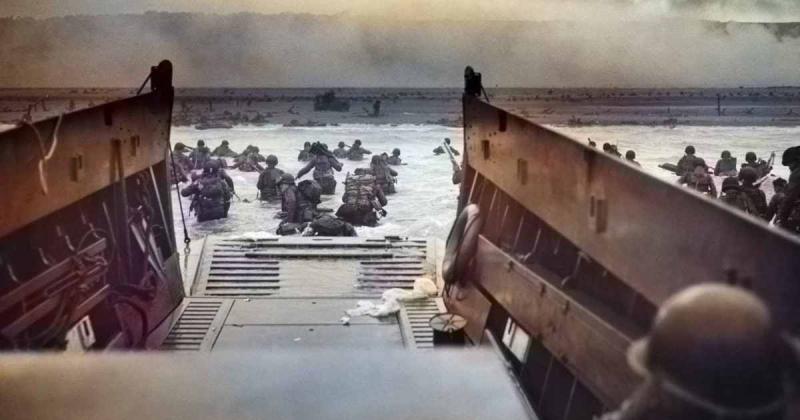

The longest day ...
 S E E D E D C O N T E N T

On June 6, 1944, Supreme Allied Commander General Dwight D. Eisenhower gives the go-ahead for the largest amphibious military operation in history: Operation Overlord, the Allied invasion of northern France, commonly known as D-Day.
By daybreak, 18,000 British and American parachutists were already on the ground. An additional 13,000 aircraft were mobilized to provide air cover and support for the invasion. At 6:30 a.m., American troops came ashore at Utah and Omaha beaches.
The British and Canadians overcame light opposition to capture Gold, Juno and Sword beaches; so did the Americans at Utah. The task was much tougher at Omaha beach, however, where the U.S. First Division battled high seas, mist, mines, burning vehicles—and German coastal batteries, including an elite infantry division, which spewed heavy fire. Many wounded Americans ultimately drowned in the high tide. British divisions, which landed at Gold, Juno, and Sword beaches, and Canadian troops also met with heavy German fire.
History Shorts: The Night Before D-Day
Under the cover of darkness, the Allies pulled off an operation in the hours before D-Day that may have changed the tide of the battle before it had begun.
1:03m watch
But by day's end, 155,000 Allied troops-Americans, British and Canadians-had successfully stormed Normandy's beaches and were then able to push inland. Within three months, the northern part of France would be freed and the invasion force would be preparing to enter Germany, where they would meet up with Soviet forces moving in from the east.
Before the Allied assault, Hitler's armies had been in control of most of mainland Europe and the Allies knew that a successful invasion of the continent was central to winning the war. Hitler knew this too, and was expecting an assault on northwestern Europe in the spring of 1944. He hoped to repel the Allies from the coast with a strong counterattack that would delay future invasion attempts, giving him time to throw the majority of his forces into defeating the Soviet Union in the east. Once that was accomplished, he believed an all-out victory would soon be his.
For their part, the Germans suffered from confusion in the ranks and the absence of celebrated commander Field Marshal Erwin Rommel, who was away on leave. At first, Hitler, believing that the invasion was a feint designed to distract the Germans from a coming attack north of the Seine River, refused to release nearby divisions to join the counterattack and reinforcements had to be called from further afield, causing delays.
He also hesitated in calling for armored divisions to help in the defense. In addition, the Germans were hampered by effective Allied air support, which took out many key bridges and forced the Germans to take long detours, as well as efficient Allied naval support, which helped protect advancing Allied troops.
Though D-Day did not go off exactly as planned, as later claimed by British Field Marshal Bernard Montgomery-for example, the Allies were able to land only fractions of the supplies and vehicles they had intended in France-the invasion was a decided success. By the end of June, the Allies had 850,000 men and 150,000 vehicles in Normandy and were poised to continue their march across Europe.
The heroism and bravery displayed by troops from the Allied countries on D-Day has served as inspiration for several films, most famously The Longest Day (1962) and Saving Private Ryan (1998). It was also depicted in the HBO series Band of Brothers (2001).
Also on This Day in History
Discover more of the major events, famous births, notable deaths and everything else history-making that happened on June 6th
1833 -- President Jackson rides the Iron Horse
In Ellicott's Mills, Maryland, President Andrew Jackson boards a Baltimore & Ohio Railroad train for a pleasure trip to Baltimore. Jackson, who had never been on a train before, was the first president to take a ride on the "Iron Horse," as locomotives were known then. The steam locomotive was first pioneered in England at […]
1856 -- Sitting president Franklin Pierce denied his party's nomination for reelection
On June 6, 1856, the fifth and final day of the Democratic Party's national convention in Cincinnati, Ohio, President Franklin Pierce becomes the first elected president of the United States not to be nominated by his party for a second term. Instead, the party chooses James Buchanan, who will go on to win the presidency […]
1865 -- Outlaw William Quantrill dies in military prison after being shot by Union soldiers
William Quantrill, the man who gave Frank and Jesse James their first education in killing, dies from wounds sustained in a skirmish with Union soldiers in Kentucky. Born and raised in Ohio, Quantrill was involved in a number of shady enterprises in Utah and Kansas during his teens. In his early 20s, he fled to […]
1889 -- The Great Seattle Fire
On June 6, 1889, a fire ignites in a Seattle woodworking shop and sweeps through some 100 acres, destroying much of the city's business district and waterfront. The Great Seattle Fire culminates in losses estimated at $20 million—and serves as a turning point in the city's history. The fire started shortly after 2:30 p.m. when […]
1918 -- Battle of Belleau Wood begins
The first large-scale battle fought by American soldiers in World War I begins in Belleau Wood, northwest of the Paris-to-Metz road. In late May 1918, the third German offensive of the year penetrated the Western Front to within 45 miles of Paris. U.S. forces under General John J. Pershing helped halt the German advance, and […]
1933 -- First drive-in movie theater opens
On June 6, 1933, eager motorists park their automobiles on the grounds of Camden Drive-In, the first-ever drive-in movie theater, located on Admiral Wilson Boulevard in Pennsauken, New Jersey. Park-In Theaters-the term "drive-in" came to be widely used only later-was the brainchild of Richard Hollingshead, a movie fan and a sales manager at his father's company, Whiz Auto Products, in […]
1964 -- U.S. reconnaissance jet shot down over Laos
A U.S. Navy jet flying low-altitude target reconnaissance missions over Laos is shot down by communist Pathet Lao ground fire. Less than 48 hours later, a second jet, which was escorting an unarmed reconnaissance aircraft, is also shot down. Washington immediately ordered armed jets to escort the reconnaissance flights, and by June 9, escort jets […]
1966 -- Civil rights activist James Meredith shot
James H. Meredith, who in 1962 became the first African American to attend the University of Mississippi, is shot by a sniper shortly after beginning a lone civil rights march through the South. Known as the "March Against Fear," Meredith had been walking from Memphis, Tennessee, to Jackson, Mississippi, in an attempt to encourage voter […]
1971 -- "The Ed Sullivan Show" airs for the very last time
Twenty-three years after its 1948 premiere, "The Ed Sullivan Show" has its final broadcast on June 6, 1971. For more than two decades, Sullivan's variety show was the premiere television showcase for entertainers of all stripes, including borscht-belt comedians, plate-spinning vaudeville throwbacks and, most significantly, some of the biggest and most current names in rock […]
1981 -- Train derails in India, killing hundreds
More than 500 passengers are killed when their train plunges into the Bagmati River in India on June 6, 1981. The rail accident—the worst in India to that date—was believed to have been caused when an engineer tried to avoid striking a cow. The nine-car train, filled with approximately 1,000 passengers, was traveling through the […]
1984 -- Indian army storms Golden Temple
In a bloody climax to two years of fighting between the Indian government and Sikh separatists, Indian army troops fight their way into the besieged Golden Temple compound in Amritsar-the holiest shrine of Sikhism-and kill at least 500 Sikh rebels. More than 100 Indian soldiers and scores of nonbelligerent Sikhs also perished in the ferocious […]
1997 -- A teenaged mother gives birth and murders her baby at the prom
Eighteen-year-old Melissa Drexler gives birth to a baby boy in the bathroom stall at an Aberdeen Township banquet hall in New Jersey during her high school prom. Maintenance workers called to clean up blood found in the stall discover a bag in the garbage with her dead baby inside. An autopsy later revealed that the […]
1998 -- "Sex and the City" premieres on HBO
On June 6, 1998, the cable network HBO airs the pilot episode of "Sex and the City," a new comedy series chronicling the lives and loves of four women living in New York City. The show's creator, Darren Star, was best known at the time for producing the long-running Fox TV series Beverly Hills, 90210, […]
Be a good human. Grossly derogatory comments, blatantly inflammatory comments, excessive trolling, mean-spirited taunting and insults, scamming, spamming, and off topic comments may be removed in compliance with the site's Terms of Service and the Code of Conduct. The moderators have the final word.

Tags
Who is online
90 visitors
An important date in American history. Let's hope it's not repeated.